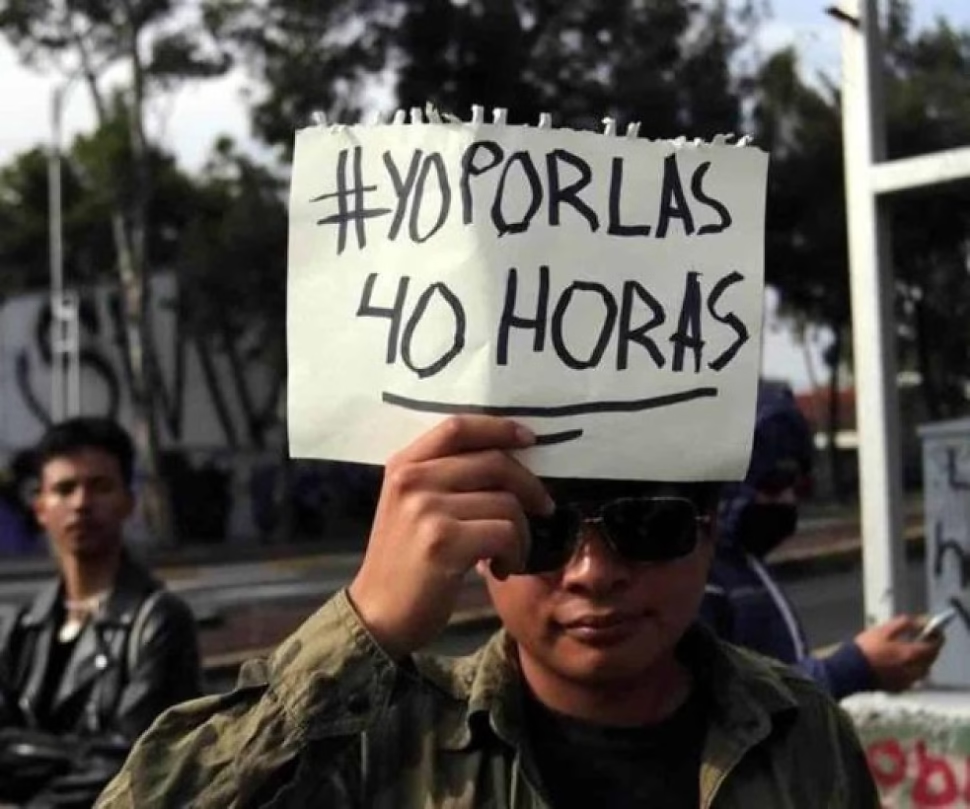
The reduction to 40 hours divides opinions but boosts productivity

The debate on reducing hours faces visions: opportunity or risk for the Mexican economy?

A change that will transform lives and businesses

Mexico is in a historic moment! The discussion about reducing the working day to 40 hours is not just a political or economic issue, it is a golden opportunity to reinvent how we work, live and grow. Imagine a country where the balance between personal and professional life is a reality, where productivity is not measured in hours, but in results and well-being. That future is closer than you think!

Voices in favor: global learning and growth

South Korea is an inspiring example: after implementing 40 hours in 2003, its economy not only remained stable, but flourished! With annual growth of 4.3% to 5.8%, a 1.5% increase in productivity and almost 3 million new jobs, it demonstrated that fewer hours can mean more opportunities. And you know what else? Leisure time boosted creative industries, from digital cameras to cinema, because leisure also moves the world!

RelatedMexico breaks migration records in AMLO’s six-year term

Rodolfo Gerardo González from the CROM highlighted the Chilean model: first they reduced it from 48 to 44 hours in 2013, and then to 40. Firm steps towards progress! And although Mexico occupies the last places in productivity according to the OECD, this is not a condemnation, it is a call to action! As Jorge Álvarez Máynez said: “There is no excuse to maintain a 20th century system in the middle of 2024.”

Challenges and solutions: together forward

Yes, MSMEs (97% of Mexican companies) need support. But as Ángel Domínguez said: “They cannot be a shield to block rights.” The key is gradualness and concrete measures: reduction of IMSS contributions, digitalization and flexible schemes such as teleworking. Raúl Maillard from Canacintra is clear: “We need an intelligent transition, with data from INEGI and Secretariats involved.” Innovating without fear is the way!

Mario López Roldán of the OECD was forceful: Mexico leads the work-life imbalance among the 38 member countries. But this is not to discourage us, it is to motivate us! Korea went from being the country that worked the most to a balanced model. If they could do it, so could we!

The call to action: let’s build the future

This is not a debate between businessmen and workers, it is a conversation about the Mexico we want. As influencers of our own destiny, we must demand evidence-based reforms, but also embrace change boldly. 40 hours are not just a number, they are the door to more time with family, more creativity and, yes, more productivity!

Ready to be part of this transformation? Share this article and join the conversation with #40HorasParaMéxico. Together we can make history! And if you want more inspiring content on workplace innovation, explore our related notes. The future of work starts today!


Citizens demand cancellation of water agreement with Israel

Thousands called to demonstrate on August 1 in several cities due to alleged opacity.

Civil unrest around the water cooperation agreement between the Chihuahua Central Water and Sanitation Board (JCAS) and the Israeli Mashav Agency has escalated to the national level. The mobilization, promoted on TikTok by the user @amigamagica, will take place on Saturday, August 1 at 9:30 a.m. in various cities across the country.

Meeting points include from the Estela de Luz towards the Zócalo in Mexico City, to concentrations in Tabasco, Pachuca, Ciudad Juárez and Jalisco. The agreement, signed in 2023 under the government of María Eugenia Campos Galván, is the center of the debate.

The legal vacuum of the agreement

According to Luis Andrés Rivera Levario, spokesperson for Save the Hills of Chihuahua, the Ministry of Foreign Affairs (SRE) confirmed that there are no legal instruments in force between Israel and Chihuahua. This, according to activists, violates the Law on the Conclusion of Treaties, which requires any inter-institutional agreement to be registered with the Foreign Ministry.

“It was left in a situation in limbo where it is impossible to request accounts, since it does not legally exist,” said Rivera Levario in an interview with IMER.

The civil organization maintains that the agreement operates in total opacity as it lacks registration with the Mexican Agency for International Development Cooperation (Amexcid).

Technical concern

Beyond the legal, protesters criticize the proposed technological model. Reverse osmosis, they explain, is not viable for Chihuahua due to the absence of the sea. They point out that aquifer wells are already becoming salinized due to poor management, and the technology would only aggravate soil salinization.

“They are coming to offer us a high-risk solution,” added the spokesperson.

The real solution, they insist, is to protect water recharge areas and carry out agricultural and industrial reconversion. The community demands that the authorities terminate the agreement, which they consider non-existent.

Continue reading

Gertrudis Bocanegra Scholarship: support for university transportation

Bimonthly support for public transportation for Zacatecas students.

New scholarship for university students in Zacatecas

President Claudia Sheinbaum announced the Gertrudis Bocanegra Scholarship, exclusive financial support for students from public universities in Zacatecas. The resource will be bimonthly and will cover transportation expenses, one of the items that most impacts the family economy.

Starting in September, informational assemblies will begin on campuses to detail rules and records. During the event, Sheinbaum handed out cards from the Rita Cetina Scholarship, annual support of 2,500 pesos for uniforms and primary school supplies, which will begin to be dispersed in August.

The Secretary of Education, Mario Delgado, reported that the fiscal year will close with 22 million scholarship recipients throughout the country, a historic figure. In Zacatecas, coordinator Julio César León detailed an active register of 180,627 students, with an investment of more than 1,600 million pesos.

The federal educational strategy includes a staggered scheme: supplies scholarship in primary school, bimonthly benefit in secondary school, Benito Juárez Scholarship in high school, and now transportation in university. In addition, a new campus will be built for the Rosario Castellanos National University and six for the Margarita Maza High School.

These announcements reinforce the government’s commitment to guaranteeing the constitutional right to economic stimuli from basic to higher.

Continue reading

Remains of missing child found in restaurant septic tank in Guasave

A 4-year-old child found dead in a septic tank at a restaurant on Las Glorias beach.

The Attorney General’s Office of the State of Sinaloa is investigating the death of a four-year-old minor, identified as Aldo Emilio N., who was reported not to be located for several hours in the tourist area of ​​Las Glorias beach, in the municipality of Guasave. The boy had gone to the scene accompanied by his parents.

Disappearance and search on the beach

According to the family story, the group came to spend the day and ate at the “Las Palomas” restaurant. After finishing the food, the parents noticed that the minor was no longer there. They immediately called emergencies and elements of the municipal police, civil protection and visitors joined an intense search throughout the beach and nearby businesses.

The authorities reviewed restaurants and businesses in the area, as well as versions on social networks about an unaccompanied minor, but none of them matched.

Finding in a septic tank

Almost four hours later, during a new inspection at the restaurant where the family ate, the child’s remains were found in a septic tank in the establishment. Experts from the Prosecutor’s Office collected evidence and testimonies to determine the causes of death.

The Prosecutor’s Office has not issued a preliminary ruling. The case remains under investigation.

Continue reading