The PRI demands answers after the tragedy of the Interoceanic Train

A railway tragedy sparks a political storm, demanding responses from the highest levels of government regarding passenger safety.

A Call to Accounts in the Middle of Tragedy

In a scenario full of tension and mourning, the voice of the political opposition resonated strongly in the corridors of power. Rubén Moreira Valdez, the coordinator of the Institutional Revolutionary Party in the Chamber of Deputies, launched a petition that shook the foundations of the public administration. With the shadow of the catastrophic derailment of the Interoceanic Train still projecting itself over the nation, he demanded that the Permanent Commission summon none other than the Secretary of the Navy, Raymundo Pedro Morales Ángeles to appear. The mission: to unravel the hidden causes behind the tragedy of December 28, a day that was marked in the history of Mexican railway transportation.

But the target of his demand did not stop there. In a point of agreement that vibrated with urgency, he also demanded the presence of other key figures: the head of the Rail Transport Regulatory Agency, Andrés Lajous Loaeza; the general director of the Decentralized Public Organization Interoceanic Corridor, Octavio Sánchez Guillén; and the general director of the Tehuantepec Isthmus Railway, Alan Tarsicio Cruz Saba. The objective was as clear as it was heartbreaking: to force officials to reveal the truth about the operating conditions, the maintenance protocols that perhaps were never applied, the care for the victims and the measures so that such a nightmare would not be repeated.

RelatedFGR and ARTF lead exhaustive investigation of the accident on the Interoceanic Train

The Crude Complaint: More than an Accident

The document, an arsenal of words full of indignation, did not limit itself to asking for explanations. He launched a devastating accusation. He pointed out that the official version of the incident, far from calming down, set off all the alarms. How was it possible that a convoy circulating under “normal conditions”, with inspections supposedly completed, broke down in such a catastrophic and fatal manner? The response, for the legislators, was an explosive cocktail: “corruption, opacity and political decisions taken outside of technology.” It was not a simple failure, they cried, but a direct threat to the lives of citizens.

The political offensive, also supported by the signatures of senators Alma Carolina Viggiano Austria and Manuel Añorve Baños, escalated to a radical proposal. Given the string of railway accidents that stained the years 2024 and 2025, they demanded the immediate suspension of the operations of both the Interoceanic Train and the Mayan Train. The latter, an emblematic colossus, had already accumulated its fourth derailment by August 2025, a figure that spoke of a terrifying pattern.

The final demand was an attempt to get to the origin of all the evils: the delivery of the feasibility studies and viability that should have supported these megaprojects. Citing even Fonatur, they pointed out deficiencies in water management and serious environmental damage, violating national and international treaties. Each word of the writing painted a picture of projects driven more by political vanity than by technical rigor, where the price of the shortcut was being paid, with their lives, by the passengers.

This was not a mere parliamentary request. It was the cry of alarm from a political sector that saw these transportation incidents as the tip of the iceberg of a systemic crisis of national security. The appearance of the Secretary of the Navy was not just a formality; It stood as a symbolic trial, an epic confrontation between the demand for transparency and the wall of opacity, where the final verdict would be given by the memory of the victims and the future security of millions.

Do you think this story should reach more people? Share this report on your social networks to keep alive the demand for justice and security in our infrastructure. Explore more content related to government transparency and accountability on our site.
Sterile fly plant inaugurated in Chiapas; key binational cooperation

New binational plant will produce 100 million sterile insects per week to protect livestock.

Strategic plant against livestock pest

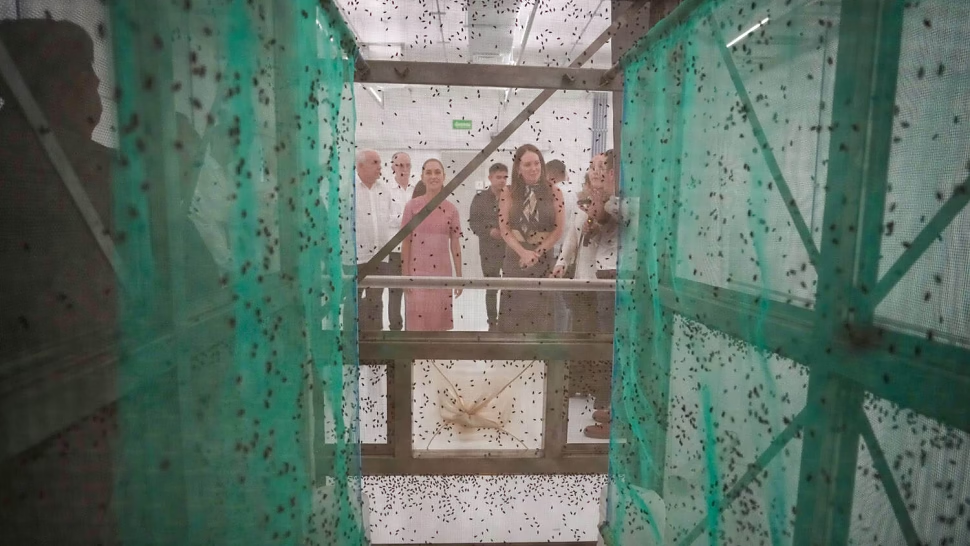
President Claudia Sheinbaum inaugurated the Production Plant for Sterile Livestock Screwworm Flies (GBG) in Metapa de Domínguez, Chiapas. The project is binational between Mexico and the United States.

The facility will produce 100 million sterile insects each week. The objective: control the pest and strengthen animal health in both countries.

Sheinbaum highlighted that international cooperation generates results in the face of phytosanitary challenges that do not recognize borders. He thanked President Donald Trump and the US authorities for their financial and technical contribution.

Investment and results

The US ambassador to Mexico, Ronald D. Johnson, announced an additional investment of 83.8 million dollars. The resources will be used to intensify the fight against the pest, increase the production of sterile flies and strengthen preventive strategies.

The US Secretary of Agriculture, Brooke L. Rollins, described the achievement as an example of the success of coordinated work.

For her part, the Secretary of Agriculture and Rural Development, Columba Jazmín López Gutiérrez, explained that the plant was built in 12 months. As part of the containment actions, 5.3 million heads of cattle have been inspected, more than 84 thousand commercial shipments have been verified and 7 billion sterile flies have been released with the support of specialists.

The bilateral relationship, Sheinbaum stressed, must continue on mutual respect, constant dialogue and sovereignty.

Continue reading

Former Pemex director investigated for alleged assault on his wife

The Morelos Prosecutor's Office is investigating Víctor Rodríguez Padilla for alleged assault on his wife.

Investigation in progress

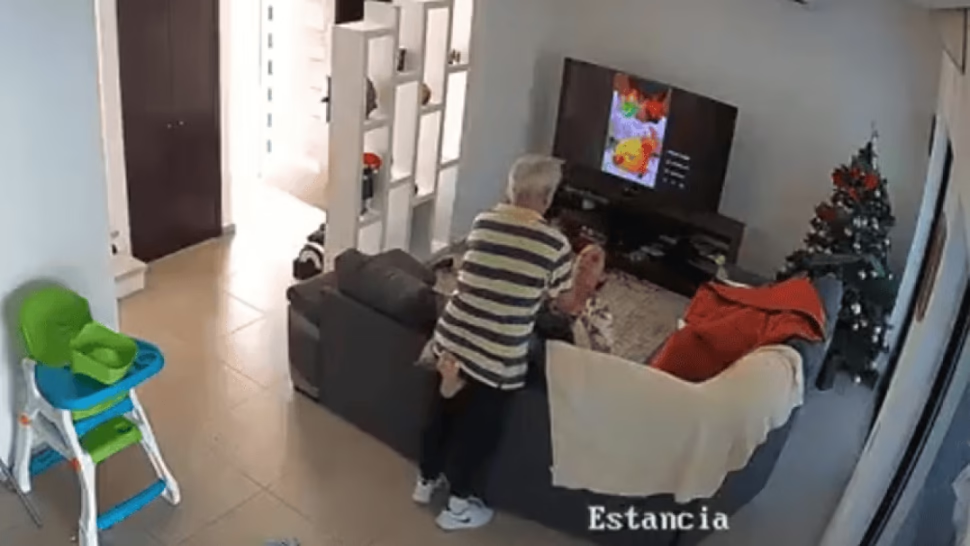
The Attorney General’s Office of the State of Morelos initiated an investigation file against Víctor Rodríguez Padilla, former director of Petróleos Mexicanos, after the dissemination of a video in which he is seen allegedly attacking his wife, María Felicia Jiménez. The recording, which circulates on social networks, shows Rodríguez Padilla repeatedly hitting the victim inside a home in the municipality of Emiliano Zapata, adjacent to Cuernavaca. According to the metadata of the video, the attack occurred on March 15.

The state agency reported that since Friday it has been exchanging information with the Women’s Secretariat of the Government of Mexico to guarantee the protection of the victim.

“The Attorney General’s Office of the State of Morelos initiated an investigation folder for the probable criminal acts derived from the dissemination of a public complaint through a video, where an act of violence against a woman is seen,” cited the FGE.

Protection actions

The Morelos Prosecutor’s Office specified that the investigation was opened in full respect for the rights of women, girls, boys and adolescents. The statement indicates that the events probably occurred on March 15 inside a home in Emiliano Zapata, with the alleged participation of a former federal official.

The institution assumed the commitment to exhaust all measures to determine responsibilities and guarantee a life free of violence for the victim. So far, no precautionary measures have been reported against Rodríguez Padilla, and the investigation is still ongoing.

Continue reading

Sheinbaum supervises progress of IMSS-Wellbeing with governors

Sheinbaum leads meeting with 23 governors to evaluate progress in the health system.

Advances in public health

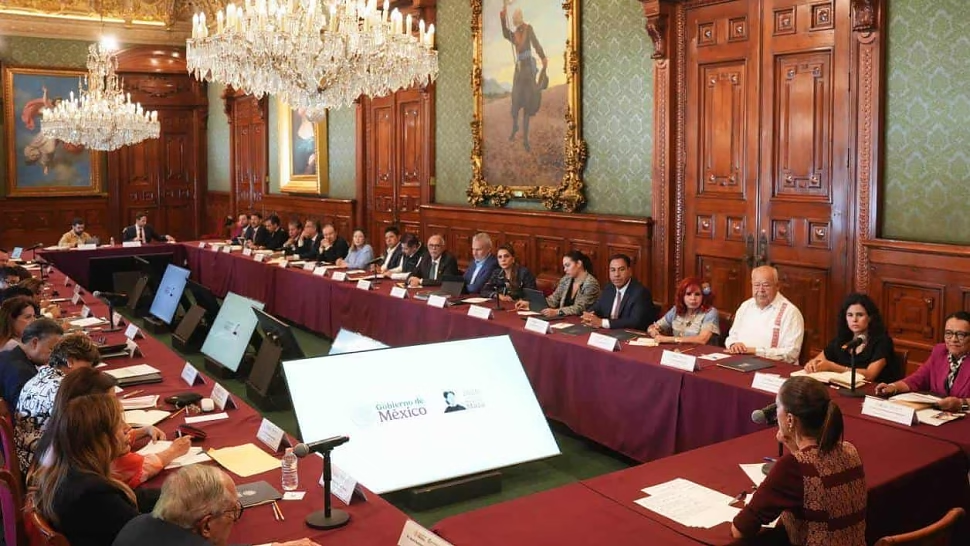
At the National Palace, President Claudia Sheinbaum led a follow-up meeting on the IMSS-Wellbeing model. Governors of the 23 entities integrated into the program participated.

“The objective is to guarantee quality, universal and free medical care for the people of Mexico.”

The federal cabinet was attended by Rosa Icela Rodríguez (Government), David Kershenobich (Health), Luisa María Alcalde (Legal Department), Eduardo Clark (Undersecretariat of Health), and the directors of IMSS-Bienestar (Alejandro Svarch), IMSS (Zoé Robledo) and Issste (Martí Batres).

The state leaders present were: Marina del Pilar Ávila (Baja California), Víctor Castro (Baja California Sur), Layda Sansores (Campeche), Eduardo Ramírez (Chiapas), Clara Brugada (CDMX), Indira Vizcaíno (Colima), Delfina Gómez (State of Mexico), Evelyn Salgado (Guerrero), Julio Menchaca (Hidalgo), Alfredo Ramírez (Michoacán), Margarita González (Morelos), Miguel Navarro (Nayarit), Salomón Jara (Oaxaca), Alejandro Armenta (Puebla), Mara Lezama (Quintana Roo), Ricardo Gallardo (San Luis Potosí), Yeraldine Bonilla (Sinaloa), Alfonso Durazo (Sonora), Javier May (Tabasco), Américo Villarreal (Tamaulipas), Lorena Cuéllar (Tlaxcala), Rocío Nahle (Veracruz), Joaquín Díaz (Yucatán) and David Monreal (Zacatecas).

The meeting is part of the periodic supervision to consolidate free coverage of health services in the country.

Continue reading