The Pope cries out for justice in the face of migration crisis and global tensions

An urgent call from Castel Gandolfo that questions global awareness of humanitarian crises and the search for justice for the most vulnerable.

A Call that Shakes the Foundations of Global Consciousness

From the serene but electric atmosphere of Castel Gandolfo, a voice emerges with the force of thunder that shakes the dormant consciences. Leo XIV, the Chicago-born pontiff, has launched a moral challenge that resonates like an echo in the corridors of world power. With words filled with passionate urgency, he has demanded a deep reflection in the United States about the treatment of migrants in custody, describing a scenario where countless souls, after years of peaceful living, are now mired in deep grief over dramatic current events.

It was a Tuesday that will be recorded in geopolitical history when, in front of a chorus of journalists, the spiritual leader unraveled with surgical precision the most sensitive threads of international politics. Far from being a mere observer, he stood as a beacon of moral clarity in the midst of an ocean of controversies: from the spiritual rights of immigration detainees to the explosive US military attacks near the coast of Venezuela, and the very tense and brittle ceasefire in the always turbulent Middle East. Every word of his was a heartbeat of concern for humanity.

RelatedLeo XIV denounces the resurgence of war and the erosion of the global order

The Silent Cry of Migrants and a Question that Will Haunt Eternity

With the solemnity of one who reads in the book of destiny, the Pope evoked a biblical question that will resonate in the final judgment of civilization: “How did he receive the stranger?” This question, simple in its formulation but monumental in its implications, hangs over the collective consciousness like a sword. Leo “Many times they have been separated from their families. No one knows what is happening, but their own spiritual needs must be attended to,” he declared in a voice that broke with emotion, painting a picture of hopelessness and abandonment that cries out to heaven.

This dramatic appeal is not an isolated event, but the culmination of a crusade. Just the previous month, the pontiff had fervently urged union leaders in his hometown of Chicago to become champions of immigrants and open their arms to minorities. A battle that he fights on multiple fronts, with faith as his shield and justice as his sword.

A World on the Brink of the Abyss: Venezuela and the Fragile Balance of the Middle East

When questioned about the deadly attacks against alleged drug traffickers in Venezuelan waters, his response was not just an opinion, but a prophetic warning. He stated that the military action was “increasing tension” in an already explosive scenario, moving dangerously close to a point of no return. Faced with this spiral of force, he planted the flag of reason: “The important thing is to seek dialogue“, he proclaimed, presenting dialogue as the only lifeline in a sea of ​​hostilities.

And while that drama unfolds, another tragedy looms over the Holy Land. With his sights set on the fragile peace agreement between Israel and Hamas, the Pope recognized with shocking realism the precariousness of the truce. He stressed the imperative need for the parties to find a path towards future governance, an almost impossible path where, miraculously, the rights of all peoples can be guaranteed. When addressing the thorny issue of settlements in the West Bank, he did not hesitate to describe it as “complex”, launching a veiled but powerful accusation: “Israel has said one thing and then done another on some occasions.” Their solution was a call to work together for justice, a justice that seems to slip through the fingers of history.

The world holds its breath for what is coming. This Thursday, the Palestinian president, Mahmoud Abbas, will be received at the Vatican in a meeting that promises to be historic. And as if fate wanted to test his leadership, at the end of November, Leo XIV will undertake his first apostolic journey to Turkey and Lebanon, two nations that are geopolitical tinderboxes. Each of your moves is a play on a global board where the pieces are human souls and the prize is world peace.

Will this call for reflection resonate in the hearts of the powerful? Humanity awaits an answer. Share this crucial information on your social networks and help us amplify this voice crying out for justice. Explore more analysis on Vatican diplomacy and global challenges on our site.
Lula conditions his position on US tariffs

Brazil's president will wait for Trump to speak before responding to the tariff increase.

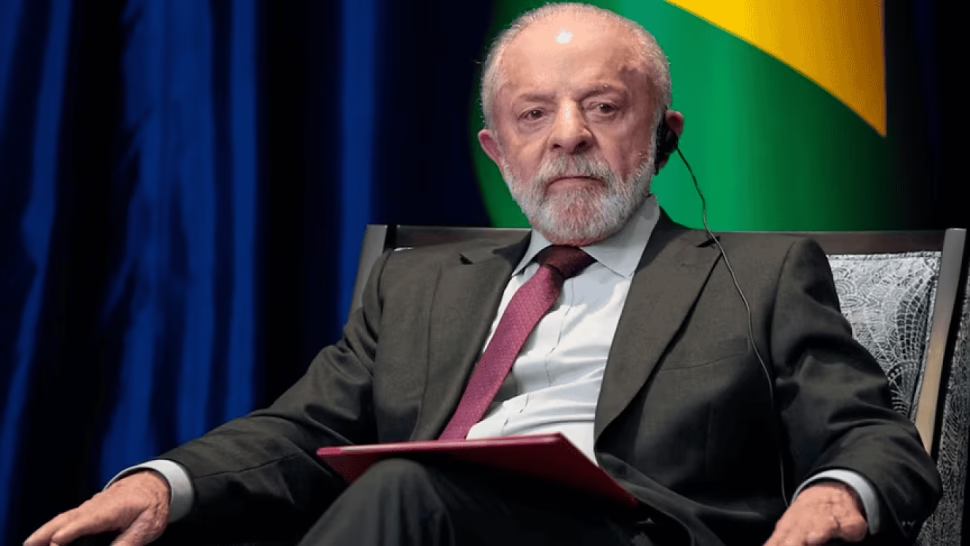
President Luiz Inácio Lula da Silva stated that Brazil does not accept being offended by any nation, in apparent reference to the tariff increase imposed by the United States. However, he warned that he will only comment on the measure after his colleague Donald Trump does so.

“This country must hold its head high because we do not accept that any other nation in the world wrongs Brazil. We want respect, in the same way that we will respect everyone,” he declared during an official event in Rio de Janeiro, accompanied by several ministers and Governor Ricardo Couto de Castro.

Strategic waiting

Lula added that he will wait for Trump’s statements before referring to the “increase in tariffs,” thus avoiding a direct exchange of accusations. “I’m going to wait to talk about the tariff when Trump speaks out. As long as he doesn’t speak, I won’t speak either, because we are going to show that no one beats Brazil with lies,” he said.

The Brazilian government, through its ministers, described as “unjustified” the 25% increase in the rates applied to the South American country’s exports. Washington’s decision has generated trade tension, although Lula opts for a prudent and conditional stance.

Regional context

The US measure impacts key sectors of the Brazilian economy, such as steel and aluminum. Brazil has historically maintained a complex trade relationship with the United States, alternating conflicts and agreements. Lula’s strategy seeks to avoid an escalation while evaluating possible retaliation or negotiations.

Analysts believe that the president’s momentary silence seeks to pressure Trump to take the first step, preventing Brazil from being seen as the initiator of a trade war. The international community is closely watching the development of this dispute between two of the largest economies on the continent.

Continue reading

China rejects Trump’s accusations of electoral interference

China rejects Trump's accusations and calls for stability in bilateral relations.

Accusations that strain the bilateral relationship

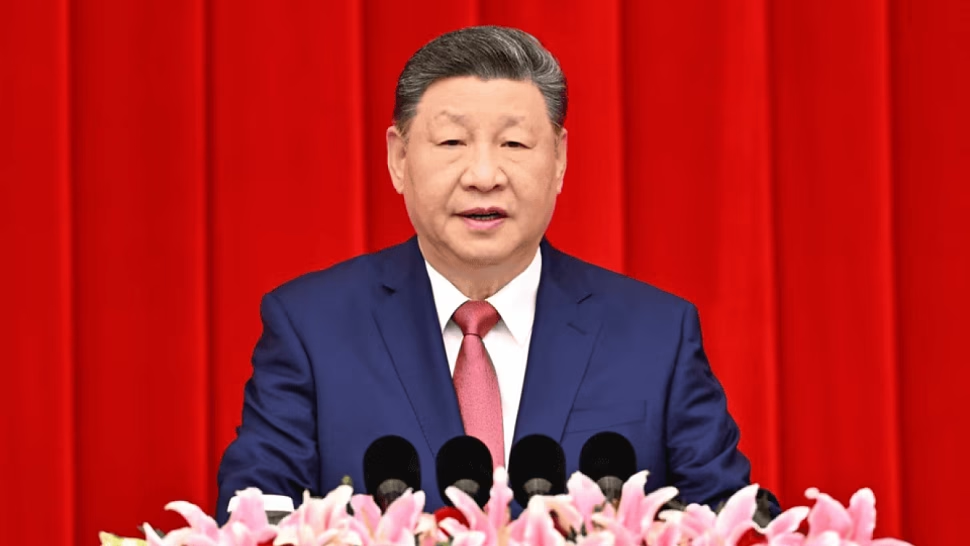
The president of the United States, Donald Trump, accused China of alleged interference in American electoral processes. The declaration conditions the diplomatic scenario between Washington and Beijing, just two months after Xi Jinping received Trump on a state visit.

The spokesperson for the Ministry of Foreign Affairs, Lin Jian, rejected the allegations, classifying them as fabrications and slander. He added that China has no interest in intervening in internal affairs or US elections, and urged maintaining communication channels under criteria of stability and mutual certainty.

The exchange occurs in a context of persistent commercial and technological rivalry. Washington maintains restrictions against Chinese technology firms, and Beijing has responded with regulatory countermeasures. Negotiations on semiconductors and foreign trade controls are at a standstill, threatening the rapprochement planned for Xi Jinping’s official visit to US territory in September.

Specialists consider that Trump’s accusations respond to internal political dynamics, since they were not accompanied by new sanctions or punitive measures. However, they move the dispute from the commercial sphere to that of national security, which increases the unpredictability in the relationship between both powers.

Continue reading

Iran hits desalination plant in Kuwait

An Iranian attack damaged a water and power plant in Kuwait, affecting drinking supplies.

Attack on strategic plant in Kuwait

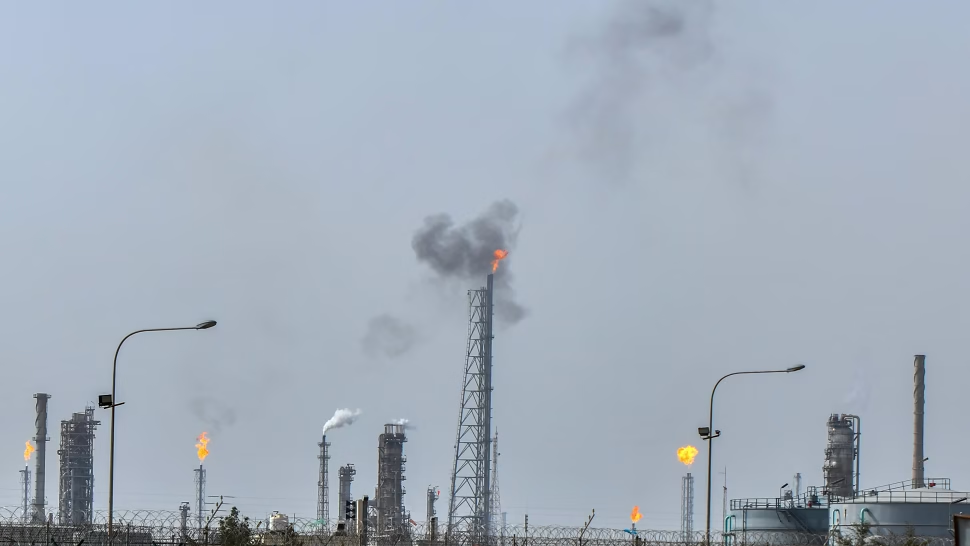
On Friday, an Iranian attack hit a power and desalination plant in Kuwait, causing damage to several power generation units and a fire that was controlled by emergency crews. Kuwaiti authorities activated contingency plans to maintain the supply of water and electricity.

Kuwait relies on desalination for about 90% of its drinking water, similar to other Gulf countries such as Oman and Saudi Arabia. Most of these facilities are on the Persian Gulf coast, making them vulnerable to missile or drone attacks.

This incident highlights the fragility of critical infrastructure in the Middle East amid regional escalation.

Continue reading