A Cry that Shakes the Foundations of the Vatican
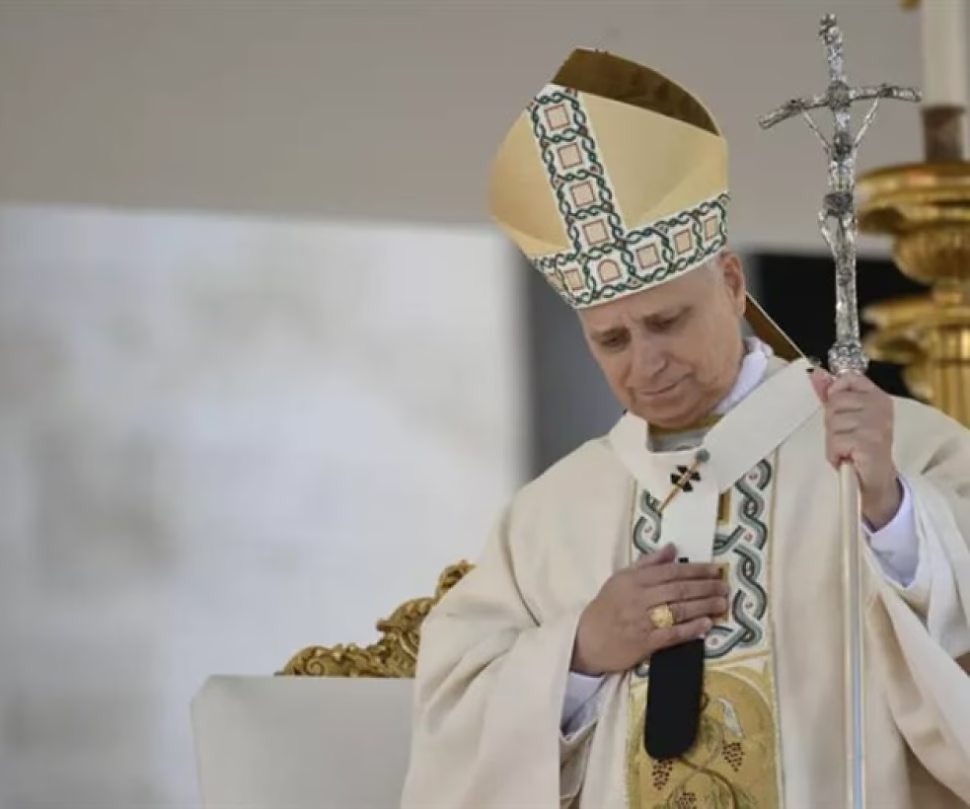
Under the majestic dome of St. Peter’s Basilica, where the echoes of history whisper ancient secrets, a single man raised his voice with the force of heavenly thunder. Leo XIV, the Pontiff, did not pronounce simple words; He launched a heartbreaking plea that sought to cross continents and stop, with the power of faith, the bullets and hatred that bloody our era. On a Sunday that would be burned into the collective memory, his message was not a mere prayer, but a spiritual ultimatum to the senselessness of war.
Thousands of souls, gathered in St. Peter’s Square like a sea of hope, held their breath. It was not the usual Angelus. It was a turning point, a watershed moment in which the spiritual leader of millions stood as the last bastion of sanity in a world on the brink of the abyss. His gaze, loaded with infinite sorrow, scanned the horizon as if he could glimpse the distant battlefields, feeling the pain of each life cut short, of each family destroyed.
The Scenarios of Pain: A Trilogy of Desolation
With an emotion that broke his voice, the Holy Father named the epicenters of the global tragedy. First, the Holy Land, that sacred and ancient land where the promise of peace seems like an unfulfilled curse, a powder keg where faith is distorted into justification for massacre. Then, his gaze turned to Ukraine, a martyred nation where the fields of sunflowers have been replaced by shell craters and the winter is not only of snow, but of a cold that freezes the souls of its inhabitants. And finally, with a tone of particular distress, he pronounced the name of Myanmar, a conflict often forgotten by the big headlines, but where human cruelty unfolds all its horror in the complicit silence of the world.
“Let us pray for peace in the Holy Land, in Ukraine and in other places of war,” he implored, and each syllable was a whip to the conscience of humanity. “May God grant all those responsible wisdom and perseverance to advance in the search for a just and lasting peace.” But these were not just pious words; It was a divine exhortation to the powerful, a reminder that their decisions are not written on paper, but in the flesh and spirit of the innocent.
The tension escalated when Cardinal Robert Prevost, with his face changed by anguish, provided a shocking testimony. His words painted a Dantesque picture of the situation in Myanmar: “the news I receive there is sadly painful.” It revealed, in blood-curdling detail, the existence of relentless armed confrontations and continuous aerial bombardments that do not discriminate between combatants and the defenseless civilian population. He spoke of schools, hospitals and homes, those infrastructures of everyday life, reduced to rubble under an indifferent sky. Each report that reaches the sacred offices of the Vatican is one more burden in the moral weight that the Holy See must carry.
Solidarity and a Final Call: The Last Breath of Hope
In a narrative turn that sought to connect pain with action, Leo XIV extended his solidarity with the victims. It was not a distant condolence, but a spiritual embrace that crossed oceans. “I am close to those who suffer violence, insecurity and so much hardship,” he declared, and in that imaginary proximity, millions of displaced, wounded and suffering people felt, for a moment, that they were not alone. But compassion is not enough; History demands facts. For this reason, the Pontiff, with the authority conferred on him by his throne, cast his greatest spell of peace: “I renew my sincere call for an immediate and effective ceasefire.”
This was not just another plea in the endless diplomatic rhetoric. It was a moral order, a challenge to the warlords. The Pope’s statements come at a time of growing geopolitical tension, where armed conflicts have challenged and humiliated international diplomacy, giving way to serious humanitarian crises that seem straight out of the darkest pages of history. It is as if the world is on the edge of a precipice, and the voice of Leo XIV is the last cable that holds it up, a cable woven with prayers and an unwavering faith in human redemption.
Will the powerful listen to this cry? Or will their hearts, hardened by ambition and resentment, remain deaf to the suffering they cause? The fate of entire nations hangs in the balance, and in the Vatican, one man has given the most important cry of his pontificate. The world holds its breath, waiting for an answer. The ball is now in humanity’s court. The clock keeps ticking, and every second that passes without peace is an eternity for those who live under the bombs.
This call for unity in the face of adversity must be heard.Share this message of hope on your social networks and help us amplify this cry for peace. Explore more content about diplomatic and humanitarian efforts on our site.