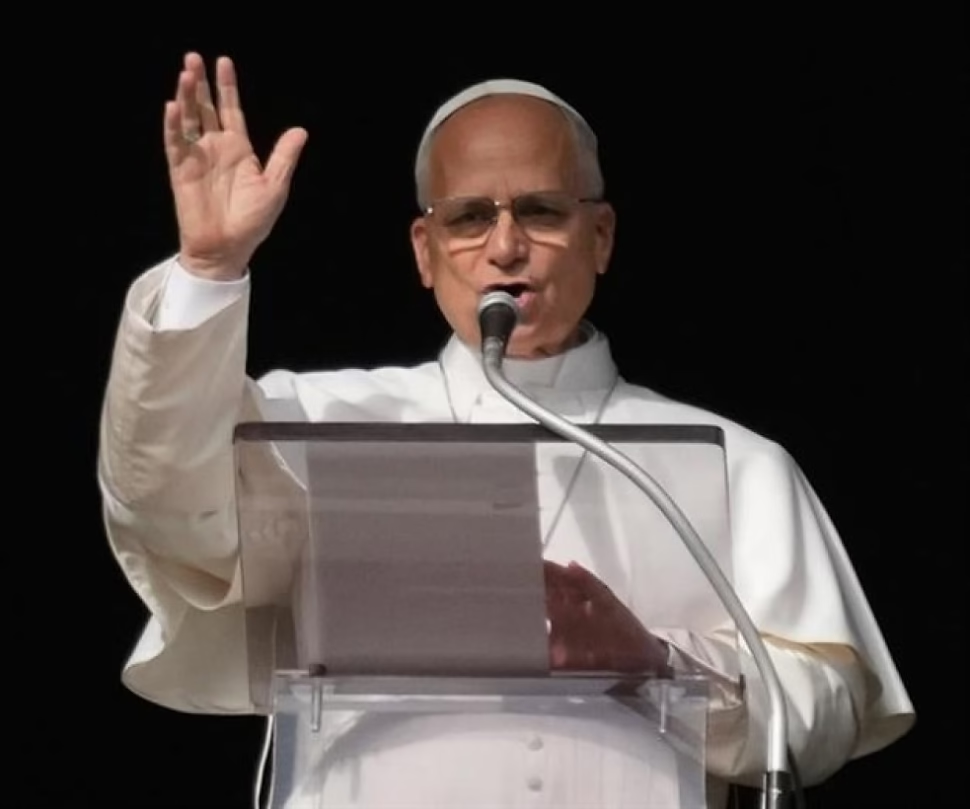
Leo XIV urges the Curia to overcome ambitions and addresses the priestly crisis

A call to fraternity and a diagnosis of the vocational crisis mark a pontificate that seeks to heal internal wounds while facing a global challenge.

A Call in the Shadow of Christmas: The Pontiff’s Warning

ROME. In the very heart of Christianity, under the majestic domes that have seen centuries of history pass by, a new pontiff has raised his voice. Not with the thunder of condemnation, but with the sharp edge of a question that rang like a bell in the expectant silence of the Roman Curia. Leo XIV, Peter’s successor, looked into the eyes of the princes of the Church and questioned them with a candor that hid a storm: “Is it possible to be friends in the Roman Curia?” An apparently simple question, but one that tore the veil of appearances to expose the living nerve of a Vatican bureaucracy that, he knows well, continues to be a labyrinth of ambitions and loneliness.

The echo of his predecessor, the revolutionary Pope Francis, hovered over every word. However, Leo XIV carved his own path. Where Francis fiercely denounced the “cancer” of cliques and “spiritual Alzheimer’s”, the American pontiff opted for a measured tone, a peacemaker strategy. But let no one be fooled. The underlying message was an iron fist in a silk glove: bitterness, the lust for power and the pursuit of personal interests continue to poison the corridors of the Apostolic Palace. “We observe with disappointment,” he confessed with theatrical pain, that certain dynamics are slow, terribly slow, to change. In his speech, he painted a longing for an oasis of authenticity: a place where the masks fall, where no one is an instrument or an outcast. A grace, he called it. In the world’s most powerful Court of Miracles, genuine friendship has become a miracle in itself.

RelatedCelebrities say goodbye to Pope Francis with emotional messages

The Battle for the Soul of the Clergy: A Crisis that Shakes the Foundations

But the intrigue did not end within the Vatican walls. While one hand extended an olive branch to the Curia, the other unrolled a map of a global and desolate battlefield. Leo XIV declared, without ambiguity, the state of crisis. The numbers sing a silent tragedy: the army of faith, the Catholic priests, is vanishing. Of the 415,348 spiritual soldiers in 2013, today there are only 406,996 left. A constant bleeding, an exodus that only finds a stop in the fertile soils of Africa and Asia. The pontiff diagnosed the evil with the precision of a surgeon: the suspicion born of abuse scandals, the ghost of loneliness that haunts the rectories, the suffocation of economic problems that divide the clerics of rich and poor parishes.

His proposal was a manifesto of hope and reform. He asked for training in seminaries to forge indestructible characters, to avoid the “painful reality” of early desertions. He demanded economic leveling, an act of fraternal justice. And, as an Augustinian who prioritizes community life, he made a prophetic call: priests should not live like islands. Community is the antidote to the isolation that kills the soul and the vocation. The challenge he launched was epic: to have the courage to make “strong and liberating proposals” to young people. In a world wounded by discord, the Catholic Church wages a war on two fronts: to heal its administrative heart and to recruit new warriors for its eternal mission.

Leo XIV’s Christmas message was not a simple greeting. It was the first act of a pontifical drama where unity and survival are the prizes at stake. A story where every gesture, every gently critical word, every proposal for reform, is a move in the great chess of the destiny of an ancient institution. The question remains floating in the incense-scented air: will the powerful of the Curia heed the call? Will young people respond to the cry for help of a Church that seeks to reinvent itself? Time, and only time, will reveal the next chapter of this saga.

Do you think this call for fraternity and reform will mark a turning point? Share this powerful story on your social networks and explore more analysis about the future of the Church on our site.
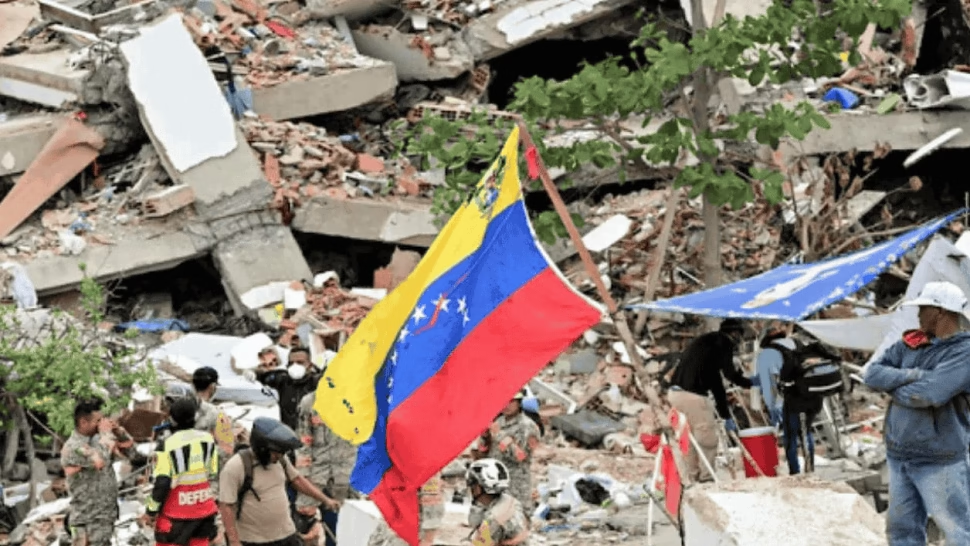
Venezuela withdraws 346 million dollars from the IMF to rebuild La Guaira

Venezuela accesses 346 million dollars from the IMF for reconstruction after earthquakes.

Own funds for the emergency

The executive vice president of Venezuela, Delcy Rodríguez, reported that the country obtained access to 346 million dollars of its own resources in the International Monetary Fund (IMF). The objective: attend to the recovery after the earthquakes of June 24.

The funds come from the reserve tranche. They are not a new loan, but rather resources that already belonged to the Venezuelan State. IMF Managing Director Kristalina Georgieva confirmed the move and explained that they worked with key counterparts “to help Venezuela access its own resources in the Fund for Urgent Humanitarian Needs.”

Support for families and reconstruction

Rodríguez explained that the money will be used for housing, infrastructure and essential public services for affected families. “This will allow affected families to be supported in housing, infrastructure, essential public services, among other requirements,” he wrote on his social networks.

Access to these resources came after the IMF and Venezuela resumed relations in April 2026, after seven years of suspension. At the beginning of July, the organization’s spokesperson, Julie Kozack, had already announced that there were talks to unfreeze the funds.

According to data from the president of the National Assembly, Jorge Rodríguez, the earthquakes left thousands of victims, including deaths, injuries and homeless families. The most devastated area was La Guaira, on the central coast, about 30 kilometers north of Caracas.

The Venezuelan government stated that these resources will strengthen the immediate response and contribute to the reconstruction of the impacted areas. The IMF reserve tranche functions as immediate liquidity, without conditionalities associated with financing programs.

Continue reading

Mayo Zambada receives life sentence in the US

Court in Brooklyn confirms life imprisonment for the historic leader of the Sinaloa Cartel.

Life sentence for El Mayo Zambada

A federal court in Brooklyn has handed down the final sentence for Ismael El Mayo Zambada, 76 years old. Judge Brian Cogan confirmed this Monday the life imprisonment for the historic leader of the Sinaloa Cartel.

Zambada pleaded guilty last year to drug trafficking conspiracy and directing a criminal organization. Prosecutors estimate that for decades he moved hundreds of tons of cocaine, heroin and fentanyl.

In addition to the sentence, the US government is demanding a fine of $15 billion as compensation for the damage caused. The figure reflects the scale of their illicit operations.

Zambada’s situation is now identical to that of his former partner, Joaquín El Chapo Guzmán, who has been serving a life sentence since 2019. Both led the most powerful criminal organization in Mexico for years.

The plea deal reached by Zambada included a key guarantee: the US Department of Justice agreed not to seek the death penalty. In exchange, the boss accepted the charges that carry mandatory life imprisonment.

The conviction closes a chapter in the fight against organized crime, but leaves open questions about the future of the Sinaloa Cartel and its trafficking routes to the United States.

Continue reading

US attacks on Iran raise tension in the Middle East

Bombings against the Iranian Revolutionary Guard escalate regional conflict.

On Sunday, the United States launched airstrikes against targets of Iran’s Revolutionary Guard. The action responds to the death of American soldiers in Jordan.

According to US Central Command, the attacks damaged coastal surveillance, air defense facilities and missile depots. The objective: to weaken Iranian control over the Strait of Hormuz, a key route for oil trade.

The offensive totals eight days. Washington has attacked Iranian strategic infrastructure. Tehran responded with bombings against facilities in Kuwait, in addition to threatening other US allies in the region.

US officials said the bombing was retaliation for an Iranian attack on a military base in Jordan. Two American soldiers died there, one is missing and four were wounded. Since the beginning of the conflict, the US reports 16 military deaths and more than 430 injuries.

Iran said the bombings left at least 50 people dead and more than 500 injured. Iran’s atomic energy agency confirmed that an attack hit the construction site of the Darkhovin nuclear power plant in the southwest of the country.

Impact on the Persian Gulf

Kuwait and Bahrain activated anti-aircraft defenses against Iranian drones and missiles. Kuwaiti authorities reported new attacks against a power and desalination plant, vital infrastructure for drinking water.

The United Arab Emirates called for restraint from all parties, after Iranian media broadcast threats against Emirati airports and ports. Tension remains high, with control of the Strait of Hormuz as a central factor.

Continue reading