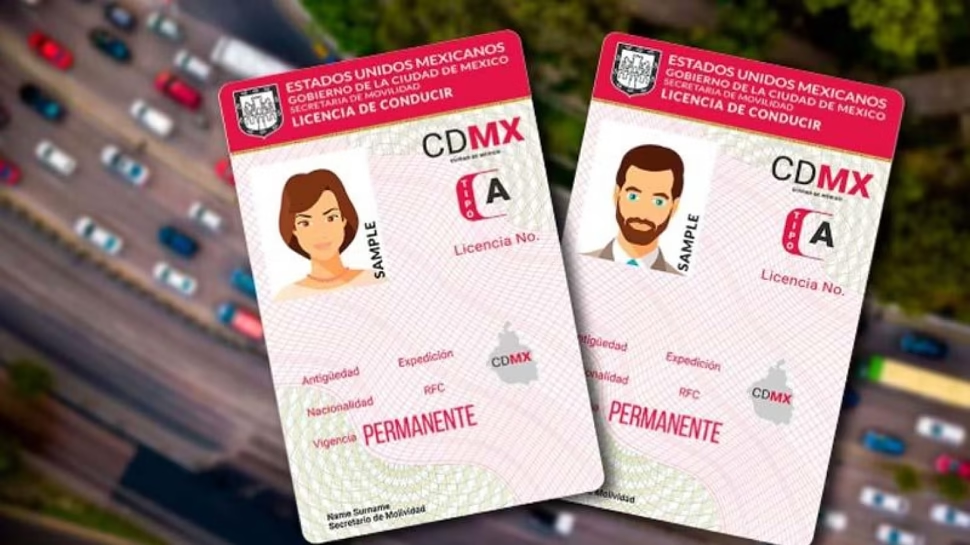
The permanent driver’s license returns to CDMX with new rules

The CDMX revives the permanent license for drivers, but with requirements that could make you reconsider if you really need it.

The permanent license: a return with a taste of bureaucracy?

Ah, the permanent driver’s license, that holy grail of capital motorists that disappeared in 2007 as if it were a forgotten meme. But surprise! The CDMX government decided to revive it in 2024, because apparently they love to play “we come and go” with our procedures. Of course, don’t expect it to be as easy as ordering an Uber Eats.

Who can apply? (Spoiler: it’s not for everyone)

If you are one of those who already have a type A license (the one that expires every three years like it were milk), congratulations, you can try upgrading to the “forever” version. But if you’re new to driving, be prepared to take the theory test, because, of course, the government doesn’t trust you to know that red means “stop” without first certifying it. Of course, forget about using it for your motorcycle, because here it only applies to private vehicles. No more feeling the wind on your face while you dodge potholes.

RelatedAntigentrification march in CDMX concludes without serious incidents

The cost? 1,500 pesos, which is basically what you would spend on three outings to a trendy bar (not counting tips). Of course, the Secretariat of Mobility warns that this is a “pilot”, so in the future they may say “psyche!” and cancel it again. Typical.

The online procedure: a labyrinth worthy of “Black Mirror”

For the brave ones who decide to venture, here is the step by step (with all the digital bureaucracy that we love to hate):

  • Login with Key CDMX Expediente (because, of course, you need one more account in your life).
  • Click on “Start” and then on “New procedure” (yes, as if you were buying tickets for a Bad Bunny concert).
  • Choose whether to pay online or with a pickup line (because sometimes technology fails and you have to go back to vintage methods).
  • Upload your official ID, proof that you don’t owe the government money (ha!) and your theory course certificate (if you’re new to this).
  • Wait 72 hours for the payment to reflect (that is, three days to regret it).
  • If all goes well, you will receive your digital certificate (which you will probably lose in the sea of unread emails).

Oh, and don’t forget to check if you have outstanding fines, because the government always finds a way to tell you “we got you.”

Is it worth the effort?

It depends. If you hate renewing your license every three years like a Netflix subscription, maybe yes. But if you are one of those who lose your wallet every two months, it may not be your best investment. Of course, it is a flex to say that you have a “permanent” license in a city where even traffic lights are optional.

Ready for the procedure? Share this information with that friend who is always late because “his license expired” and continue browsing our site for more guides that will save you from the capital’s bureaucracy. 🚗💨
Mexico and PAHO/WHO sign health strategy 2026-2030

Mexico and PAHO/WHO sign agreement to strengthen the health system and reduce the burden of diseases.

Bilateral agreement to strengthen the health system

The Government of Mexico, through the Ministry of Health, and the Pan American Health Organization/World Health Organization (PAHO/WHO) signed the Country Cooperation Strategy 2026-2030. The goal: strengthen the national health system and reduce the burden of disease.

The agreement includes priority actions to address non-communicable diseases, cancer and mental health disorders. It also promotes prevention strategies and timely care throughout the population’s life course.

In addition, it seeks to strengthen the stewardship of the Ministry of Health and the coordination between the institutions of the National Health System. The goal is to move towards a model of universal access to quality medical services.

Among the central axes are the strengthening of the capacity to respond to health emergencies, the promotion of health self-sufficiency and the strengthening of the national regulatory authority.

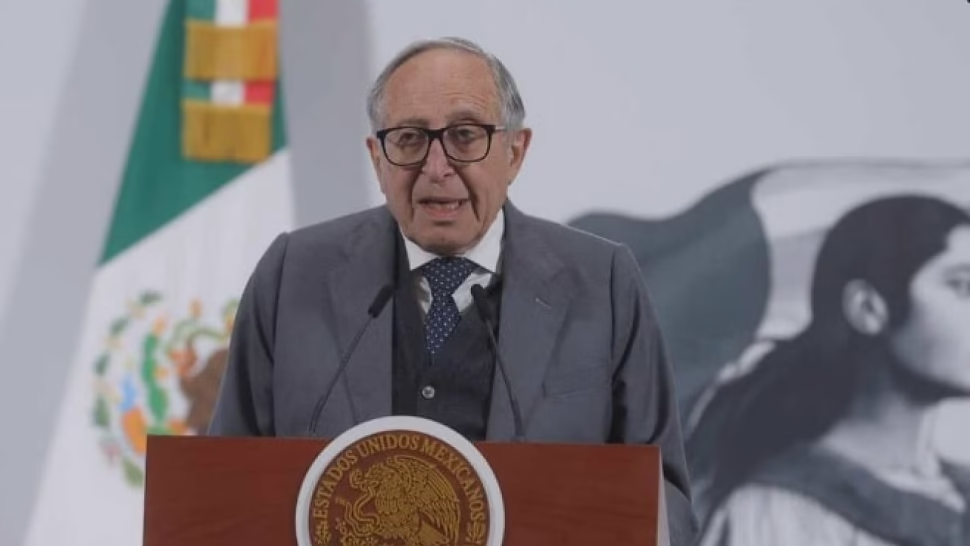
Health Secretary David Kershenobich said:

The strategy will allow national priorities to be aligned with the technical experience of PAHO/WHO, which will contribute to expanding access to health services, with emphasis on prevention, primary care and universal coverage.

The agreement lays the foundations for technical cooperation that addresses the country’s main health challenges in the next five years.

Continue reading

Mexican peso recovers after confirming the validity of the T-MEC

The peso recovers after confirming the validity of the T-MEC until 2036 with annual reviews.

The peso recovers ground against the dollar

The national currency registered an appreciation of 0.4% this Thursday, closing at 17.48 units per dollar in wholesale operations. At bank windows, the greenback stood at 17.91 pesos for sale, breaking a streak of two consecutive days with losses.

The recovery occurs after the continuity of the Treaty between Mexico, the United States and Canada (T-MEC) was confirmed until 2036, under the annual review scheme agreed upon by the three countries.

The details of the official announcement

The Secretary of Economy, Marcelo Ebrard, reported that the first formal review will begin on July 20 with the visit of a US delegation to Mexico. During the virtual meeting with their counterparts from the United States and Canada, Washington’s concern about the trade deficit was addressed.

Ebrard highlighted that more than 80% of Mexican exports to the United States continue to be tariff-free, with no changes to that scheme expected. The next working groups will focus on strengthening regional integration in strategic sectors such as the pharmaceutical industry and semiconductors, with the aim of reducing dependence on imports from other regions.

He specified that negotiations on the future of the treaty are limited exclusively to trade issues and do not include security issues.

Continue reading

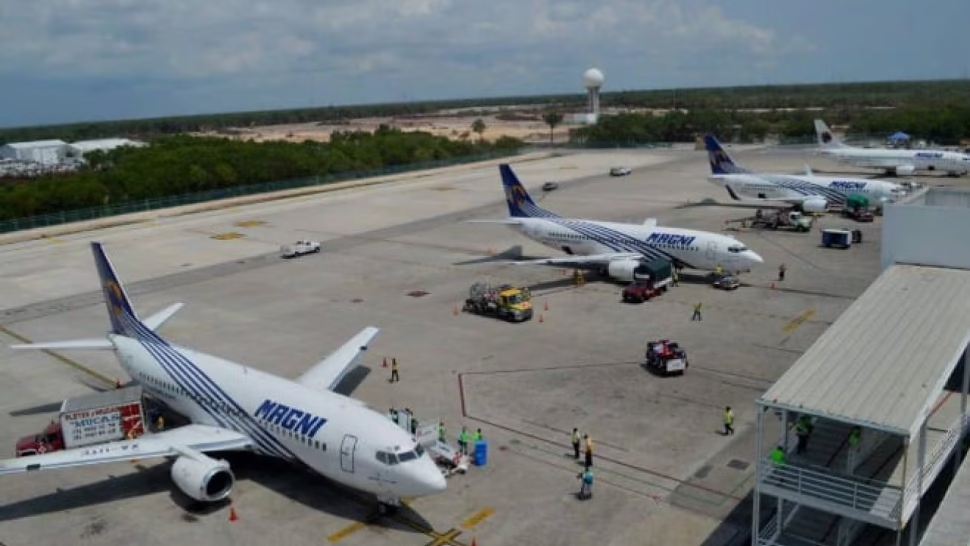
AFAC revokes Magnicharters certificate after non-compliance

The airline could not prove regulatory compliance after an extraordinary verification.

Regulatory decision

The Federal Civil Aviation Agency (AFAC) revoked Magnicharters’ air services operator certificate. The measure was notified on June 29, after a regulatory review process.

The Secretariat of Infrastructure, Communications and Transportation (SICT) reported that the company’s right to a hearing was respected throughout the procedure. It was granted legal deadlines to present information and evidence that demonstrated compliance with current aeronautical regulations.

However, the documentation provided was insufficient. The airline was unable to prove that it met the necessary requirements to continue operating as a provider of passenger air transportation.

Origin of revocation

The decision derives from an extraordinary major verification carried out in January 2026. In it, non-compliance with the regulation of the sector was detected. This led to formal requirements and, subsequently, the temporary suspension of operations in April, as a preventive measure.

The SICT stressed that the revocation is based on the lack of sufficient evidence on the part of Magnicharters to prove its regulatory status. The company now faces the loss of its certificate, which prevents it from offering commercial air services.

Continue reading