The biometric CURP for children arrives with clear rules and deadlines

The new identity document is available to everyone, but processing it for the little ones has its own rules and deadlines. We tell you the details you need to know.

The New Reality: Your Child Needs a CURP 2.0

It seems that the future we saw in the movies is already here, but instead of flying cars, we got mandatory digital identity. Yes, the famous CURP biometric, that government upgrade that sounds like a software update, has already been in force since October and, attention millennial and Z moms and dads, it will be forced to use starting in February 2026. Basically, the government is telling us: “Get everyone on the biometrics bandwagon, please.”

Forget about that old letter and number key that looked like a randomly generated password. This is the Unique Population Registry Key in its Deluxe version. Now it includes the entire kit: fingerprints, photo (hopefully it turns out well), iris scanning (like in spy movies), electronic signature and facial recognition. Everything so that your identity is more secure than the password of your favorite streaming account.

RelatedThe CURP Biometrics is implemented in Mexico without replacing the INE

Why so much trouble? Spoiler: It’s Not Just a Bureaucratic Whim

The official objective of this improved identity document is quite serious, to be honest. It seeks to guarantee the authenticity of people and protect their personal data when carrying out any procedure, public or private. The idea is to reduce fraud and identity theft to minimum levels. In addition, and this is key, it aims to create a robust national database that serves as a fundamental tool to expedite the search for missing people. That is, behind the technological process there is an important human reason.

The Survival Kit to Process your Mini-Me’s CURP

According to the National Population Registry (Renapo), the paperwork necessary to register children and minors is as follows. Take note in your reminders app:

For the protagonist (your child):

– An original and updated birth certificate. No yellowed photocopies.
– An official identification of the minor with a photograph. Here the passport, the school ID or even the vaccination record come into play (in the original, obviously).
– The child’s traditional CURP, but only if they already have it and it is validated by RENAPO.

For you, father, mother or legal guardian (the responsible adult):

– Your current official identification: the classic INE, passport or driver’s license.
– A proof of address less than three months old. Don’t forget it.
– An active email that you do check. This is where you will receive notifications.

The Golden Rule and the Detail of Babies

Arturo Arce Vargas, the head of RENAPO, dropped the bomb: to process the minor’s ID, parents or guardians must already have their own biometric CURP. Yes, you read that right. The identity of the child will be linked to that of one of the two parents or guardians. First it’s up to you to do the process, then it’s up to your offspring. It is the law of family bureaucracy.

And here is the most curious fact for parents of babies and newborns: although they can start the process, the minimum age to take their fingerprints is 5 years. The reason? It turns out that before that age, fingerprints are not fully defined and biometric recognition systems cannot capture them well due to the tiny size of the fingers. Technology has its limits, even in the face of so much tenderness.

So, for those under 5 years old who are registered, only their photograph will be taken. But be careful, this photo is not forever: it will have to be renewed at least every year. Get ready for a mandatory annual photo session with a white background, without filters. This will keep your face updated in the system while your fingerprints mature.

Ready to enter the era of family biometric identity? Share this guide with other parents on your social networks so that no one is left out of the deadline and explore more content on procedures and digital life in our section.
Sheinbaum highlights record in clean energy and economic rebound

Sheinbaum reports historic growth in renewables and low inflation at 3.55%.

Economy and energy: the president’s announcements

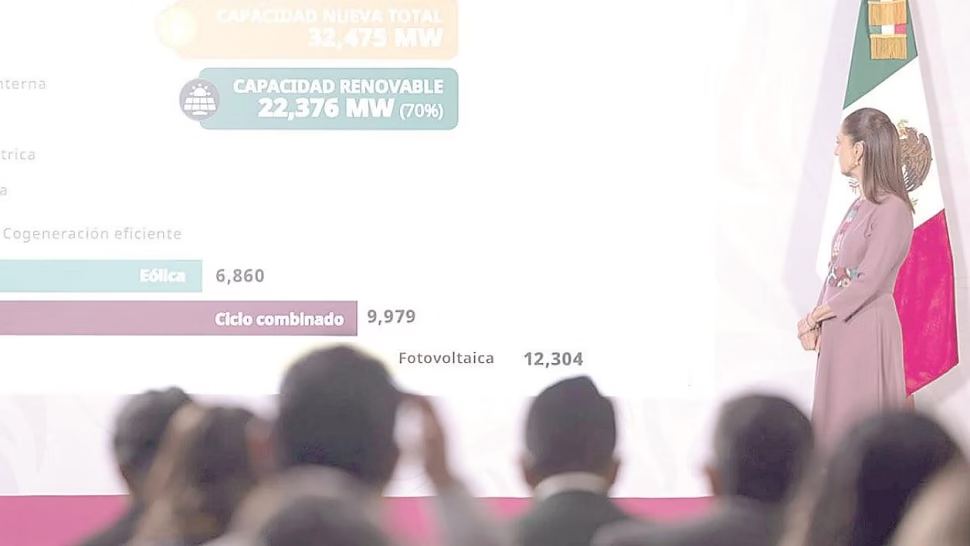
President Claudia Sheinbaum reported that, for the first time, Mexico has projects for 32 thousand megawatts of additional electrical capacity, of which 70% are renewable. “When we leave the government, natural gas consumption will decrease and energy generated by renewable resources will increase,” he stated.

Sheinbaum also highlighted economic growth. According to Inegi, the Global Indicator of Economic Activity (IGAE) rose 1.2% in April compared to March, the best advance since 2021. The annual rate reached 2.2%. The president attributed this to the boost in construction, especially the housing program.

Regarding inflation, the president pointed out that it fell to 3.55% annually in the first half of June, its lowest level since October 2025. This is due, she said, to agreements with gas stations to set maximum fuel prices and the Package Against Inflation and Scarcity (Pacic) to control the basic basket.

Energy transition with 32 thousand megawatts

The Secretary of Energy, Luz Elena González, explained that by 2030 32 thousand megawatts will be added; 22 thousand will be renewable. The goal is for at least 38% of generation to be clean to meet climate commitments. He assured that the CFE will maintain its majority participation, providing 61% of the electricity at the end of the six-year term.

The director of CFE, Emilia Calleja, explained the projects. In Baja California Sur, the Oasis System will combine solar energy, batteries and green hydrogen to supply Mulegé and 40 thousand homes. It includes a 72 megawatt plant, 20 megawatt storage and will produce 120 cubic meters of water per year, avoiding 94 thousand tons of CO2.

In Sonora, the “Rafael Galván” photovoltaic plant in Puerto Peñasco will reach one thousand megawatts of capacity and 246 megawatts of storage. It currently provides 400 megawatts. The investment exceeds 1.4 billion dollars. “They are environmental benefits that strengthen energy sovereignty,” concluded Secretary González.

Continue reading

Controversy over an interview with Monsiváis reaches the Senate and the Palace

The republication of a 1999 interview unleashes accusations between the Executive and legislators.

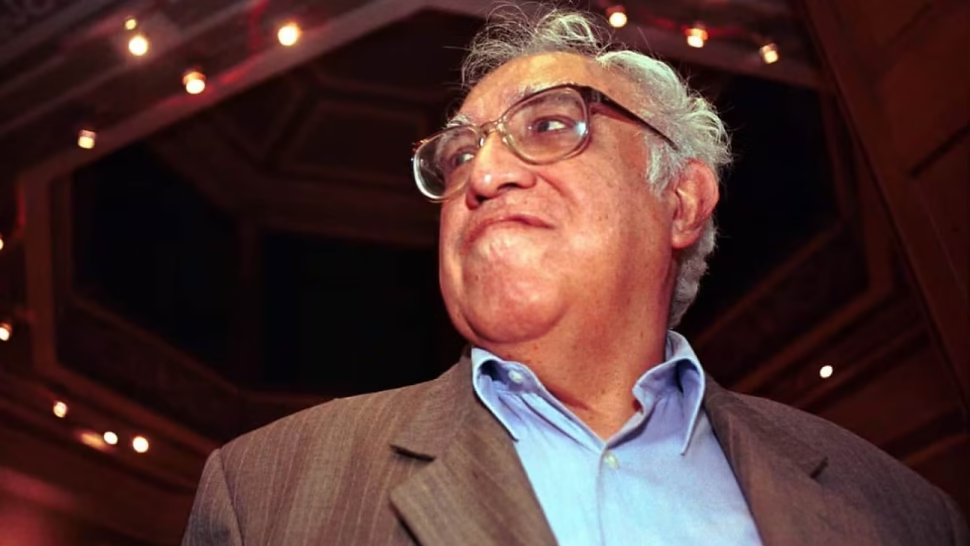
The republication of an old interview attributed to Carlos Monsiváis climbed to the center of the Mexican political debate this Wednesday. The issue was discussed both in the Senate and in President Claudia Sheinbaum’s morning conference.

The original text was written by journalist Edmundo Cázares in 1999 and recently republished by El Universal. It contains statements about the then head of Government Andrés Manuel López Obrador. Its veracity and context have been questioned, generating conflicting positions.

Sheinbaum describes the content as “grotesque”

During her conference, the president harshly criticized the publication. He described the content as “grotesque” and accused the medium of generating a controversy that distorts the tribute to the Mexican intellectual.

Reactions in the Senate

The issue also reached Congress. Senator Lilly Téllez read fragments of the text on the platform. In response, Gerardo Fernández Noroña rejected its use and maintained that it was a false publication with the intention of political attack.

The exchange reflects the polarization around the figure of López Obrador and the use of historical documents as partisan weapons.

Continue reading

PRI demands urgent action against violence in Guerrero

They denounce an incursion of armed civilians in Coyuca de Catalán; party calls for state intervention.

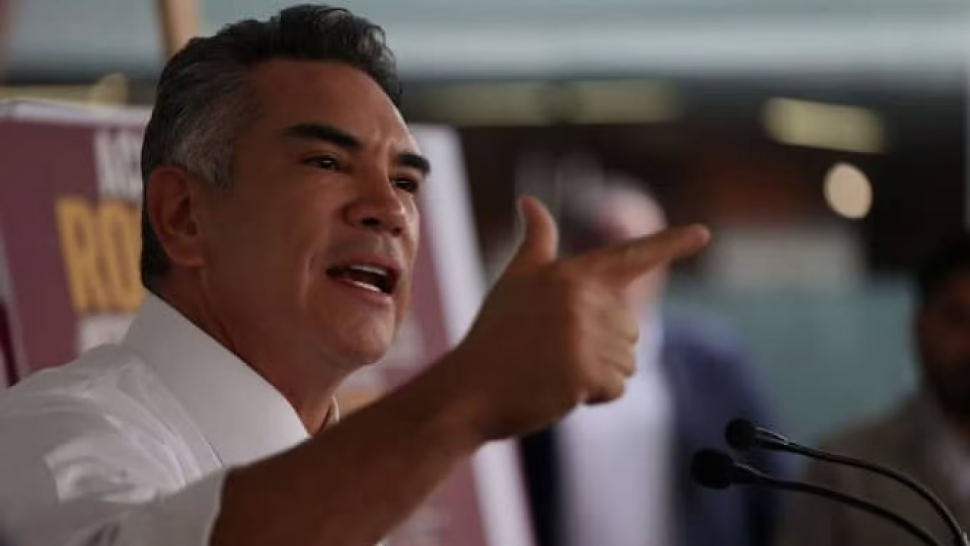
The national leadership of the PRI demanded that the Mexican State intervene urgently in response to the complaint by inhabitants of the Guajes de Ayala ejido, in Coyuca de Catalán, Guerrero. The residents reported the incursion of armed civilians into their community in the Sierra.

Call for safety

Alejandro Moreno Cárdenas, president of the party, asked the authorities to guarantee the safety of the families. He warned that these events should not be normalized due to the risk they represent for the civilian population.

The leader pointed out that in various communities in Guerrero they live under siege by armed groups. This has caused displacement, confinement of inhabitants and a constant climate of fear and uncertainty. He considered an immediate response from the State necessary.

Moreno Cárdenas also criticized the federal government for minimizing the situation of violence in the country. He affirmed that the population faces conditions of insecurity that require priority attention to restore the rule of law in the region.

Continue reading