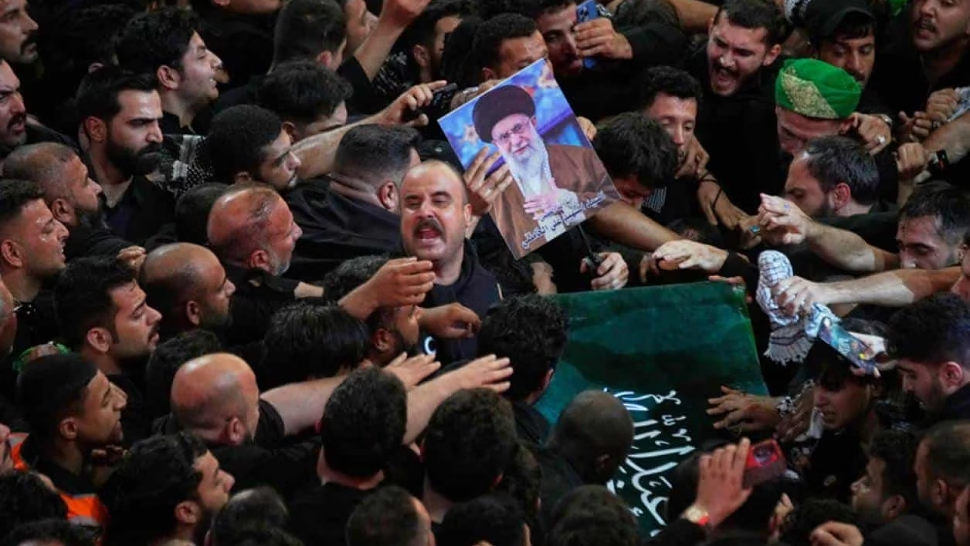
The Israeli offensive in Gaza leaves more than 58 thousand Palestinians dead

The death toll in Gaza is reaching devastating levels as the international community watches in horror.

A scene of horror that challenges humanity

The soil of Gaza, once a vibrant territory, today turns red under the weight of a tragedy that seems to have no end. The figures, cold and heartbreaking, reveal a terrifying balance: 58,500 souls uprooted by the relentless fury of the Israeli military offensive. Each number is a muffled scream, a destroyed family, a truncated future. The authorities of the enclave, under the yoke of Hamas, raise their voices in despair: 93 more deaths in just 24 hours, adding to a macabre list that grows mercilessly.

The human cost: a wound that does not heal

The Gaza Ministry of Health, in a statement full of pain, displays figures that shock even the most insensitive: 58,479 martyrs and 139,355 wounded, many of them with wounds that will mark their bodies and souls forever. Among them, horror stories that defy reason: 844 people killed while searching for a crust of bread or a drop of water, and 5,604 more who survived, but at what cost? Since that fateful March 18, when Israel broke the fragile ceasefire, 7,656 lives have vanished like tears in the sand.

RelatedIsraeli offensive in Gaza leaves 59 dead and collapses health system

The United Nations, helpless witness to this carnage, raises its voice with a fact that freezes the blood: 875 Palestinians massacred in just six weeks, many of them near the aid points of the Humanitarian Foundation for Gaza. How to explain to a child that he will die for a piece of bread? How can we justify that aid, financed even by the United States and Israel, becomes a death trap?

A call to global consciousness

This is not just a conflict; It is a modern holocaust that cries out to heaven. The images of inert bodies piled up, the cries of mothers who bury their children with empty hands, the collapsed hospitals where hope is exhausted… All of this paints a Dantesque picture that demands immediate action. The international community can no longer remain a spectator. Every second of indecision is a crime against humanity.

Share this story. May the world not forget the price of indifference. Explore more about how you can raise your voice against this injustice. Silence, today more than ever, is complicity.

Act now! Spread this story on your social networks and join the demand for peace. Time is running out for Gaza.
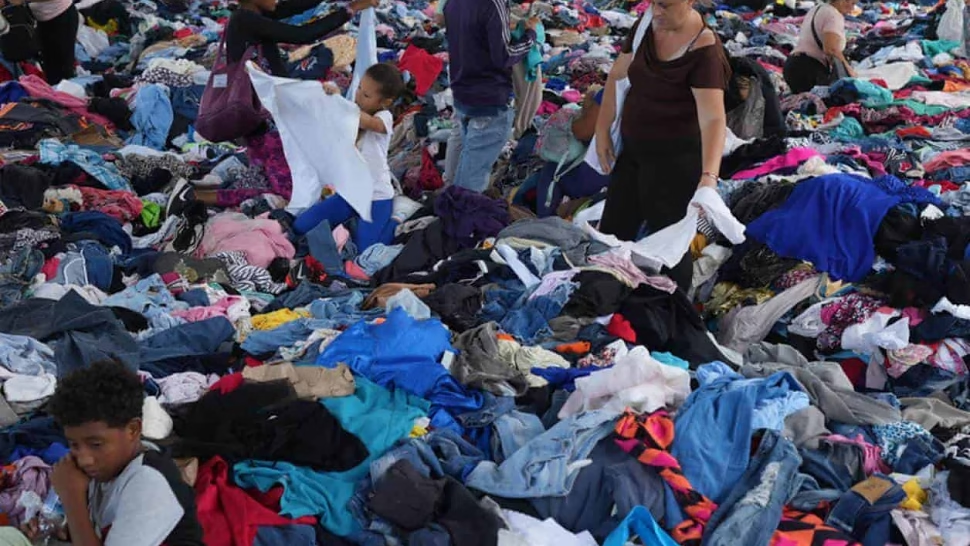
PAHO alerts: health risks after earthquakes in Venezuela

PAHO warns about outbreaks and lack of water after earthquakes in Venezuela.

Immediate health risks

The Pan American Health Organization (PAHO) warned that the greatest risks after the June 24 earthquakes in Venezuela do not only come from injuries. Limited access to vaccines, disruption of routine medical services and deficiencies in the supply of clean water are the main threats.

“In the coming weeks, the greatest health risks could arise not only from injuries caused by earthquakes, but also from disruptions in health services, conditions of access to medical care, deficiencies in water and sanitation, and access to vaccination and routine medical care,” said Jarbas Barbosa, director of PAHO, in a video conference from Washington.

PAHO collaborates with the Venezuelan Ministry of Health to detect outbreaks in shelters. Barbosa explained that respiratory diseases, like the flu, spread quickly in small spaces. Conditions resulting from the consumption of non-potable water or spoiled food are also of concern.

Damage and needs

Armando Denegri, PAHO representative in Venezuela, reported that three hospitals suffered structural damage and were evacuated. Another 24 had damages that temporarily compromised their operation, although most of them have already been repaired.

“50% of La Guaira’s health professionals were directly affected. Some disappeared, some died, others were greatly affected by the crisis, impacting their families,” Denegri detailed, without specifying more.

PAHO estimates that $24 million is required to cover urgent health needs until the end of the year. According to Barbosa, this amount will allow maintaining services, supporting rehabilitation and restoring facilities.

The magnitude 7.2 and 7.5 earthquakes occurred 39 seconds apart along the northern coastal mountain range of Venezuela, the United States Geological Survey reported. They were the strongest in the country in more than a century.

Venezuelan authorities reported 3,811 deaths and 16,740 injuries in Caracas, La Guaira and Miranda. Most of the deaths were concentrated in La Guaira, 20 kilometers north of Caracas. The government of interim President Delcy Rodríguez estimated that 18,000 people lost their homes and now live in schools, parks and public squares.

Continue reading

Death of Mexican in Houston sparks support campaign

Hispanic community in the US raises funds and demands investigation after the death of Lorenzo Salgado.

The case of Lorenzo Salgado Araujo

The death of Mexican Lorenzo Salgado Araujo, 52, on July 7 in Houston after being shot by an Immigration and Customs Enforcement (ICE) agent, has generated shock in the Hispanic community.

The League of United Latin American Citizens (LULAC) launched a GoFundMe campaign to support the family. As of this Thursday, 242,109 dollars (4.2 million pesos) had been raised out of a goal of 350,000. Among the donors, the activist Carlos Eduardo Espina stands out.

“Lorenzo was taken from those who loved him most. He was a husband, father of three children, owner of a small business and the soul of his family,” the campaign states.

The funds will go towards funeral and legal expenses and daily needs of the wife and children.

The Department of Homeland Security (DHS) states that Salgado attempted to flee and rammed his vehicle into an agent, who fired in self-defense. However, the family and activists demand an independent investigation. A video spread on social media shows ICE chasing the truck, not the attacking Mexican.

LULAC recalled the case of Renee Good, where a similar version was denied by videos.

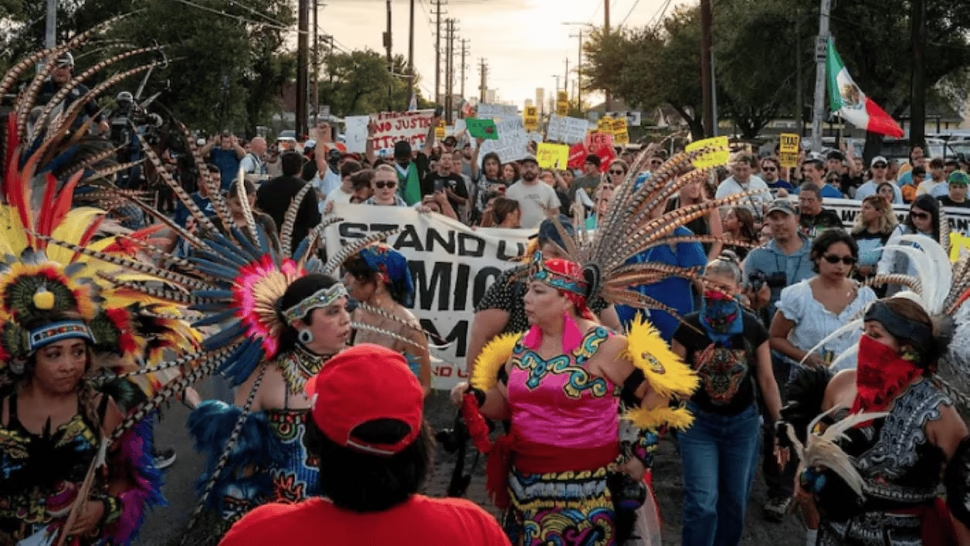
Hundreds of people protested Wednesday in the Magnolia Park neighborhood. César Espinosa, from FIEL Houston, declared:

“This is the place where Lorenzo breathed his last. If they come for one of us, they come for all of us.”

Activist Conchita Reyes, on behalf of the family, said:

“My dad was shot and bled to death. He didn’t deserve to die. He deserved to come home to his wife.”

The organization demands that Lorenzo Salgado’s name be repeated and that the facts be clarified.

Continue reading

US and Iranian attacks threaten Middle East ceasefire

New US airstrikes on Iran and Iranian retaliation put the truce in the region at risk.

New attacks and reprisals

Early Thursday morning, the United States launched new airstrikes against Iran. In response, Tehran attacked Persian Gulf countries allied with Washington. The escalation puts at risk a provisional agreement that sought to end the war in the region.

Warning sirens sounded at least three times in Bahrain, headquarters of the US Fifth Fleet. Missiles also hit Kuwait and Qatar. Later, Jordan, where the US has troops and aircraft, also raised its alarms.

Iranian reaction and victims

An Iranian official accused Washington of attacking the area around the country’s only nuclear power plant. During the afternoon, more explosions were reported in other areas.

According to Iran’s Ministry of Health, the two days of bombing have left at least 14 dead and 78 injured. The majority belonged to the armed forces.

In Kuwait, one person was injured by debris when air defenses shot down three ballistic missiles, a cruise missile and 10 drones. Bahrain reported that it intercepted incoming fire, without further details. Jordan, through its spokesman Mohammad al-Momani, confirmed that all Iranian fire was intercepted.

Iranian state television reported that the Revolutionary Guard fired missiles at a US base in Jordan. So far there are no reports of damage in Qatar.

The actions come hours after President Donald Trump warned that Iranian attacks on ships in the Strait of Hormuz meant the end of the fragile ceasefire. He threatened to escalate the conflict if the attacks did not stop. The international community fears that the region will once again fall into a multiple war, which could block energy shipments through the strait, vital for the global economy.

Continue reading