The health census that turned 20 thousand nurses into medicine detectives

An army of 20,000 nurses invades Mexican homes in the name of health, while the numbers dance between statistics and good intentions.

The epic (and bureaucratic) crusade of home visits

Ah, International Nursing Day. That time of year when politicians remember that there are people who do the real work in the healthcare system. President Claudia Sheinbaum, in a burst of statistical enthusiasm, announced with great fanfare that her Salud Casa por Casa program has already invaded—sorry, visited—8.5 million older adults and people with disabilities. How did they achieve it? Simple: with the delicacy of an elephant in a china shop and the rhythm of a sleepy snail. Half an hour at home, sometimes an hour, because of course, who could resist a government survey between tea and memories of youth?

And not content with collecting data as if they were Pokémon (“Gotta catch ‘em all!”), healthcare personnel now also play at being doctors, psychologists and prescription deliverers. The Wellness Pharmacies—which sound as idyllic as a Heidi village—promise to supply medications, although we don’t yet know if they will include a bureaucracy machine for additional paperwork. Of course, if Grandpa has a mental problem, he’ll be referred to a specialist… as long as the health center’s phone isn’t busy with calls from 8.5 million other people.

RelatedSheinbaum turns nurses into domestic superheroes with health program

The numbers that (maybe) matter

The Secretary of Health, David Kershenobich (a name that seems taken from a 19th century medical treatise), boasted the hiring of 20 thousand nurses for this mission. 20 thousand? It sounds like an army, but in reality it is as if each one had to visit 425 houses. Cheer up, syringe soldiers! Meanwhile, the Secretary of Welfare, Ariadna Montiel, delighted us with a classification of beneficiaries that seems taken from a role-playing game: from the “healthy and happy” (35%) to the “total dependents” (1.4%). Prize for the largest group? A pat on the back and the promise that someone, at some point, will follow up.

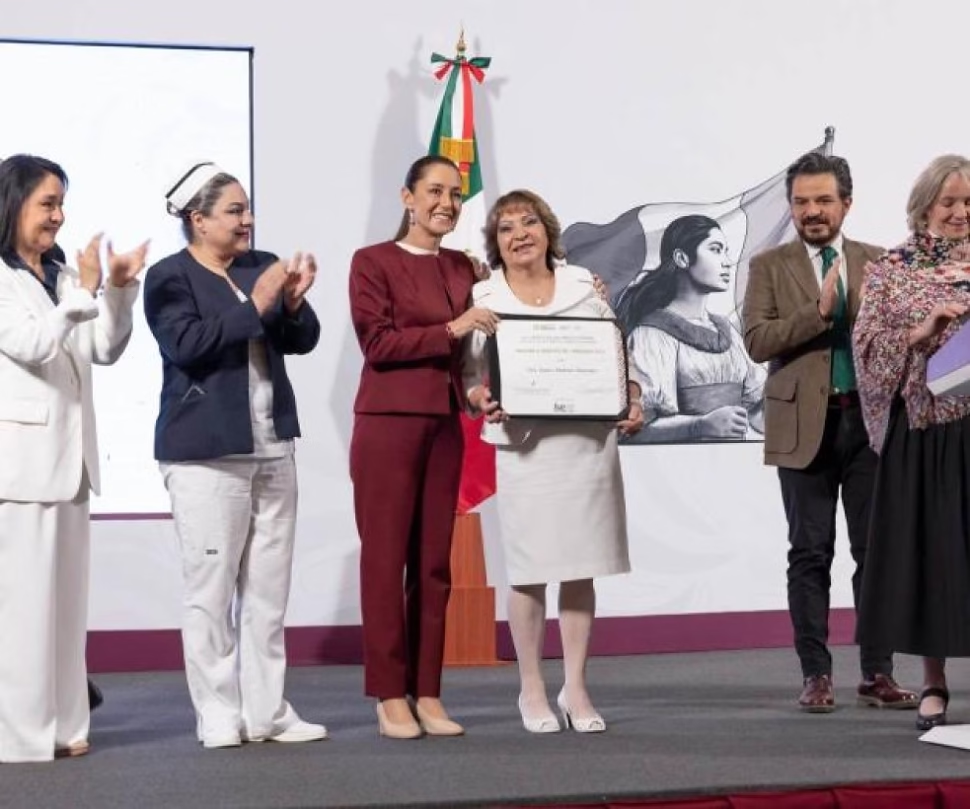
And the award ceremony could not be missed, because what would a government be without its annual dose of medals and photos for the archive? The award-winning nurses—Juana, Yolanda and Sandra—received their diplomas to applause, while the heads of the institutions competed for who had the most staff under their command. The IMSS: 121 thousand nurses. The ISSSTE: 32 thousand. And the prize for the cheesiest speech? For the director of the IMSS Bienestar, who declared that his nurses are “the backbone and the heart” of the institution. How beautiful. I hope they are also paid as if they were vital organs.

The final goal? Survey 13.7 million people. For now they are at 62.3%. That is, if they keep up the pace, by the time they finish, some of those older adults will have already achieved immortality… or at least we hope so.

Did you like this gem of public administration? Share it on networks and join the debate: medical visit or disguised census? And if you want more doses of reality with a touch of sarcasm, explore our content!
Key meeting between the US and Mexico to reopen the livestock border

US ambassador and head of Sader agree on steps to reopen border crossings to livestock.

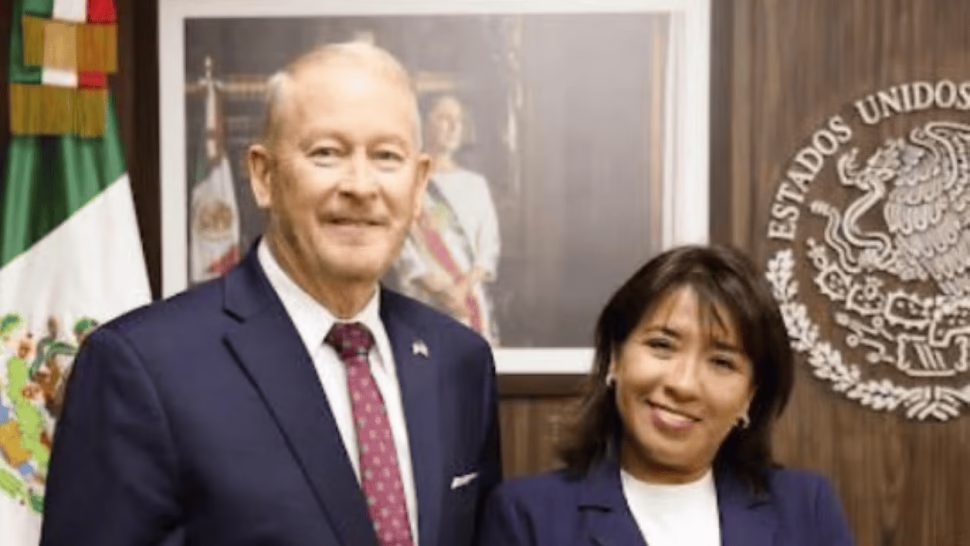
The United States ambassador to Mexico, Ronald Johnson, met with the Secretary of Agriculture, Columba López, following the bilateral agreement to reopen the border to livestock trade, affected by screwworm outbreaks.

Johnson described the meeting as productive and noted that it strengthens high-level cooperation. “Together we continue to generate results for the benefit of ranchers, producers and consumers of both countries,” he published on social networks.

Gradual reopening plan

The reopening will be staggered. It will begin in Sonora and then in Chihuahua, as reported by President Claudia Sheinbaum in her morning conference. The president recognized the work of former secretary Julio Berdegué and current secretary Columba López to achieve this progress.

Sheinbaum detailed the actions against the pest: from artisanal traps to the operation of a plant in Chiapas that produces sterile flies to prevent the spread of the larva. “It is considered that we are quite advanced to open the border in August,” he said.

The president highlighted the technical coordination between both governments. “There are still joint actions to be developed, but it speaks of good collaboration, very technical, to prevent this damage to livestock from spreading,” he concluded.

Continue reading

PAN demands Sheinbaum declassify Pemex audits

PAN deputies demand declassification of Pemex audits reserved for three years.

They demand declassification of Pemex audits

Deputies of the National Action Party (PAN) demanded that President Claudia Sheinbaum declassify the financial reviews and audits of Petróleos Mexicanos (Pemex) during the administration of Víctor Rodríguez Padilla. They considered the argument that it compromises strategic information “vague.”

This, after EL UNIVERSAL revealed that days before resigning from Pemex, Rodríguez Padilla classified the findings of internal audits as “reserved” for three years.

“False, it is about covering the corrupt backs of this man accused by his wife of physical abuse and domestic violence,” declared PAN member Paulina Rubio.

He added that reserving the information is a sign of the President’s “unconditional love and support” for women’s aggressors. “Now the president gives us a new face, her commitment to opacity and corruption in Pemex.”

Shield against corruption

Ernesto Sánchez, federal deputy of the PAN and member of the Transparency and Anti-Corruption Commission, warned that this is “a new attempt to shield corruption from citizen scrutiny.”

He pointed out that access to information is a constitutional right and that reservation is only justified exceptionally, not to hide irregularities or protect “friends” of the regime.

“Morena has turned the exception into the rule. What should be maximum publicity is used to close files and avoid accountability. Transparency cannot be applied only to adversaries. Reserving information of public interest feeds the suspicion of impunity,” said Sánchez.

Federico Döring, GPPAN spokesperson, stated that “all of Víctor Rodríguez’s misdeeds at Pemex before he left will remain hidden.” He pointed out that oil spills and “corrupt” contracts given to companies related to López Obrador’s children will be protected.

“Sheinbaum’s government protects this man so much that they watched his back so that the deals he made under higher instructions would not be known,” added Döring.

Raúl Torres Guerrero, local PAN deputy, assured that Pemex “is practically bankrupt” and reserving information compromises the administrative failure and would turn on red lights for international rating agencies. “For the world, Pemex is no longer a solid company but a burden for the Mexican State.”

Torres criticized that Mexico cannot compete “when it has corrupt companies that do not provide guarantees for investment, send oil to dictatorships like Cuba or give contracts to friends of children of former populist presidents like AMLO.”

Continue reading

Direct vote for plurinominales: the Espadas proposal in the INE

Councilor Uuc-kib Espadas proposes that citizens directly elect proportional representation deputies.

Two tickets for deputies

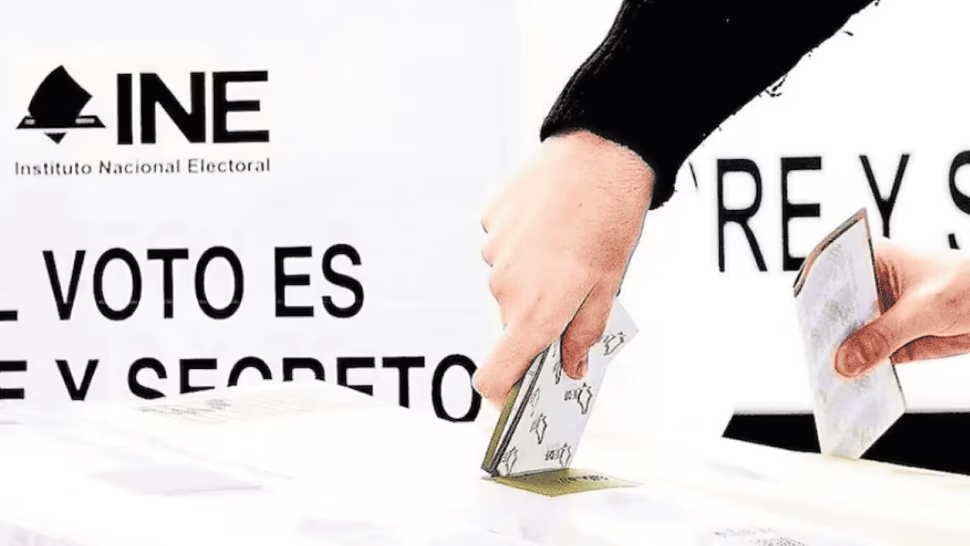
The electoral advisor Uuc-kib Espadas Ancona will present a key proposal to the General Council of the INE: allow citizens to vote directly for multi-member deputies in the 2026-2027 federal process.

The initiative proposes dividing the election into two ballots. One will contain the relative majority candidates; the other, the group names of those who the parties nominate as proportional representation.

Espadas announced that he will present his model to his fellow councilors at the end of September or beginning of October.

Cost and logistics

The counselor acknowledged that issuing an extra ballot would imply an additional expense of between 200 and 250 million pesos, within the usual INE printing package. However, he pointed out that, after the experience of the election of the Judiciary in 2025, it would be possible to put both ballots in the same ballot box and do the counting separately, as is already done.

No need for legal reform

Espadas clarified that the INE has the power to implement this change without a legal reform. According to him, the April electoral reform was the right time to legislate it, but the authority can act on its own.

“The electoral authority does have the possibility of implementing two ballots for the election of deputies even without this legal reform, I insist, since this would fully guarantee the freedom of voting through the two current election methods,” he explained.

The debate is just beginning, but the proposal opens the door to a transformation in the way federal legislators are elected.

Continue reading