The fossil gas megaproject that puts the Gulf of California at risk

A controversial energy project threatens the Gulf of California, unleashing legal and social resistance due to its irreversible consequences.

An in-depth analysis of the Saguaro Energía project and its implications

Latin America has historically been a region exploited for its natural wealth, from the excessive extraction of resources to its use as a geopolitical scenario. In the 21st century, this pattern persists in new forms, such as the Saguaro Energía megaproject, promoted by the Mexico Pacific company. This plan seeks to establish an energy corridor between the Permian Basin of Texas and the Gulf of California, with the objective of exporting liquefied gas to Asia. However, its environmental and social repercussions are deeply alarming.

Ecological and social impact: worrying figures

The project includes an 800-kilometer gas pipeline and a liquefaction terminal in Puerto Libertad, Sonora, which would occupy an area equivalent to 6,000 soccer fields. According to independent studies, its operation would generate 73 million tons of CO₂ annually, exceeding the combined emissions of Sweden and Portugal. This figure represents more than 10% of Mexico’s total emissions, calling into question the country’s climate commitments.

RelatedPemex is committed to gas and fracking in its energy policy

The Gulf of California, recognized as a Natural Heritage of Humanity, is home to 39% of the planet’s cetaceans and six of the seven species of sea turtles. The installation of industrial infrastructure and the transit of LNG tankers would directly threaten endangered species, such as gray whales that use these waters to reproduce. Furthermore, more than 60% of national fishing production depends on this area, which would compromise the food security of millions of people.

Legal resistance and community mobilization

Faced with this scenario, opposition to the project has been overwhelming. The Security, Energy and Environment Agency (ASEA) has acknowledged five amparo lawsuits that paralyze its progress, while court records reveal at least seven additional lawsuits against Mexico Pacific. Local communities, including fishermen and indigenous groups, lead the “Whales or Gas” campaign, highlighting the incompatibility between economic development and ecological preservation.

This case is not isolated. Other projects such as AMIGO LNG, Vista Pacífico LNG and the Sierra Madre and Corredor Norte gas pipelines seek to consolidate a “death corridor” in northern Mexico. These initiatives, framed as “investment”, violate international treaties such as the Paris Agreement and the Escazú Agreement, which protect environmental and social rights.

A call for coherent climate action

COP30, which will be held in Belém do Pará (Brazil), will be a key stage to redefine Latin America’s role in the energy transition. The region must reject false solutions such as fossil gas, which perpetuate extractivist models. The defense of the Gulf of California is not only an act of conservation, but also a precedent to prevent other territories from continuing to be sacrifice zones.

Are you concerned about the future of our ecosystems? Share this information to make the consequences of fossil megaprojects visible and explore more content on sustainable energy alternatives. #ClimateJustice

Note: This analysis is based on official data, environmental reports and public judicial documents, guaranteeing rigor and transparency in each statement.
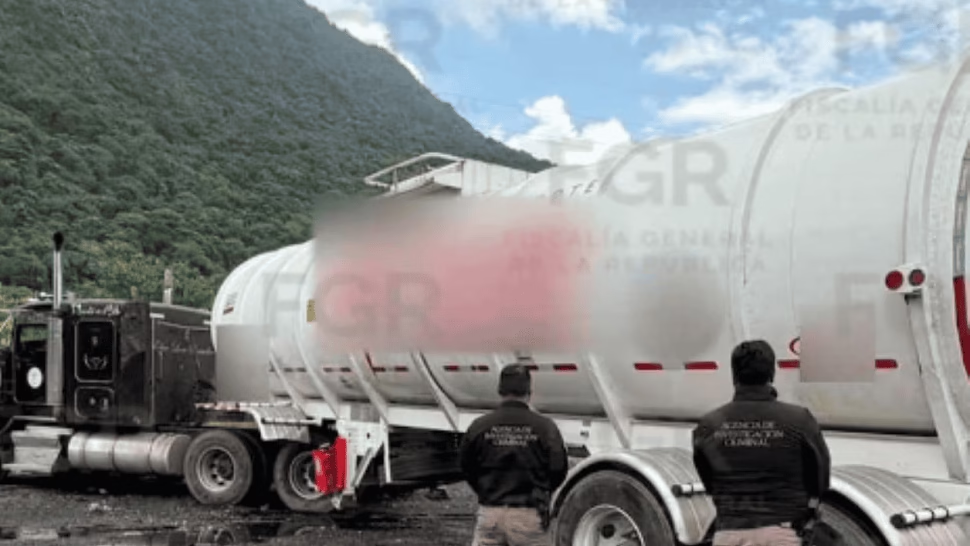

They secure more than 33 thousand liters of hydrocarbons in Veracruz

Search in Río Blanco leaves fuel seized without arrests.

Insurance in Veracruz

Elements of the Criminal Investigation Agency (AIC) of the Attorney General’s Office (FGR) seized approximately 33,250 liters of hydrocarbons in the municipality of Río Blanco, Veracruz. The operation derived from a search warrant issued by a judge for a possible crime contemplated in the Federal Law to Prevent and Punish Crimes Committed in the Matter of Hydrocarbons.

State and federal police participated in the search, as well as members of the Secretariat of the Navy (Semar) and the National Defense (Sedena), who provided perimeter security. In addition to the fuel, a property, a tank-type semi-trailer, a tractor-trailer, a scooter and two motorcycles were seized. Everything was left at the disposal of the Public Ministry, which continues the investigations. There were no arrests.

Conviction in Puebla

In a different case, the FGR reported that Cristian “N” was sentenced to 10 years in prison and paid a fine of 730,400 pesos for illicit possession of hydrocarbons. The man was arrested while driving a truck in the municipality of Amozoc, during surveillance tours by the state police. Four containers with 3,880 liters of fuel were found in the vehicle, without documentation proving its origin.

Both cases reflect the actions of the FGR against organized crime and the regulation of the hydrocarbon sector in the country.

Continue reading

AT&T loses a million prepaid users due to telephone registry

The mandatory registration of mobile lines already modifies the behavior of the prepaid market in Mexico.

Fall in prepaid

Mandatory cell phone registration already impacts operators. AT&T Mexico reported a loss of one million prepaid users during the second quarter of 2026. At the end of June, the company added 15 million 829 thousand subscribers in that segment, according to its financial results.

In contrast, postpaid customers grew by 369 thousand, an increase of 20.7%, to reach 7 million 457 users. The difference is due to the government requirement to register all lines in the cell phone registry.

The original deadline expired at the end of June, but only 43% of the lines had been registered. The federal government extended the date. The suspension of service will begin on August 15 and will be staggered until December 31, depending on the last digit of the number.

The consulting firm The Competitive Intelligence Unit (CIU) pointed out that the contraction of prepaid lines is directly due to this obligation.

Financial results

Despite the drop in prepaid, AT&T Mexico’s total revenue reached $1,224 million in the second quarter, an increase of 16.1% compared to the same period in 2025. The company attributed the growth mainly to the favorable exchange rate.

EBITDA amounted to 227 million dollars, an increase of 12.9%. In contrast, operating income fell by 8 million, reaching $38 million.

The general director of AT&T Mexico, Mónica Aspe, stated:

“The results for the second quarter of 2026 reflect the discipline with which we execute our strategy: strengthening the network, taking care of the relationship with our customers and maintaining focus on initiatives that drive profitable growth.”

Regarding the registration, Aspe added: “Looking to the second half of the year, we will continue to focus on successfully completing the process of linking mobile lines.”

The company also highlighted its deployment of 5G in stadiums and Fan Fest areas during the world soccer tournament, an investment that considers lasting infrastructure beyond the event.

Continue reading

Entangled humpback whale rescued in BCS

Humpback whale trapped in nets released in Baja California Sur.

Personnel from Profepa, the National Network for Attention to Entangled Whales and tourism service providers freed a humpback whale trapped in a nylon net in Baja California Sur.

The rescue

The environmental authority, headed by Mariana Boy Tamborrell, reported that they located the entangled marine mammal and, following safety protocols, removed most of the material. This reduced the risk of amputation, infection or impairment of mobility.

Gillnets represent a constant danger to cetaceans, especially during humpback whale season in the Gulf of California.

Threats to the species

The Action Program for the Conservation of the species indicates that entanglement, collisions with boats, acoustic disturbances, habitat degradation due to pollution and urban development are the main threats. It also mentions whale watching tourism and other forms of harassment.

In Mexico, humpback whales are found throughout the Pacific from November to May, although some remain in the Gulf of California year-round. They have an annual migratory cycle: in summer they feed in groups; In winter they hardly eat, as they dedicate themselves to childbirth, breeding and competition between males for females.

According to Conabio, these mammals are part of the 11 species of bearded cetaceans in the world and are distributed in all oceans.

Continue reading