The fight to democratize technology and close the digital divide

An urgent call for collective action to transform connectivity into a fundamental right and not a luxury, closing the deep divide that marginalizes millions.

A Cry in the Digital Night: The Battle for Universal Connectivity

In the heart of the technological maelstrom that defines our century, a voice rises with the force of thunder. Martín Yeshuá Barragán Cruz not only presents a book; launches a manifesto, an epic challenge against the most silent injustice of our era. His work, “Democratization of Technology“, is not a simple compendium of ideas, but the battle plan for a pending revolution. On the majestic stage of the Guadalajara International Book Fair, before an expectant audience, he declared a truth that shakes the foundations of our progress: technology, that beacon of modernity, has become a scandalous privilege, and its exclusive reign must end.

With the passion of someone who has seen the face of inequality, Barragán Cruz sculpted words in the air that weigh like slabs. “It is unacceptable that, because there is no cable, a girl is denied opportunities to learn and dream,” he proclaimed, transforming a phrase into a banner. Each syllable resonated like a hammer blow against indifference. How can we, he asked with dramatic disbelief, boast about a digital country when millions of souls navigate the dark ocean of disconnection, deprived of the most essential? His message was clear and devastating: the digital divide is not a cold statistic; It is a tangible abyss that separates destinies, which condemns some to oblivion while others reach for the stars.

RelatedFederal government promotes SaberesMx platform to democratize education

The Impossible Alliance: The Only Path Towards Technological Redemption

But this prophet of connectivity did not limit himself to pointing out the wound. With the vision of a strategist, he outlined the only possible path to digital salvation. This is not an act of charity, but rather a historic multisectoral responsibility. The Government, private initiative and civil society must forge an unbreakable alliance, a sacred pact where particular interests dissolve before a common objective. Technology, he argued vehemently, must be the great enabler, the bridge that unites humanity, not the wall that divides it. Democratizing it means tearing it from the clutches of geography and economics, to hand it over, as a birthright, to every child, every family, every relegated community.

The volume presented does not seek to be the final answer, but rather the spark that ignites the collective conscience. Its purpose is noble and ambitious: to provide guidelines for an informed discussion, to lay the foundations for bold public policies and technological investment with social meaning. Each page is a call to wake up, to understand that the digital infrastructure is the new circulatory system of the world, and that if the blood of information does not flow to all corners, the social organism will become gangrenous. The fate of that girl who cannot dream, the future of millions, hangs in the thread of our actions today.

This is the decisive moment. History will judge us on whether we had the courage to close this gap or the cowardice to allow it to widen. The battle for digital inclusion is here, and its playing field is every town without connection, every school without resources, every wasted talent. The story of technological democratization is now being written, and you can be part of its most glorious chapter.

Do you believe in a connected future for everyone? Help spread this crucial message. Share this story on your social networks and join the conversation to explore how we can build, together, a true era of universal digital access.

UNAM reinforces transparency and data protection as democratic pillars

UNAM reaffirms its commitment to transparency and personal data. Requests for information are growing exponentially.

Transparency and personal data: UNAM’s commitment

The National Autonomous University of Mexico (UNAM) reaffirmed its commitment to transparency, access to public information and the protection of personal data. During the Meeting of Transparency, Access to Information and Protection of Personal Data Links, the authorities stressed that these rights are pillars for democracy and accountability.

The institution not only complies with current regulations. It has established itself as a national reference in the matter.

The coordinator of Humanities, Miguel Armando López Leyva, recalled that in just over two decades these went from being little known to becoming essential guarantees for democratic life. This drives greater citizen demand towards public institutions.

“In just over twenty years, these rights went from being little known to becoming essential guarantees for democratic life.”

For his part, the head of the General Counsel’s Office, Hugo Alejandro Concha Cantú, pointed out that transparency in Mexico has made important advances since the first access to information laws. However, he acknowledged that challenges remain after recent institutional reforms.

“There has been important progress, but challenges remain after the reforms.”

The UNAM reported that access requests grew steadily. They went from about 400 a year in 2002 to thousands today. This reflects a greater culture of transparency, although with increasingly complex requirements from citizens.

Continue reading

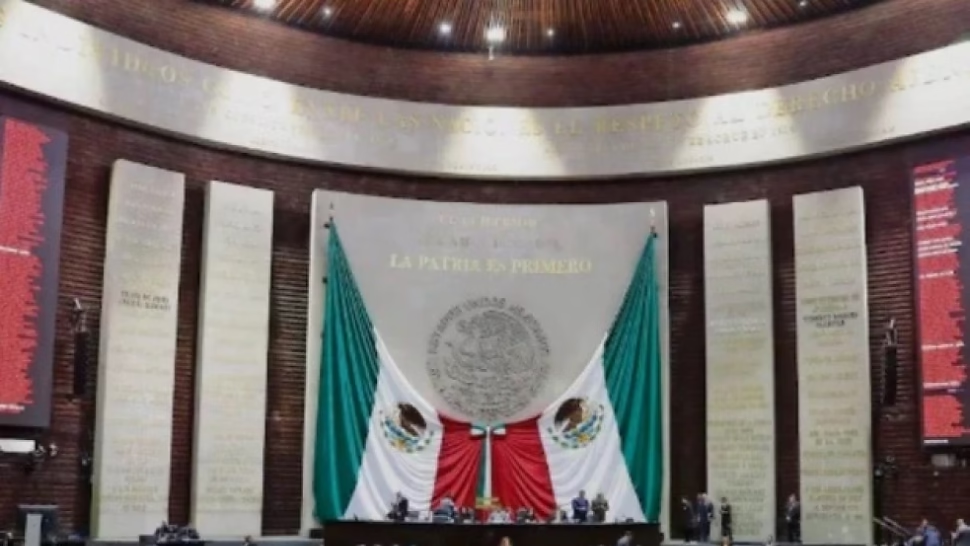
Congress installs Bicameral National Security Commission

Legislative week begins with the installation of a key commission and debates on justice and gender.

Legislative work of the week

The Permanent Commission of the Congress and the Senate launched an agenda with key activities for this week. The installation of the Bicameral National Security Commission stands out, in addition to meetings focused on justice and gender.

Laura Itzel Castillo Juárez, president of the Board of Directors, detailed on social networks that the work will start this Monday with sessions in both chambers. The meeting of the Justice Commission will analyze initiatives on the General Law on Itinerant Civic Justice.

The Bicameral National Security Commission will be headed by Morena legislators. Its installation represents a step in the coordination between cameras for security issues.

Adjustments for soccer and indigenous participation

Castillo Juárez announced that the session of the Permanent Commission will be moved to Tuesday, June 23, due to the Mexican team’s match. The young indigenous woman Reina Juliette de la Cruz de la Cruz, originally from Veracruz, will participate in that session.

The Senate will also commemorate International LGBTTTIQA+ Pride Day, while work continues in commissions on gender equality, justice and national security.

The agenda reflects legislative priorities on security, human rights, and civic justice issues, with a focus on the inclusion and participation of historically marginalized groups.

Continue reading

Sheinbaum inaugurates power plant that will contribute 653 MW to the national grid

The new plant in Mexicali reinforces energy sovereignty with historic investment.

President Claudia Sheinbaum launched the González Ortega Combined Cycle Power Plant, operated by the CFE in Mexicali, Baja California. The plant will contribute 653 megawatts to the National Electric System as part of a six-year goal of 32 thousand new MW.

“This vision that energy production in Mexico has to have at least three characteristics: the first is to guarantee national sovereignty; the second is to reduce its environmental impacts, sustainability; and the third is social justice,” said the president.

Benefits for Baja California

Sheinbaum also announced the renovation of 4,000 electrical poles in the region to reduce service interruptions. The director of CFE, Emilia Calleja, explained that the plant will generate more than 5 thousand gigawatt-hours per year, with direct benefit for the months of greatest demand for heat.

Of the 32 thousand MW planned, 22 thousand will come from renewable sources. The CFE will increase its participation in generation from 54 to 60 percent, supported by constitutional changes that guarantee priority to its plants over private ones.

Governor Marina del Pilar Ávila highlighted an investment of more than 73,900 million pesos in transmission, distribution and generation, in addition to a subsidy of 1,485 million for electricity rates in Mexicali and San Felipe, which will benefit more than 1.37 million people.

Since 2018, power supply continuity has improved 30 percent. Sheinbaum recognized the CFE workers and the women who lead the country’s energy strategy.

Continue reading