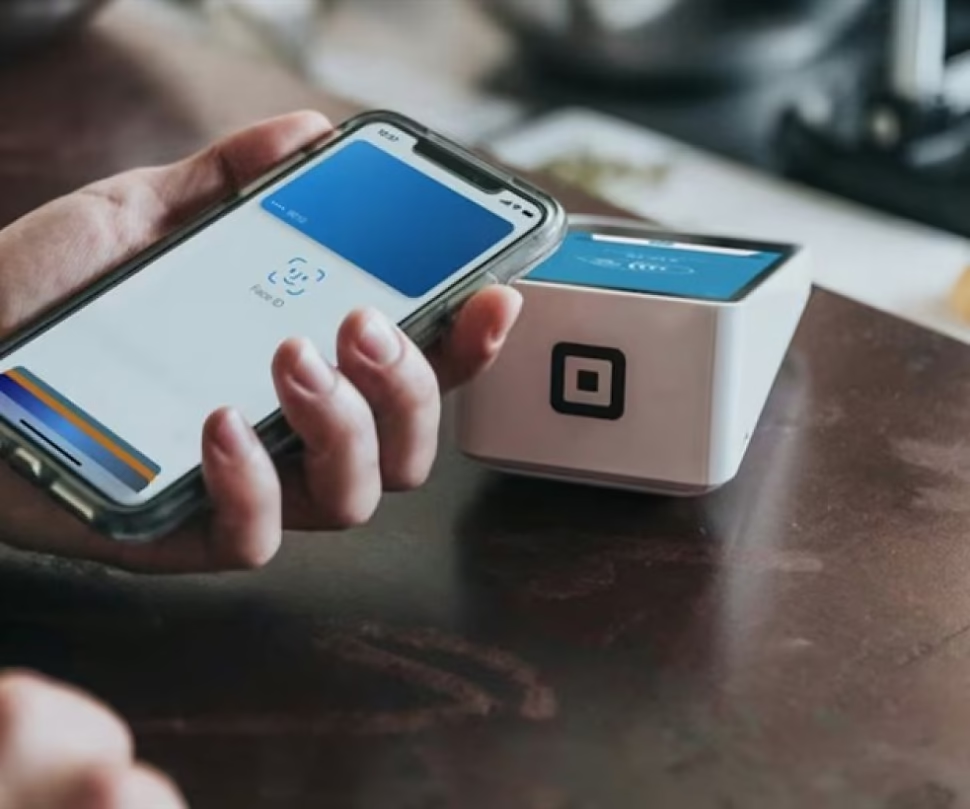
Current panorama of payment methods in Mexico
The evolution of the payment system in Mexico presents a scenario of significant contrasts. On the one hand, there is a sustained growth of 20% annually in the use of digital financial instruments, such as cards and electronic transfers. However, data provided by institutions such as the National Institute of Statistics and Geography (Inegi), the Banco de México (Banxico) and Mastercard confirm a persistent reality: approximately 80% of transactions under 500 pesos continue to be settled using bills and coins. This dichotomy highlights an incomplete financial transition, where modernization coexists with deep-rooted habits.
The technological infrastructure has experienced a notable expansion, with more than 1.4 million Point of Sale Terminals (POS) deployed by commercial banks throughout the national territory. However, this advance in installed capacity has not translated into universal adoption. Resistance to change by a considerable segment of the population and businesses continues to be the main obstacle to consolidating a predominantly digital payments ecosystem.
Determining factors in the adoption of digital solutions
According to the analysis of Mercado Pago, the financial arm of the e-commerce giant Mercado Libre, the acceleration of this technological migration depends critically on three fundamental pillars: the development of infrastructure, the promotion of financial education and the building of trust among users. Enrique Hocarsitas, Senior Director of Small and Medium Enterprises of the firm, emphasizes that the final decision falls on the consumer, who must feel comfortable and safe with these new payment methods.
International experience offers valuable lessons. Ramiro Nández, Director of Users of the company, pointed out that strategic collaboration between regulatory authorities, traditional banking and new financial players is an essential catalyst to achieve profound transformations. The success story of the Pix system in Brazil stands as a paradigmatic reference, demonstrating how a joint initiative can promote financial inclusion on a large scale. This tripartite cooperation model is showing encouraging results in other economies in the region, such as Argentina, indicating a viable path for Mexico.
The immediate context poses a historic window of opportunity with the proximity of the FIFA World Cup 2026, whose shared venue includes Mexico. This global event projects the arrival of more than five million international visitors and an estimated economic impact of 10,000 million pesos. Taking advantage of this potential requires an aggressive strategy to digitize small businesses and strengthen digital collection infrastructure in tourist corridors and destinations, ensuring a seamless experience for tourists accustomed to more advanced financial environments.
Technological trends and changes in consumer habits
The internal metrics of Mercado Pago reveal a palpable transformation in payment behaviors. More than a third (37%) of the operations carried out with its cards are already executed using contactless technology. This indicator shoots up to 57% when analyzing transactions processed specifically in their own point of sale terminals. This marked preference confirms an active search by consumers for methods that prioritize speed, security and operational simplicity.
The company maintains that this trend is completely redefining the everyday payment experience among Mexicans. The acceleration in the adoption of digital payments is clearly manifested in the physical ecosystem. In the period between September 2024 and September 2025, the volume of payments processed through terminals doubled, registering an increase of 100%, driven primarily by the demand of small and medium-sized businesses. In parallel, transactions made with Mercado Pago cards experienced year-on-year growth of 130%.
Ecosystem expansion and adaptation strategies
To address this exponential increase in the volume of operations, the company has undertaken an ambitious expansion of its technological infrastructure. Its network already exceeds one million active terminals in the country and is complemented by a network of more than 40,000 physical points enabled to enter or withdraw cash. This latest initiative is a deliberate strategy to digitize physical money in regions with traditionally unequal access to formal financial services. The company’s plan focuses on accelerating card issuance, deepening terminal penetration and consolidating its cash digitization network, thus closing the gap between the physical and digital world.
The transition to a less cash-dependent economy is a complex and multifaceted process. The data analyzed demonstrate unequivocal, although heterogeneous, progress towards financial digitalization in Mexico. Future success will depend on continuity in investment in infrastructure, the effectiveness of financial education campaigns and the ability of all actors involved to generate the necessary trust that allows users to take the definitive leap. The path has been set, and the coming years will be decisive in defining the country’s financial profile.
Did you find this analysis about the future of money insightful?Share this article on your social networks to expand the conversation about financial inclusion and explore more content related to digital transformation and the economy on our site.