The Court endorses increasing penalties for crimes linked to artificial intelligence

Justice reinforces the legal framework against crimes committed with advanced digital tools.

Supreme Court backs tougher penalties for AI crimes

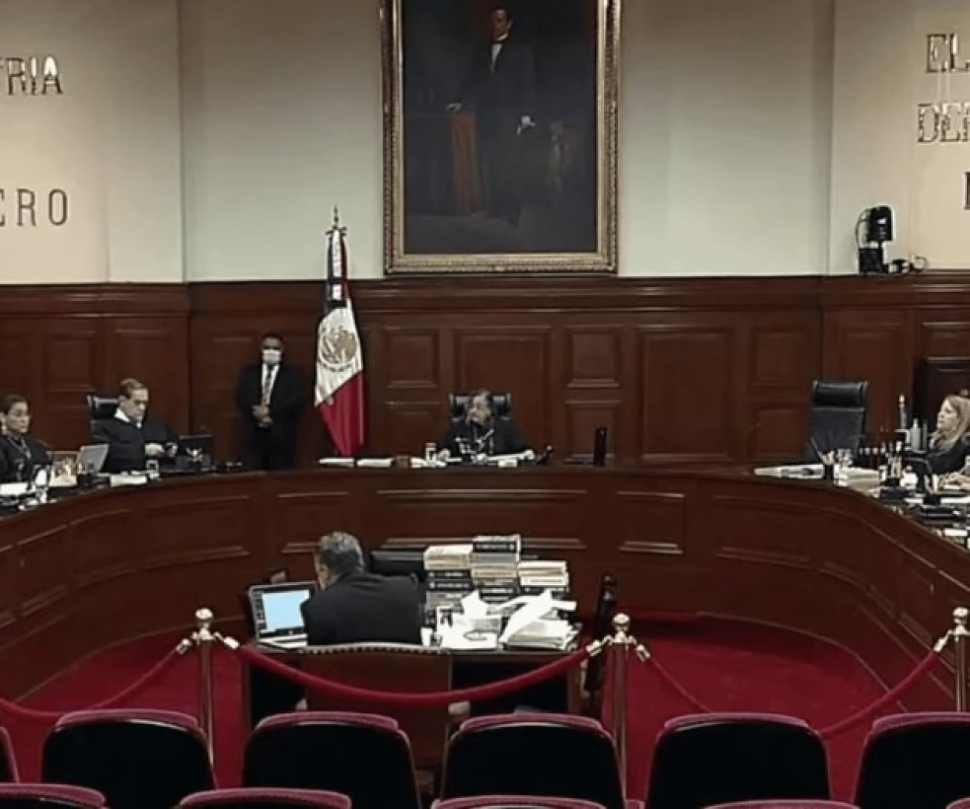
In a historic decision, the Plenary of the Supreme Court of Justice of the Nation (SCJN) validated this Monday the application of increased penalties for any crime committed through artificial intelligence. The resolution, approved by five votes to four, confirms a reform to the Penal Code of Quintana Roo that establishes the use of AI as a generic aggravating factor in judicial processes.

Technical details of the reform

Article 20 Bis of the Quintana Roo code stipulates that, when AI systems are used to facilitate the commission of a crime, sentences may be increased by up to an additional 50%. The standard defines AI as “the ability of technological systems to emulate human abilities such as learning, reasoning or autonomous data processing”. This conceptualization was key in the debate, since the Federal Executive had challenged the reform because it considered the terminology vague.

RelatedLegal reform protects digital identity against artificial intelligence

Minister Margarita Ríos Farjat defended the precision of the definition: “If we wait for global consensus, we will leave the victims of technological abuse unprotected.”. In contrast, Minister Alberto Pérez Dayán argued that including the term “artificial intelligence” generated legal ambiguity, proposing to focus on criminal conduct rather than on the tool used.

Legal implications and precedents

This ruling expands previous jurisprudence on AI, such as the case of Sinaloa regarding algorithmically generated sexual content. However, the Quintana Roo reform is pioneering in establishing a cross-cutting mechanism: it applies to any crime, from fraud to identity theft, as long as it involves autonomous systems. State courts must analyze case by case whether the aggravating circumstance is configured.

President Norma Piña clarified that, since the eight votes required to invalidate were not reached, the ruling only dismisses the action of the Executive without ruling on the merits. However, it sets a precedent for future legislation on digital criminal law.

Why is it relevant? This decision reflects the regulatory challenges faced with disruptive technologies. By recognizing the criminogenic potential of AI, the Court balances innovation and citizen protection, although it raises questions about how to oversee constantly evolving tools.

Share this analysis on your social networks and continue exploring our specialized content on technology legislation.

Classes suspended in CDMX due to Mexico’s match in the 2026 World Cup

CDMX Government suspends classes and recommends home office for Mexico vs Czechia match.

Suspension of classes and teleworking due to the party

On Wednesday, June 24, the match between the Mexican National Team and the Czech Republic in the 2026 World Cup not only generates expectation among fans, but also doubts about school and work activities. The Government of Mexico has already responded: there will be suspension of classes in the capital.

The measure applies to all educational levels—preschool, primary, secondary, high school and higher education—in both public and private schools, including morning and afternoon shifts. Although the SEP calendar did not contemplate this day as a rest, a special decree published in the DOF made the suspension official.

What happens to work centers?

Government agencies must implement teleworking, remote work or flexible modalities to reduce the physical presence of staff. The private sector was also urged to adopt the home office, with the aim of reducing vehicular traffic and avoiding complications due to the logistics of the game.

However, there are strategic sectors that will continue to operate in person. Among them: health services, hospitals, emergencies, civil protection, national and public security, immigration control and customs operations. All workers in these essential areas will not be able to benefit from the remote scheme.

The recommendation seeks to minimize impacts on the roads near the Mexico City Stadium and on the main routes of the city. The authorities are confident that the combination of school suspension and work flexibility will reduce the impact on mobility.

Continue reading

Sheinbaum speaks out against nepotism in politics

The president rejected family members inheriting positions and asked not to use gender as a pretext.

Sheinbaum reiterates his stance against nepotism

President Claudia Sheinbaum once again spoke out against direct family members inheriting elected positions. She did so during her morning conference on Tuesday, when questioned about cases such as that of San Luis Potosí, where Senator Ruth González—wife of Governor Ricardo Gallardo—is seeking the governorship.

“People don’t like it when the family member stays, but it depends on each political party,” he responded.

Sheinbaum recalled that he promoted a constitutional reform to prohibit nepotism up to the fourth level of kinship. The measure was established, but will come into force until 2030.

“Evidently I made that proposal, because I do not agree that in 2027 there will be a family member, however it was no longer in the Constitution for 2027. The Morena party assumed that from 2027,” he emphasized.

The president also warned about the use of gender as a justification for appointing candidates. Although he supported gender equality in the applications, he asked not to abuse that criterion to guide candidates.

“I do not agree that the change in the case of gender is used to justify whether one person or another person goes,” he added.

Sheinbaum pointed out that the INE must regulate the issue of gender equality, but considered that legislation is needed to avoid distortions. His position comes in the middle of the electoral process that will start in 2027, where several states will renew governorships and local congresses.

Continue reading

Confrontation in Villa Juárez leaves minor injured

A minor was injured during a police operation in Villa Juárez, Navolato.

Confrontation in Villa Juárez leaves two injured

Culiacán, Sin. — Elements of the State Preventive Police carried out an operation to recover stolen vehicles in the Villa Juárez administration, Navolato. When they located a unit and proceeded to secure it, they were attacked with gunfire. The officers repelled the attack; In the exchange, one of the alleged attackers was injured, while his companions fled.

A minor who was nearby suffered incidental injuries. Her relatives took her to a local hospital. The State Attorney General’s Office was informed and opened an investigation file.

The identity of the minor is kept confidential by legal provision. So far no arrests have been reported.

Continue reading