The biometric CURP redefines the official identity in Mexico

A monumental shift in citizen identity redefines access to rights and services, sealing an unprecedented pact of inclusion.

An Epic Turn in the History of Mexican Identity

In a movement that will resonate through the annals of history, Rosa Icela Rodríguez, the powerful head of the Ministry of the Interior, rose as the herald of an identity revolution. It was not just another procedure, no! It was the dawn of a new era for millions of souls, the moment when the State extended its arm to finally recognize each of its children. The Unique Population Registration Key, the sacred CURP biometric, left behind its role as a mere code to become something much more profound: the master key of citizenship.

With the passion of someone who reveals an ancestral secret, Rodríguez proclaimed that this implementation would be voluntary, gradual, orderly and coordinated. Each word fell like a hammer, forging the future. But make no mistake, this was not a dry matter of desks and forms. It was a question of pure and simple social justice! It was the epic final battle against invisibility, a crusade to open paths where before only abysses of oblivion existed.

RelatedThe CURP Biometrics redefines the official identity in Mexico

The Battle Cry for Universal Recognition

Imagine for a moment the drama of thousands: ancestral indigenous peoples, isolated rural communities, mobile people with truncated histories, women, older adults and people with disabilities fighting every day for a piece of recognition. For them, this is not a document. It’s a shield! It is the materialization of a collective dream where, for the first time, they will have the same recognition and opportunities as anyone else. The Mexican State, in an act of redemption, bows to say: “I see you, you exist, and you count!”.

In the commemoration of the 45 years of the National Population Registry (Renapo), the atmosphere was charged with an electricity of unstoppable change. The head of Segob, with the conviction of a prophetess, assured that the use of this credential will be the unbreakable bulwark that will reinforce identity security. Goodbye to the shadows of duplicity! Goodbye, ghosts of fraud! Each biometric data, each line of code, becomes a relentless guardian that ensures that no one, absolutely no one, will remain unrecognized by the nation. It is the end of an era of anonymity and the beginning of one of certainty.

And then came the earth-shattering statement: “This is a historic breakthrough!” For the first time, Mexico, in all its vast and complex glory, will have an official identification that is a beacon of reliability, a monument to inclusion and a bridge to accessibility. Especially for girls, boys and adolescents, who will inherit a country where their identity is not a question, but a right irrevocably recorded. The destiny of a nation is redefined in a single, glorious, dramatic movement.

Are you ready to be part of this historic transformation? Share this news and help spread the word about this new chapter for Mexico
Sheinbaum starts delivering homes in Michoacán; goal 1.8 million

32 homes delivered in Morelia; federal plan adds 1.8 million housing solutions.

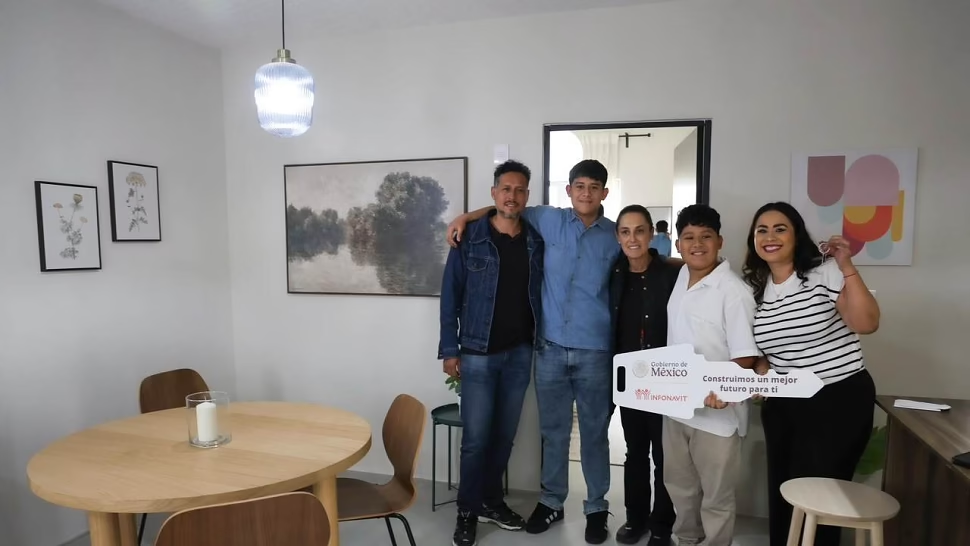
President Claudia Sheinbaum closed her tour of Michoacán with the delivery of 32 homes in Morelia. They are the first of the Housing for Wellbeing program, which plans to build 1.8 million housing solutions during the six-year term.

At the event, Sheinbaum highlighted that the concept of well-being is reflected in indicators such as the 154% increase in the minimum wage and the provision of 12 thousand new hospital beds. He stated that the program makes it easier to acquire one’s own home with payments adjusted to income, eliminating excessive requirements of the past.

The Secretary of Agrarian Development, Edna Elena Vega, explained that 82 thousand housing actions are planned for Michoacán: 50 thousand from Infonavit, 20 thousand from Conavi and 12 thousand from Fovissste. In addition, 307 property deeds managed by INSUS were delivered.

Octavio Romero, director of Infonavit, specified that the entity’s goal rose from 19 thousand to 50 thousand homes, with an investment of 31 billion pesos. The 32 homes delivered are part of the “Infonavit Camponubes” development, which includes 1,248 properties. He also reported that in Michoacán 97,220 loans considered unpayable were restructured, within a universe of 4.8 million regularized financings nationwide.

Continue reading

The ‘kiss of three’ in the World Cup: risks that you ignore

Specialists warn about infections due to the challenge of kissing strangers in fan zones.

The hidden side of the ‘kiss of three’

During the World Cup, the viral “kiss of three” challenge has proliferated in squares, bars and fan zones: three people kiss at the same time to celebrate a play. What seems harmless can have health consequences.

Specialists warn that exchanging saliva with strangers increases exposure to viruses and bacteria. The most common is infectious mononucleosis, caused by the Epstein-Barr virus. According to the Mayo Clinic, this pathogen is transmitted by kissing or sharing glasses, bottles or cutlery. A person can shed the virus in their saliva even months after recovering, unknowingly spreading it.

The CDC estimates that more than 90% of adults worldwide have been infected with Epstein-Barr at some point. Many never show symptoms, but they are contagious. In mass events, the concentration of people, physical contact and shared glasses increase the risk.

In addition to mononucleosis, saliva can spread cold sores, influenza, Covid-19, and common colds. Kissing is not the main way of transmitting sexually transmitted infections (STIs), but if there are active sores or lesions in the mouth, there is a possibility of transmitting syphilis, gonorrhea, chlamydia or HPV, although it is less common.

Recommendations and other danger

Health authorities recommend avoiding kissing if there is fever or blisters on the lips, not sharing drinks or food, and going to the doctor if persistent discomfort appears.

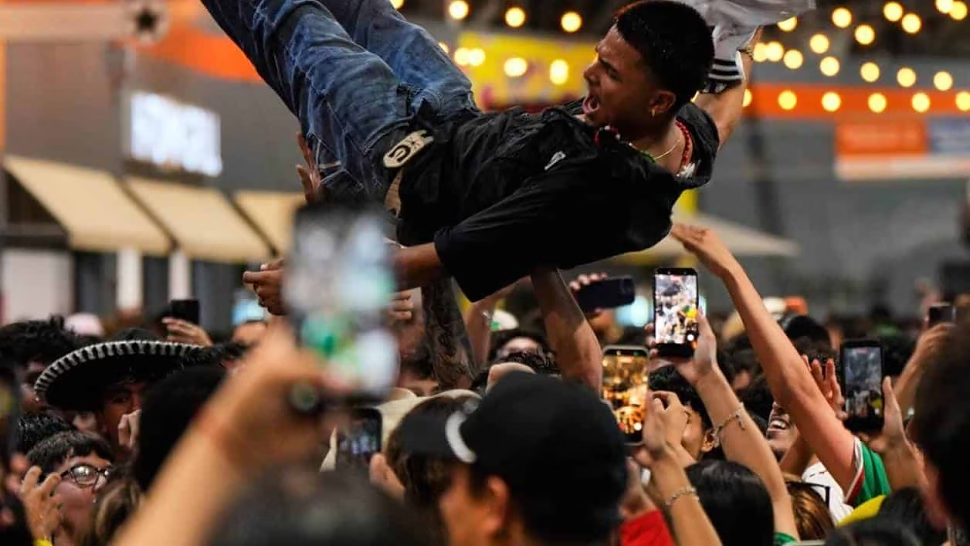
The euphoria of triumphs also includes the game “He wants to fly, he wants to fly!”, throwing a person into the air. The CDMX Health Secretariat warns that it can cause fractures, spinal injuries and even put life at risk. A poorly coordinated fall causes concussion, cervical sprains or spinal damage. Those who carry also suffer dislocations or tears.

In the event of an accident, call 911, ask for security support at the Fan Fest or use the My Police application to report the emergency.

Continue reading

SEP announces summer holidays 2026

The school year ends on July 15; tentative return on August 31.

Official cycle closing dates

The 2025-2026 school year ends on Wednesday July 15, according to the calendar of the Ministry of Public Education. Starting Thursday, July 16, preschool, primary, and secondary school students begin summer recess.

The teaching staff will participate in an intensive continuing training workshop on July 16 and 17, so the campuses will remain closed to students from the 16th.

Ballet delivery will be on Tuesday, July 14, so that parents and guardians know the results of the cycle.

Back to school 2026-2027

The SEP has not yet published the official calendar for the next cycle. However, a tentative date is Monday, August 31. The agency recommends keeping an eye on the Official Gazette of the Federation for confirmation.

Recommendations for a healthy summer

Specialists suggest maintaining habits that promote the well-being of girls, boys and adolescents during rest:

  • Regular sleep schedules.
  • Recreational, sports or cultural activities.
  • Reading and learning through games.
  • Limit excessive use of electronic devices.
  • Family and outdoor time, with safety measures.

The vacation period covers approximately six weeks and is used by many families to travel or live together before the new school year, which includes 185 effective days of classes.

Continue reading