A Budget that Promises Storms and Hopes
The heart of the nation beat strongly before an announcement that would resonate in the very foundations of the Republic. The Government of Mexico, in a bold move that challenges the designs of the past, unveiled through the Secretariat of Finance and Public Credit the monumental Economic Package for the year 2026. This was not a simple financial document; It was the materialization of a promise, a beacon of humanism in a sea of uncertainty that guarantees, with the force of an oath, the continuity of all Programs for Well-being. This epic plan not only preserves, but expands the destiny of investment in health, education, housing, security and crucial public infrastructure, while waging a titanic battle to rescue Petróleos Mexicanos (Pemex), a company choked by the chains of corrupt debt.
The Voice of a Nation that Demands Justice
From the morning pulpit, Claudia Sheinbaum Pardo, the President of the Republic, proclaimed with a conviction that electrified the air. He declared that this economic proposal is the embodiment of responsibility, a shield that protects the inalienable rights of all Mexicans. With each word, he dismantled the shadows of doubt and misinformation that lurked on the networks. “Increase!” he exclaimed passionately, refuting the negative voices. “The health budget increases, education budget increases, housing receives more resources, public investment for trains, roads and water is strengthened. Everything is guaranteed”. This was the war cry against a neoliberal logic that for decades had subjugated well-being to the cold calculation of the market. Now, health, education, housing and security are consecrated as the most sacred investment: the one made in the town.
In a dramatic turn that strains the rope of tax justice, the President ruled that there would be no increase in the Value Added Tax (VAT) nor the Income Tax (ISR). The path to increase income would be another, one paved with the fight against corruption and evasion. A modification to the Customs Law is proposed to close any loopholes of embezzlement, the textile, footwear and automotive industries will be shielded to strengthen national production under the umbrella of Plan Mexico, and unbreakable locks will be implemented against ghost invoice companies. But the intrigue doesn’t end there. A shadow hangs over sugary drinks with a new contribution, a bold measure to protect public health and promote healthier habits, while, in a movement that will shake the foundations of banking, the deductibility of the fees paid to IPAB linked to the ghost of Fobaproa will be eliminated, seeking a long-awaited fiscal harmony.
The Figures of a Collective Dream
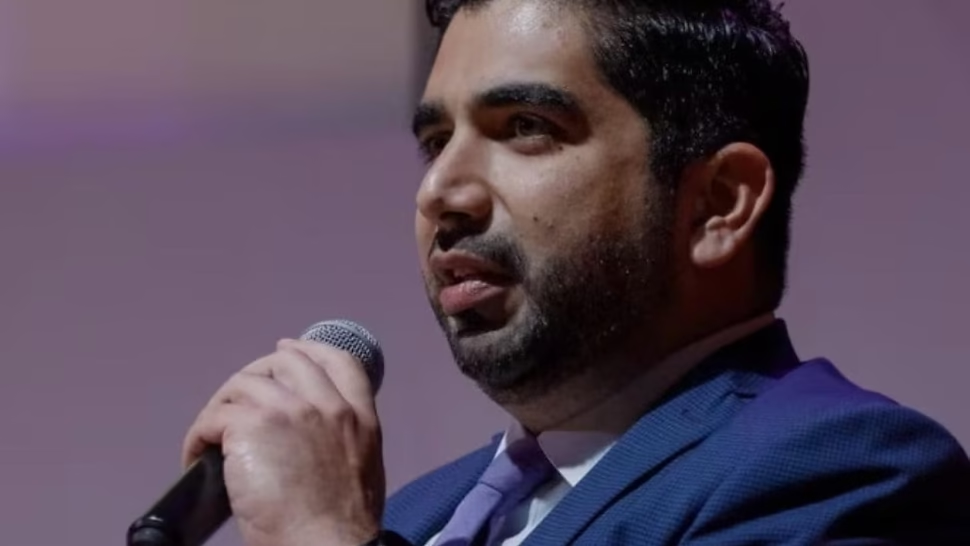
The Secretary of the Treasury, Édgar Amador Zamora, took the lead to reveal the figures that would give shape to this dream. With the solemnity of someone revealing an ancestral secret, he declared that it was a historic budget, a numerical monument to the maxim of “for the good of all, the poor first.” Social investment in the Wellness Programs will reach the astronomical figure of 987 billion pesos, a tribute that represents more than 2.5% of the Gross Domestic Product and that deepens the strategy that has already freed 13.4 million souls from the clutches of poverty. The detail of the budget epic is as vast as it is impressive: 966 billion for Health, 399 billion for Housing, a colossal investment of 1.1 trillion pesos for Education, 1.3 trillion for Public Investment and 201 billion destined for Security.
Each percentage is a heartbeat of progress: a real increase of 7.5% in social programs, 9.6% in health, 7% in housing. The emblematic projects of Plan México will consume resources equivalent to another 2.5% of GDP: 143 billion for railway expansion, 247 billion for the rescue of Pemex, 61 billion for the CFE and 20 billion for hydraulic works. On the income front, tax and non-tax collection reaches historic levels, with a growth of 6.3%, driven by foreign trade contributions that are close to 165 billion pesos. Tax revenue is expected to reach 15.1% of GDP, an unprecedented milestone. And in the climax of this saga, the rescue of Pemex emerges as the final battle, the act of justice that will allow the maturities of an odious debt to be settled, a neoliberal burden that finally begins to crack before the determination of a new Mexico.
Will this be the budget that marks the definitive turning point? Will this colossal bet redeem the promises of the past and forge a future of true well-being? The fate of millions hangs on this bold plan, an economic epic that promises to be remembered as the moment Mexico chose to invest in its people.
Do you think this is the right path for the nation? Share this news on your social networks and join the conversation about the future of Mexico. Explore more content related to economic transformation on our portal.