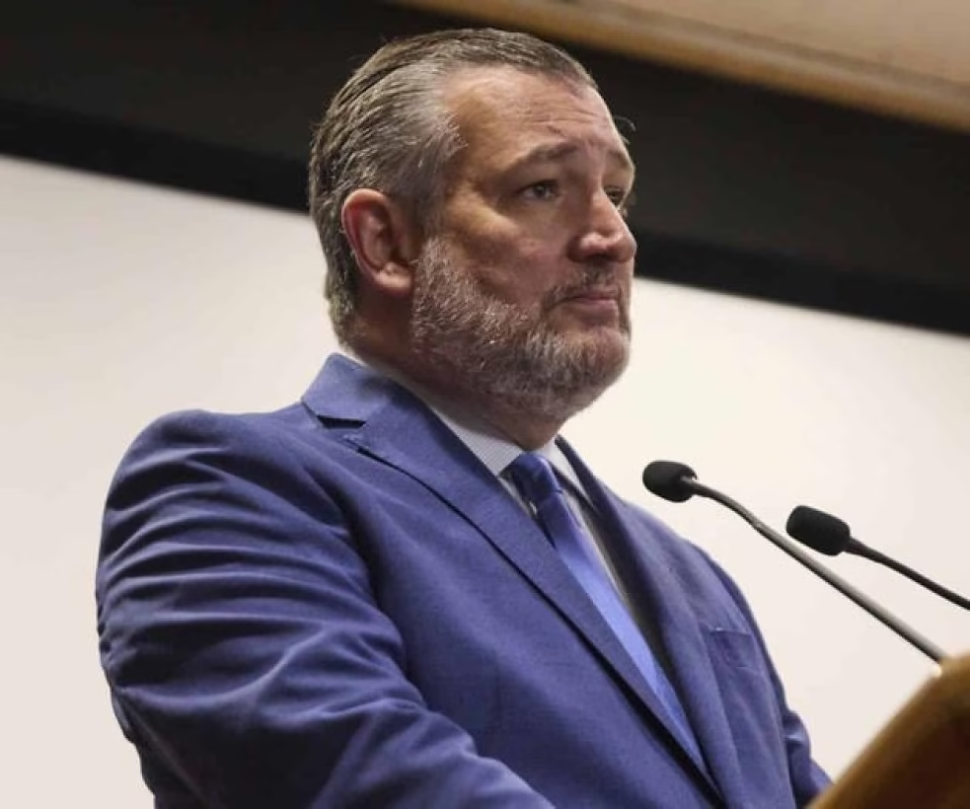
Ted Cruz suggests that Mexico adopt the Bukele model against drug trafficking

The Texas senator suggests a controversial security model, unleashing a new chapter of diplomatic tensions between neighbors.

The neighbor to the north who always knows what is best for you

In a twist that no one saw coming—no one, except perhaps everyone who has read a headline in the last decade—US Senator Ted Cruz has decided to share his geopolitical expertise with Mexico. On Friday, the Republican legislator from Texas, after what we can only imagine was an exhaustive whirlwind tour of Central America, declared that Mexico should take notes from El Salvador’s play sheet in its fight against drug trafficking. Because, of course, what could go wrong when importing a security model from a country with a completely different social, economic and political reality? It’s almost like suggesting that Texas adopt Norway’s snow policies.

The senator, making a technical stopover in Mexico City after his tour, seemed to launch one of those offers that one cannot refuse, in true cinematographic style. He suggested, with the subtlety of an elephant in a china shop, that if the Mexican government insists on rejecting joint cooperation, Washington could be… oh, what a tragedy!… forced to take matters into its own hands. Because nothing says “respect for sovereignty” like a veiled threat of unilateral intervention.

RelatedTed Cruz urges Mexico to adopt the Salvadoran model against cartels

The mysterious offer and sensitive sovereignty

The most fun thing about this whole show was the mystery. Cruz repeatedly mentioned a magnanimous offer of help from the United States. However, when journalists, in a fit of audacity, asked him to provide concrete details about this proposal, the senator opted for the perfect avoidance strategy: ignoring the question. What does the offer contain? Drones? Advisors? A discount coupon for the purchase of military equipment? The world may never know, but we’re sure the terms are great… for someone.

This is not, of course, the first time that an American politician has dreamed aloud of deploying his military power on Mexican soil. Former President Donald Trump had already flirted with the idea, a suggestion that was received in Mexico with the same enthusiasm as a dentist. President Claudia Sheinbaum was categorical in rejecting the idea, making it clear that, although there is bilateral collaboration, the line between cooperating and invading is more than drawn. “The United States is not going to come to Mexico with the military,” he declared, in what could be loosely translated as: “Thanks, but no thanks.”

And here’s the ultimate irony: As Cruz was giving his press conference, there was evidence that cooperation is, in fact, already happening. The same Mexican government had requested weeks ago the support of a US drone for an investigation against organized crime. It seems that reality is much more nuanced and less dramatic than the grandiose narratives of political speeches.

The Bukele mirage and the final message

The crown jewel in Cruz’s speech was the suggestion that Mexico should emulate the “success” of Nayib Bukele in El Salvador. Because who wouldn’t want to imitate a leader who has suspended constitutional guarantees and imprisoned more than 1% of his population? A method that, while it has reduced crime rates in the short term, has done so at such a high cost in human rights and democratic health that even the most neutral observers raise an eyebrow. But of course, for the American right, Bukele is a rockstar. He is the fashionable authoritarian hero, a model of “iron fist” who ignores small details such as the rule of law.

Mexico, for its part, has intensified its own actions against the cartels, extraditing dozens of criminal leaders to the United States and collaborating to drastically reduce irregular migration, an achievement that undoubtedly benefits the US administration. However, violence persists, a complex and structural problem that cannot be solved with simplistic imported solutions or with bravado from the other side of the border.

In the end, Cruz’s message to “accept our offer as a friend” sounds as genuine as those emails from a Nigerian prince who needs help transferring a fortune. The relationship between these two nations is intricate, a constant dance of shared interests, sovereign tensions, and an uneasy but inevitable neighborliness. National sovereignty is a non-negotiable concept, and the history lessons on foreign interventions are there for anyone who wants to read them.

Do you agree with this scathing analysis of international politics? Share this article on your social networks and tell us what you think about the complex relationships between nations. Explore more content related to politics and security in our analysis section.
INEHRM becomes a research and teaching center

The INEHRM is transformed into a research and teaching center under the new secretariat.

Transformation of the INEHRM

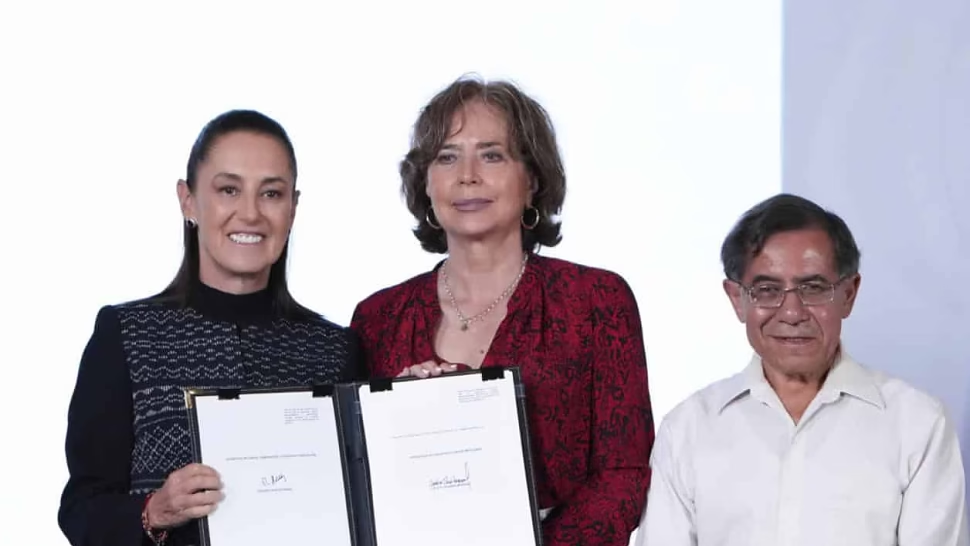
President Claudia Sheinbaum signed the decree that transfers the National Institute of Historical Studies of the Revolutions of Mexico (INEHRM) to the Secretariat of Science, Humanities, Technology and Innovation (SECIHTI). The institute becomes a decentralized public body with an academic focus.

Rosaura Ruiz Gutiérrez, head of SECIHTI, explained that the new scheme will train specialists in history to strengthen national capacities in social sciences and humanities.

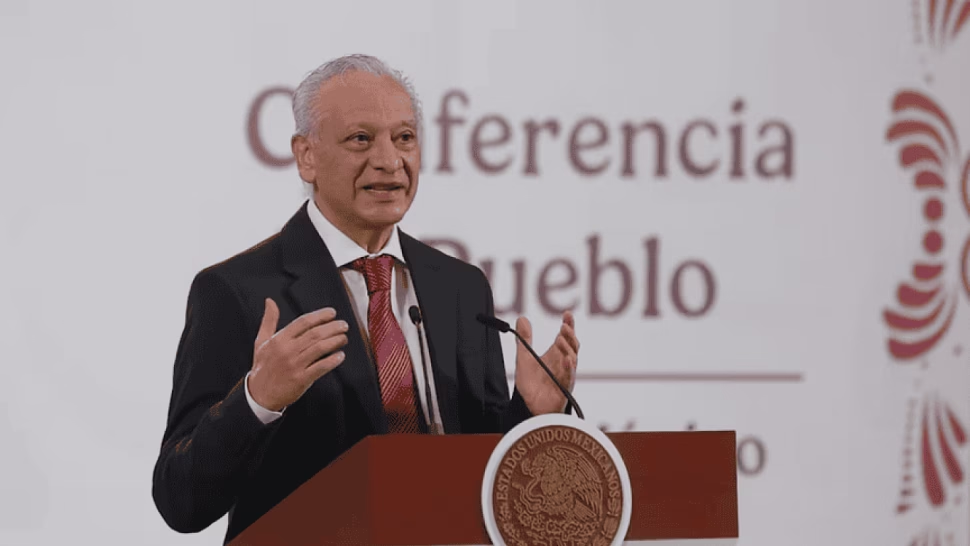
Felipe Arturo Ávila Espinosa, director of the INEHRM, explained that the study plans will link historical knowledge with social, economic, political and cultural problems of the country, and will address the needs of the Federal Public Administration.

Hybrid educational offer

The offer will include bachelor’s degrees in History, Social Sciences and Humanities, and Public Administration and Good Government. In postgraduate studies, master’s degrees will be added in Mexican Humanism, Gender and Feminism Studies, and Social Movements and Rescue of Historical Memory. There will also be specialties in Political Communication and History Teaching.

Graduates will cover topics such as agrarianism, health, migration, artificial intelligence, violence and human rights.

Headquarters and call

The new headquarters will be at 80 Guatemala Street, Historic Center of Mexico City. The first admission call will be launched in July, and classes will begin in September.

Continue reading

Prosecutor’s Office grants protection measures to victim of family violence

The Morelos Prosecutor's Office issued protection measures after a complaint of family violence against the former director of Pemex.

The Morelos Attorney General’s Office activated protection measures in favor of Felicia Jiménez Lavie, who filed a complaint for family violence against her husband, Víctor Rodríguez Padilla, former director of Pemex. This was reported by prosecutor Fernando Blumenkron Escobar.

The measures, the official explained, will be available when the victim requires them. The complaint was filed in Mexico City and the Women’s Secretariat of the Government of Mexico directly follows up on the case.

Investigation in progress

Until now, Jiménez Lavie has not gone to the local Public Ministry to contribute more elements to the investigation folder. This was initiated ex officio last Friday, June 26, after a video was broadcast with images of attacks against the woman.

Blumenkron assured that the portfolio continues its integration. “The proceedings have not stopped and we are going to continue to guarantee justice for the victim,” he said. In addition, he indicated that there is coordination with the Women’s Secretariat and the capital’s Prosecutor’s Office, under the care route for victims of family violence.

Among the actions carried out, the Morelos Prosecutor’s Office seeks to locate the address where the physical assault occurred, to carry out expert reports in accordance with the images of the video broadcast by the victim herself.

Continue reading

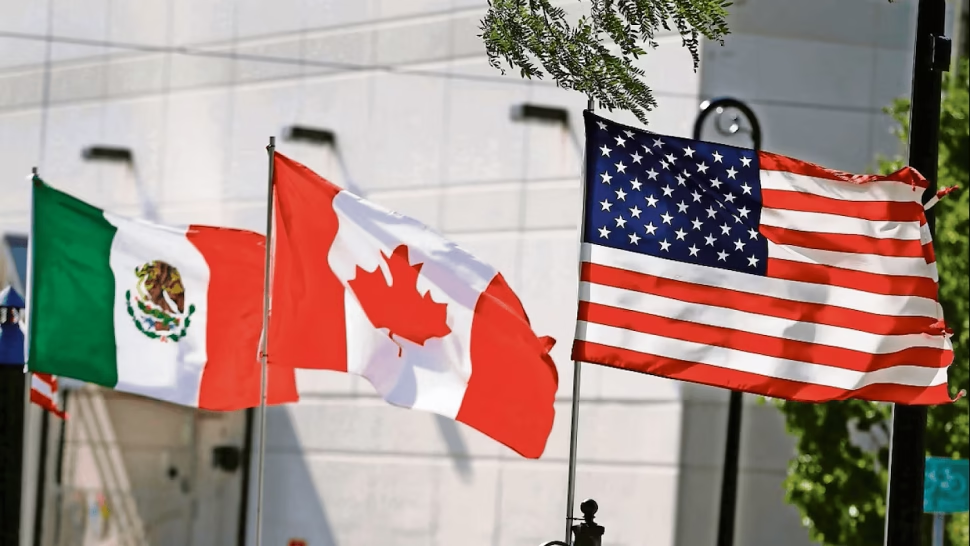
Trump does not extend T-MEC: Mexico faces annual review

US rejects automatic extension of the T-MEC; validity is reduced to 10 years with annual review.

Rejection of automatic extension

The United States decided not to automatically renew the Treaty between Mexico, the United States and Canada (T-MEC) for 16 years. This reduces its validity to a decade with an annual review. The measure generated concern among Mexican legislators.

Ricardo Monreal, coordinator of Morena in San Lázaro, explained that the treaty remains in force for another 10 years, but subject to evaluation each year. He noted that the United States presented 54 observations, including issues such as the vaquita porpoise and piracy. Mexico, for its part, raised 13 points, including clause 232 on tariffs.

“Only it will be reviewed year after year, but the Treaty is not finished, it continues for another 10 years because that is how it was signed six years ago,” declared Monreal.

The legislator warned that Donald Trump has been a constant critic of the USMCA and called for considering the benefits it has brought to the three nations.

Reactions of the opposition

Héctor Saúl Téllez, vice economic coordinator of the PAN, considered that the US position shows a lack of strategic anticipation on the part of the federal government.

“The US decision not to automatically extend the USMCA for 16 years in today’s review is not the end of the treaty, but it does reveal a lack of strategic anticipation by the federal government,” he stated.

Téllez recalled that Article 34.7 of the agreement had been known since 2018. Reaching July 1 without a clean extension represents a risk that, he said, should have been avoided.

The annual review will allow adjustments, but uncertainty about the future of regional trade persists. Mexico and Canada will seek to maintain the stability of the agreement for the next ten years.

Continue reading