Maduro calls Bukele’s proposal to exchange prisoners illegitimate

Maduro rejects the controversial exchange proposed by Bukele in a duel of statements that escalated online.

The diplomatic pulse that no one asked for but everyone comments on

Nicolás Maduro, the Venezuelan president who never misses an opportunity for a television drama, came out this Monday with a “no, thank you” well loaded with irony towards Nayib Bukele. The reason? The Salvadoran leader—yes, the one of the megaprison and the anti-gang controversies—suggested exchanging 252 Venezuelans deported by the US (and locked up in their country) for political prisoners from Venezuela. Maduro, in his role as “defender of human rights” (yes, read sarcastically), demanded the immediate release of his compatriots and blurted out: “Bukele is a serial violator of freedom.” Ah, the hypocrisy.

Twitter, the ring of modern diplomacy

It all started when Bukele, in a tweet worthy of a Netflix script, proposed to Maduro to free activists, journalists and relatives of opponents imprisoned in Venezuela. Between the lines: “I’ll give you these if you give me those.” Maduro, obviously, called it “illegitimate and abusive”, because according to him, Venezuelans are “kidnapped” in El Salvador. Of course, not a word about the political prisoners in his country. Priorities, right?

RelatedThe United States carries out a military operation and captures Maduro in Venezuela

The best: Bukele mentioned that the package also included detainees from 23 other nationalities, as if it were an exchange of Pokémon but with human beings. “The only reason they are there is to oppose you,” he snapped. Maduro, meanwhile, continues without publishing the minutes of the last elections… but that is another topic.

The context? El Salvador is in the crosshairs for receiving deportees from the US—accused without evidence of being gang members—and Maduro continues in his saga of “questioned reelections”. Meanwhile, the relatives of the deportees are clamoring for information. Who wins in this game? Nobody. Who loses? Everyone.

Are you left wanting more geopolitical chaos? Share this and continue exploring how leaders turn Twitter into their favorite battlefield. #21stCenturyDiplomacy

7.1 magnitude earthquake shakes Venezuela and raises alerts

7.1 tremor shakes Venezuela; tsunami warning in Puerto Rico.

7.1 tremor in Venezuela activates tsunami alert

A 7.1 magnitude earthquake was recorded this Wednesday in Venezuela, according to the United States National Oceanic and Atmospheric Administration (NOAA). The earthquake occurred at 22:04 GMT with the epicenter located 21 kilometers east of Morón, in the state of Carabobo.

The depth of the earthquake was 9.6 kilometers, which increased its perception on the surface. NOAA issued a tsunami warning for Puerto Rico and the Virgin Islands, although so far no major damage has been reported in those areas.

Aftershocks and affected areas

The tremor unleashed scenes of alarm in Caracas, where residents took to the streets after feeling the movement. It was also noticed in several cities in Colombia, such as Bogotá, Barranquilla and Bucaramanga, although without serious consequences.

Local authorities evaluate possible effects. Venezuela is located in an area of ​​moderate seismic activity, and events of this magnitude are rare. No casualties or significant structural damage have been reported as of press time.

Continue reading

Evacuation of ships in Hormuz: 11 thousand sailors leave under UN plan

The UN coordinates the staggered departure of cargo ships stranded in the Strait of Hormuz.

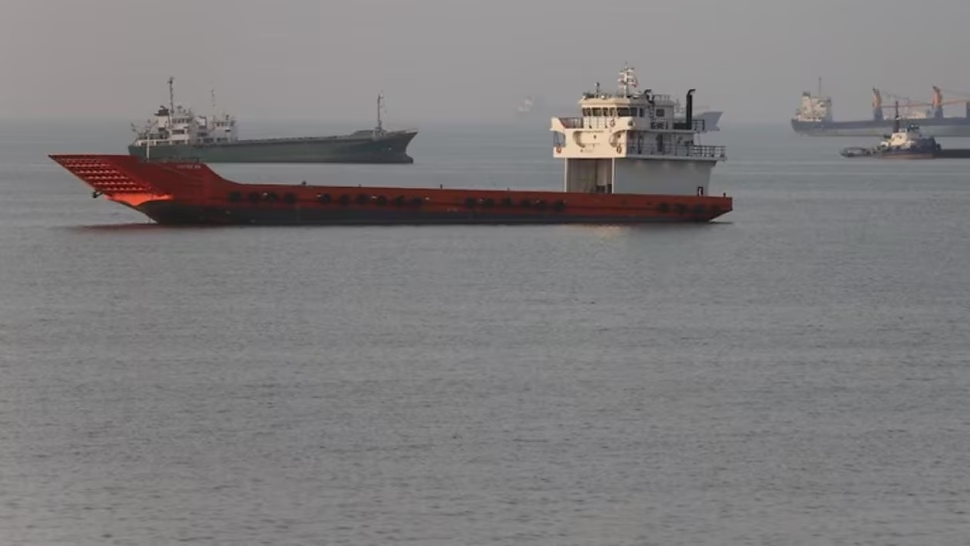
The Strait of Hormuz begins to free its first stranded ships. Since this Wednesday, several cargo ships have left the area under a security scheme designed by the International Maritime Organization (IMO), an arm of the UN.

The measure seeks to evacuate thousands of civilian crew members who were trapped for months by hostilities between the United States, Israel and Iran. After a memorandum of understanding between Washington and Tehran, the flow of oil and LNG tankers picked up.

Priority for bulk carriers and general cargo

The UN humanitarian plan gives priority to bulk and general cargo ships that entered before the closure of the passage in March. According to Reuters data, the first vessels are already sailing in the Arabian Sea, while another thirty are waiting their turn.

The IMO roadmap plans to free about 11,000 sailors, out of a total census that exceeded 20,000 stranded people. To avoid risks from maritime mines in the strait—barely 30 kilometers wide—conventional traffic was suspended. The ships advance in a staggered manner through corridors coordinated by Iran and Oman.

Security protocol and energy markets

Captains must keep their automatic identification systems (AIS) on and not maneuver without instructions from centers such as the British UKMTO or the French MICA.

In parallel, energy markets are stabilizing. The International Energy Agency reports that the region already exports 85% of its usual crude oil, with a barrel of Brent at $73, close to pre-crisis levels.

Continue reading

Kenya suspends construction of Ebola quarantine center

The project intended for Americans generates judicial controversy and local protests that have left people dead.

Suspension ordered by the Government

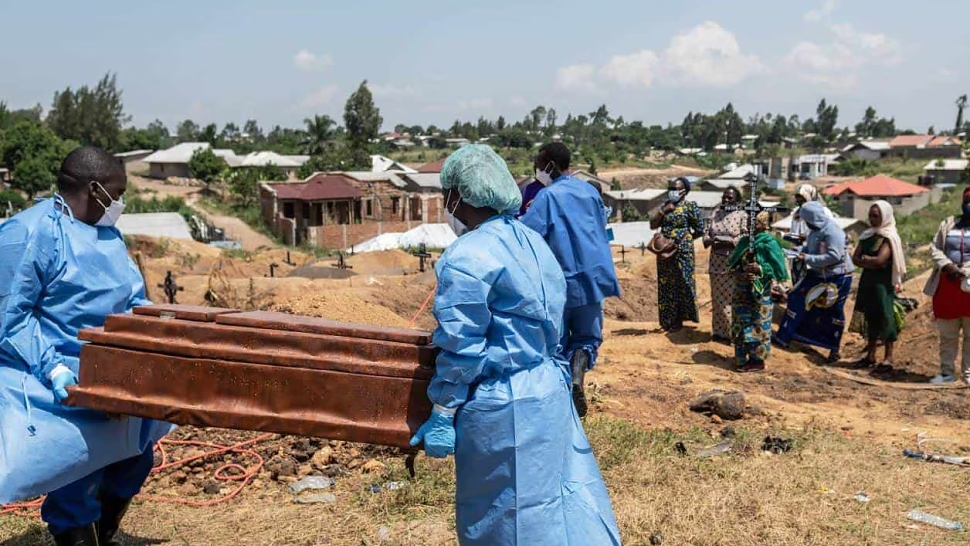
The Kenyan Ministry of Health ordered to stop the construction of an Ebola quarantine center for US citizens. Minister Aden Duale’s decision came a day after a court found him in contempt for allowing the project to continue, despite a previous court order requiring its stoppage.

The court had requested to stop the works while a lawsuit filed by civil and constitutional rights organizations is resolved.

Reactions and local context

The center was designed to receive Americans exposed to Ebola abroad, avoiding their direct repatriation to the United States. Protests in the local community have been intense and have left people dead in recent weeks, although official figures are not available.

The case reflects the tensions between the decisions of the Executive and the judiciary in Kenya, as well as citizen unrest regarding projects that they consider imposed from abroad.

Continue reading