T-MEC remains in place until 2036 with annual reviews, Ebrard announces

The trade agreement will remain in force until 2036 with annual evaluations.

T-MEC: validity and annual reviews

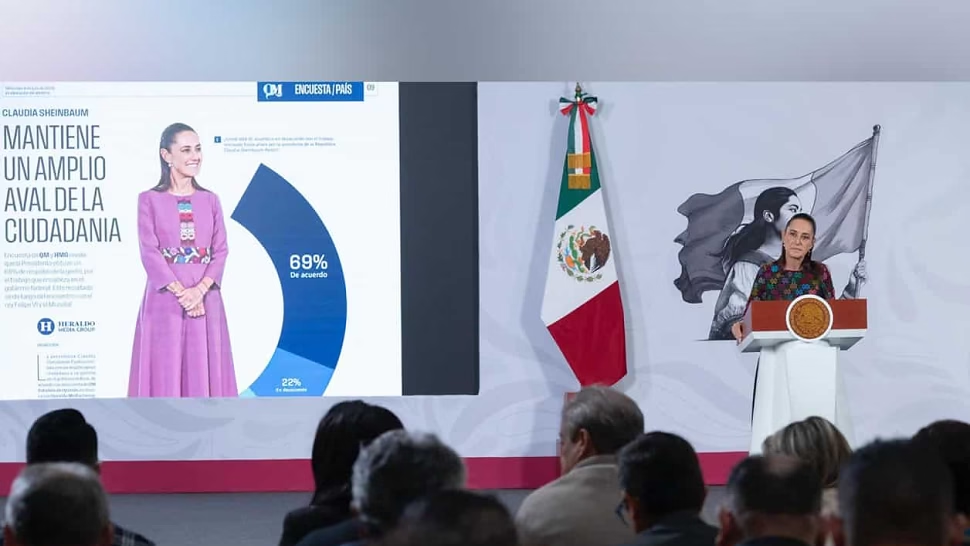
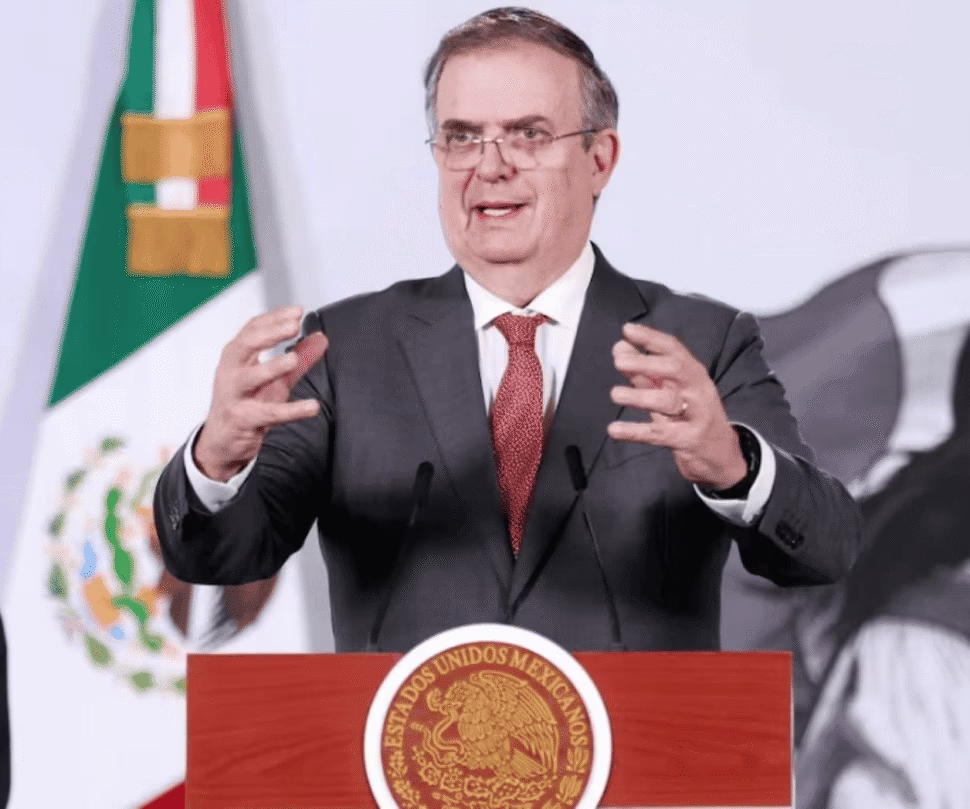
The Secretary of Economy, Marcelo Ebrard, confirmed that the Treaty between Mexico, the United States and Canada (T-MEC) will remain in force until 2036. This was agreed upon by the three countries during a virtual meeting on July 1, as reported in the morning conference of President Claudia Sheinbaum.

Ebrard explained that annual reviews of the agreement will be carried out. The first formal stage will begin on July 20, when a delegation from the United States visits Mexico. The official stressed that the validity of the treaty is not under discussion, only the way to evaluate its operation.

RelatedEbrard anticipates high bilateral component in T-MEC review

The positions of each country

Mexico and Canada proposed extending the validity until 2042, with reviews every six years. However, the US government rejected that option. He preferred to maintain the current calendar accompanied by annual evaluations, due to his concern about the trade deficit with both nations.

“The treaty remains in force between now and 2036, as scheduled, and we will conduct an annual review,” said Ebrard.

Priority issues and Mexico’s position

During the meeting, Donald Trump’s administration expressed concern about the trade deficit. Therefore, it will seek to review specific issues of the agreement periodically. Ebrard pointed out that the Mexican government’s priority is to preserve current competitive advantages. He highlighted that more than 80% of Mexican exports to the United States do not pay tariffs.

“Mexico’s position with respect to the group of countries that trade with the United States is the best,” he stressed.

Among the issues to be addressed in the reviews are the tariffs imposed by Washington under provisions other than the T-MEC. In addition, regional production will be strengthened in strategic sectors such as the pharmaceutical industry and semiconductors. The objective is to reduce imports from other regions and contribute to reducing North America’s trade deficit.

Ebrard described the meeting as “very cordial” and trusted that the revisions will allow the agreement to be strengthened without modifying its essence or its validity until 2036.

This is how fiscal fuel smuggling operates in Mexico

FGR combats fuel smuggling networks that operate by sea and rail.

Fuel smuggling: the other side of huachicol

Unlike hydrocarbon theft through clandestine seizures, fiscal smuggling—known as fiscal huachicol—operates with front companies, importers, customs agents and financial schemes. The Attorney General’s Office (FGR) reported that it is strengthening investigations to combat this crime that evades taxes and damages the national economy.

Two main routes

In the maritime route, organizations use false documentation to unload fuel in ports without declaring it. Then they store it in clandestine sites and distribute it mixed with legal product to hide its origin. On the railway route, the Security Cabinet detected networks that declared volumes much lower than actual volumes or changed the tax burden, using Coahuila, Durango and Zacatecas as logistical nodes.

Recent blows

The Specialized Prosecutor’s Office for Organized Crime (FEMDO) reported key seizures. In Tampico, Tamaulipas, the Challenge Procyon ship was seized with 10 million liters of diesel, tractors and infrastructure; two people arrested. The economic impact: 372 million pesos. In Ensenada, Baja California, 8.8 million liters were seized from the TORM AGNES vessel in El Sauzal, with three detainees.

In the railway sector, the FGR secured 170 rail tankers with 18.9 million liters in San Luis Potosí, Nuevo Laredo, Tampico and Coahuila. The impact amounts to 238.8 million pesos.

Open investigations

The authorities maintain lines of investigation against more than 70 individuals and legal entities in nine entities. A large-scale scheme stands out at the Customs of Matamoros, Tamaulipas, where 15 million liters of hydrocarbons, 129 railway tankers and tractor-trailers were seized. Arrest warrants have been served and alleged members of the network, which includes logistics operators and public servants, have been prosecuted.

Continue reading

Prosecutor Godoy denounces possible FBI intervention in the capture of Zambada

Prosecutor Godoy reveals alleged FBI participation in the capture of Zambada.

Reactions of the FGR to the capture of Zambada

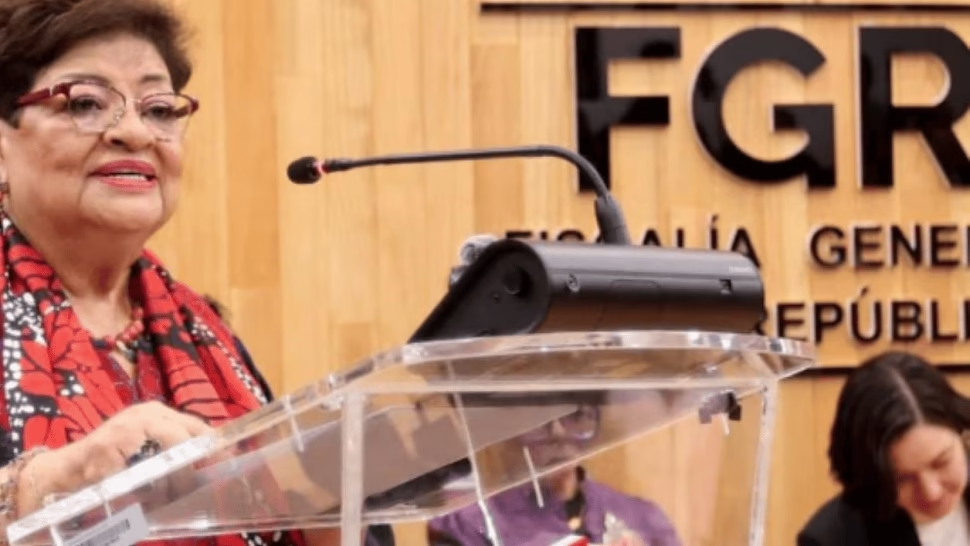
The Attorney General of the Republic, Ernestina Godoy Ramos, offered a conference to detail the capture of Ismael “El Mayo” Zambada. He pointed out that the transfer of Ovidio Guzmán López to prison triggered the operation.

Godoy warned that, if US authorities participated, we would be faced with three serious scenarios: violations of Mexican and international law, an agreement outside the law and a false statement by Ken Salazar, then US ambassador to Mexico.

Doubts about the official version

According to the prosecutor, Salazar assured that there was no FBI intervention, but rather an agreement between criminal groups to hand over Zambada and Joaquín Guzmán López. However, the FGR opened a new line of investigation to clarify the real role of the US agency.

Godoy described the situation as “a lie from a diplomat” if the FBI’s participation is confirmed. The agency has already requested data on the operation.

Continue reading

Mexico reports record employment and historic minimum wage

Minimum wage rose 122% since 2018 and formal employment reaches an unprecedented figure.

Mexican economy: achievements in employment and minimum wage

President Claudia Sheinbaum presented 12 indicators that reflect economic advances under the model of Mexican Humanism. He highlighted the responsible administration of spending, the recovery of the minimum wage and the impact of the Wellbeing Programs.

In labor matters, the minimum monthly wage went from 2,800 pesos in 2018 to more than 9,400 pesos in 2026, an increase of 122% endorsed by the OECD.

The director of the IMSS, Zoé Robledo, reported that at the end of June 2026, 22 million 779 thousand 704 formal jobs were registered, a historical record. The base contribution salary reached 669.1 pesos per day, also unprecedented. Mexico achieved the second lowest unemployment rate among OECD members, at 2.7%, only behind Japan.

In the financial field, the Secretary of the Treasury, Édgar Amador Zamora, pointed out that Mexico entered the top 10 in the world for attracting Foreign Direct Investment with 41 billion dollars captured. Bilateral trade with the United States totaled 839 billion dollars, maintaining Mexico as its main partner. Global exports reached 723 billion dollars.

The report also showed an annual growth of 5.9% in fixed investment as of April 2026 and a 2.1% increase in private consumption. Inflation fell to 3.6%, its lowest level in eight months.

Federal authorities attributed these results to a greater distribution of wealth. They highlighted that 13.5 million people escaped poverty, reducing inequality gaps.

Continue reading