Sudan: commanders accused of crimes against humanity

Amnesty International accuses senior FAR commanders of atrocities in Darfur.

Amnesty International presents report

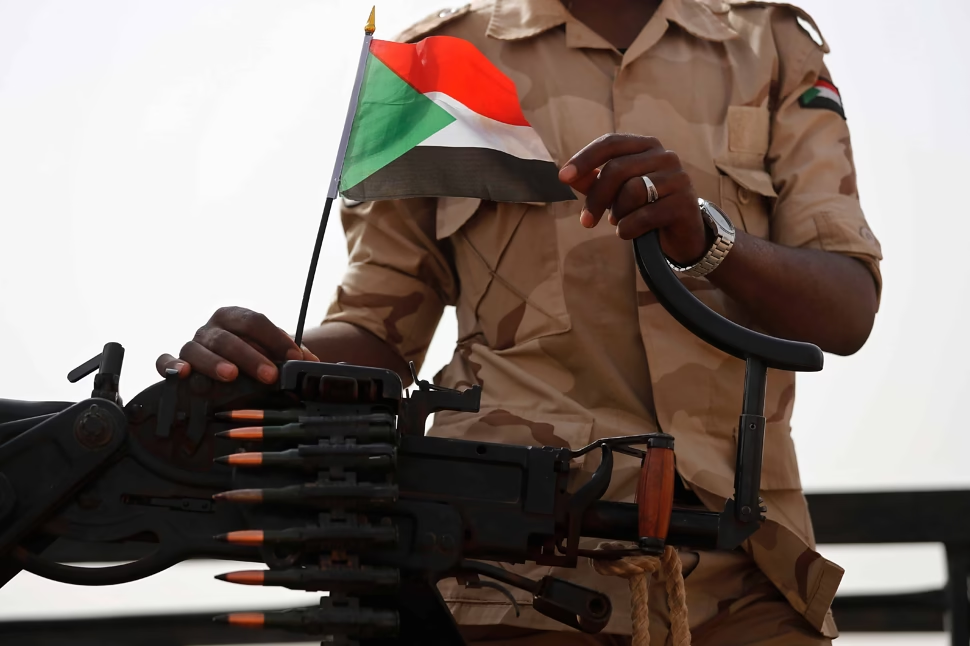
Amnesty International has named three senior commanders of the Rapid Support Forces (FAR) as allegedly responsible for war crimes and crimes against humanity committed during the siege of the town of el-Fasher, North Darfur, in October 2025.

The report, presented in Nairobi, documents homicides, torture, sexual assaults, sexual slavery, forced transfers and acts of persecution against the civilian population. The organization maintains that these acts constitute a campaign of ethnic cleansing. The evidence includes videos showing deprivation of life and torture attributed to commanders of the paramilitary group.

RelatedHumanitarian crisis in Sudan leaves 23 children dead from malnutrition

The humanitarian crisis in Darfur

The FAR has controlled large areas of Darfur since the start of the armed conflict in Sudan in April 2023. The offensive on el-Fasher left hundreds of civilians dead and displaced thousands. Humanitarian organizations have warned about the lack of access to food, water and medical care in the region.

Amnesty International calls on the international community to investigate and punish those responsible. So far, diplomatic reactions have been divided, with calls for accountability but no concrete action. The UN and the African Union have expressed concern, but the Security Council has yet to take binding action.

The report underscores the urgency of protecting civilians and breaking the cycle of impunity in Darfur.
Earthquakes in Venezuela: water crisis and massive displacement

Families in La Guaira face serious shortages of drinking water after earthquakes.

Water and sanitation crisis in La Guaira

Thousands of people affected by last month’s earthquakes in Venezuela face increasing difficulties in accessing drinking water, sanitation and hygiene. In La Guaira, the hardest hit state, entire families use the beaches to bathe and relieve themselves. Feces are now visible in areas that were previously busy.

Other people use the water left in broken water tanks to wash dishes and clean themselves. According to Venezuelan authorities, 190 buildings collapsed and 856 were damaged in the consecutive earthquakes on June 24, which left 3,811 dead. Some 18,000 victims now live in temporary shelters, sidewalks, parks and squares.

“We always have water in the tank, but with the earthquake most of the tanks broke,” said Juliani Herrera, 20 years old. “Now we wait for a cistern to arrive to fill buckets.”

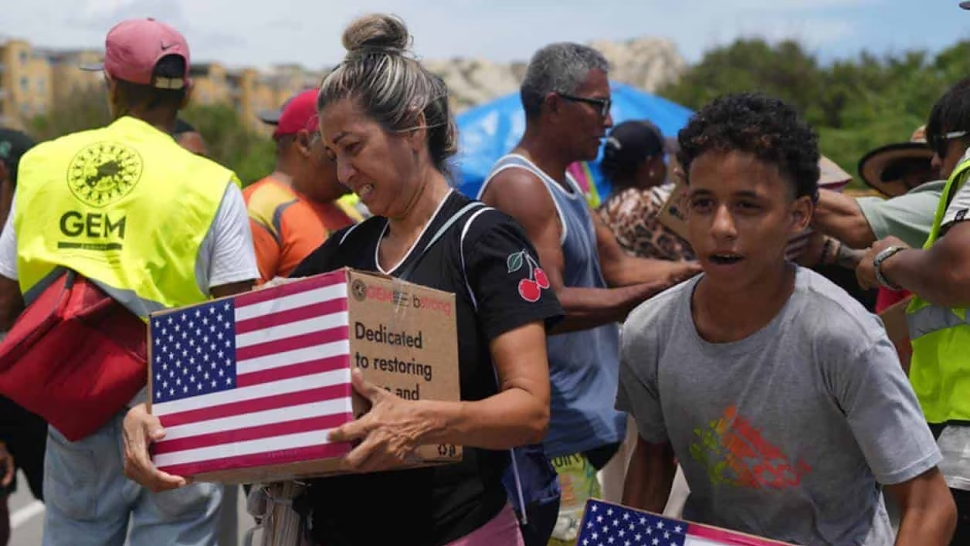
Before the earthquakes, some communities only received drinking water once or twice a month. In Maiquetía, people lined up to receive boxes with food, water and hygiene kits. Herrera received one of those boxes; He carried her several blocks with scratches on her arms and hands, the result of a motorcycle fall during the earthquake.

Government response and UN call

The acting president Delcy Rodríguez announced that they are working with experts to identify areas suitable for “building new homes and anti-seismic cities.” He also said that local and international companies were summoned for the accelerated construction of homes. Rodríguez indicated that he sent a letter to the King of England to request the release of Venezuelan gold reserves frozen in the Bank of England.

Beatriz Ochoa of the Norwegian Refugee Council said better conditions are needed to prevent disease, given overcrowding, high temperatures and seasonal rains. “I have seen families doing everything they can to maintain dignity,” he said.

The UN Office for Disaster Risk Reduction estimated direct physical damage at about $37 billion. UN humanitarian aid chief Tom Fletcher met with Rodríguez and survivors; His office issued an appeal for $300 million to assist 1.3 million Venezuelans in urgent need.

Continue reading

IMF cuts global growth estimate due to Iran conflict

The IMF reduces its global forecast to 3% in 2026 due to the conflict in Iran, although AI partially compensates.

The International Monetary Fund adjusted downwards its projections for the world economy, affected by the energy shock derived from the conflict with Iran. However, the rise of investment in artificial intelligence and other technologies partially offsets the impact.

The organization expects the global economy to grow just 3% in 2026, compared to 3.5% the previous year and the 3.1% estimated in April. By 2027, the IMF expects a rebound to 3.4%.

Effects of the conflict in Iran

After the military actions of the United States and Israel against Iran on February 28, Tehran interrupted transit through the Strait of Hormuz, through which a fifth of the world’s crude oil and natural gas circulates. Energy prices skyrocketed, putting pressure on companies and consumers. The IMF now expects oil to rise almost 32% this year and global inflation to reach 4.7% in 2026, up from 4.1% in 2025, halting two years of anti-inflationary progress.

These forecasts assume that the strait will reopen this month and that trade will normalize by March, although the White House declared on Wednesday that the ceasefire with Iran was over.

Regional overview

“The global economy has weathered the shock better than feared,” said Petya Koeva Brooks, deputy director of the IMF’s research department. The damage was limited because countries used oil reserves and exporters outside the Persian Gulf increased production.

The United States, which produces its own energy and benefits from investment in AI, will grow 2.3% this year, up from 2.1% in 2025. Trump’s tax cuts, productivity improvements and a strong stock market sustain its economy. In contrast, the eurozone — hit by high energy prices — will grow just 0.9%, compared to 1.4% in 2025.

China will expand 4.6% this year, less than the previous 5%, but driven by public works, high-tech manufacturing and exports, despite the real estate collapse. India will continue to be the fastest growing large economy, at 6.4%, supported by strong consumption.

The IMF, a credit organization for 191 countries, seeks to promote growth and global financial stability.

Continue reading

Former captain convicted for sinking the ARA San Juan

Federal court imposed three years of suspended prison on Claudio Villamide for the 2017 tragedy.

Condemnation for the sinking of the ARA San Juan

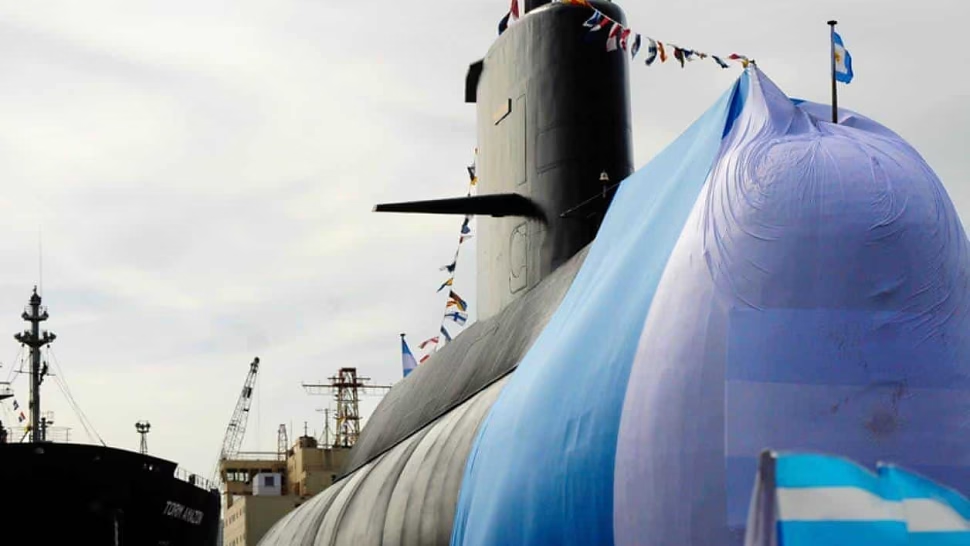
A federal court sentenced Claudio Villamide, former ship captain and former commander of the Argentine Submarine Force, to three years of suspended prison. The sentence, issued on Tuesday in Santa Cruz, found him responsible for breach of duties as a public official and negligent damage aggravated by the disappearance of the submarine ARA San Juan in 2017, which caused the death of its 44 crew members.

Villamide stated before the verdict:

“I am innocent. To this day I do not clearly understand why they have accused me of the sinking of the submarine.”

The judges imposed rules of conduct for three years: establish address and telephone number, notify changes, not commit new crimes and submit to criminal control. The ex-marine will not go to prison.

Acquitted and appeal

The court unanimously acquitted Luis Enrique López Mazzeo, Héctor Alonso and Hugo Correa, three other accused officers. Luis Tagliapietra, father of a deceased crew member and representative of the plaintiffs, announced that they will appeal the sentence.

“The sentences imposed are far from what we had requested,” he told The Associated Press. Tagliapietra had requested between seven and eight years in prison for the four sailors.

Chronology of the tragedy

The ARA San Juan disappeared on November 15, 2017 in the South Atlantic, while returning from Ushuaia to Mar del Plata. That day he reported a fault due to water entering the batteries, but he claimed to have solved it. Hours later an explosion occurred.

The judicial investigation determined that the German-made submarine had operational deficiencies reported to Villamide before setting sail on October 25. The water entered through the ventilation system, causing a short circuit and an uncontrolled descent. After exceeding 600 meters of depth, the hull imploded.

A year later, the company Ocean Infinity found the remains 600 km east of Comodoro Rivadavia, in the province of Chubut.

Continue reading