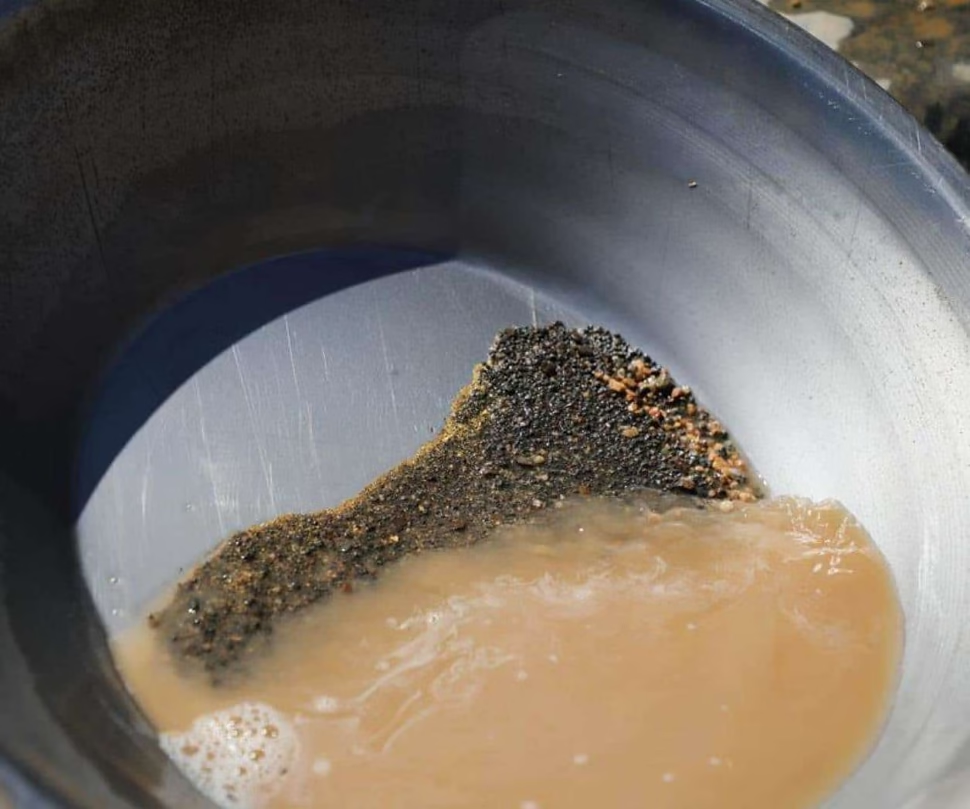
Egypt detains hundreds for illegal gold mining on border with Sudan

More than 200 people arrested, including 136 foreigners, in an operation against illegal mining and gold trafficking.

Egyptian security forces detained hundreds of people, including foreigners, on the border with Sudan on accusations of illegal gold mining and smuggling. This was reported by the army on Monday.

Operational in the south

The southern region of Egypt is home to rich gold mines. The government has promoted large projects, such as the Sukari megaproject. The military statement indicated that the detainees total 87 Egyptians and 136 foreigners, without specifying nationalities. Additionally, “large quantities of equipment used in illegal mining operations” were seized.

RelatedSouth American bloc orders Peru to stop illegal mining and mercury trafficking

The area borders Sudan, also rich in gold. The three-year armed conflict in that country has left much of mining unregulated. According to a 2024 report by a UN panel of experts, more than 50% of the gold mined in Sudan was smuggled out. Gold represents 70% of Sudanese income.

Videos on the internet showed hundreds of Sudanese at a border crossing. Sudanese media reported that they were miners detained and expelled by Egypt. Gold has been central to the Sudanese conflict: the paramilitary group Rapid Support Forces has trafficked tons from Darfur and Kordofan to finance itself.

The Egyptian military claimed that several suspected miners surrendered to authorities and were sent back to their country. He did not give further details about the nationalities. He also warned that he “reserves all available options to address all threats.”
Trump grants Ukraine license to manufacture Patriot

The US will share technology for Ukraine to manufacture Patriot missiles. The announcement was made at the NATO summit.

A key boost for Ukrainian defense

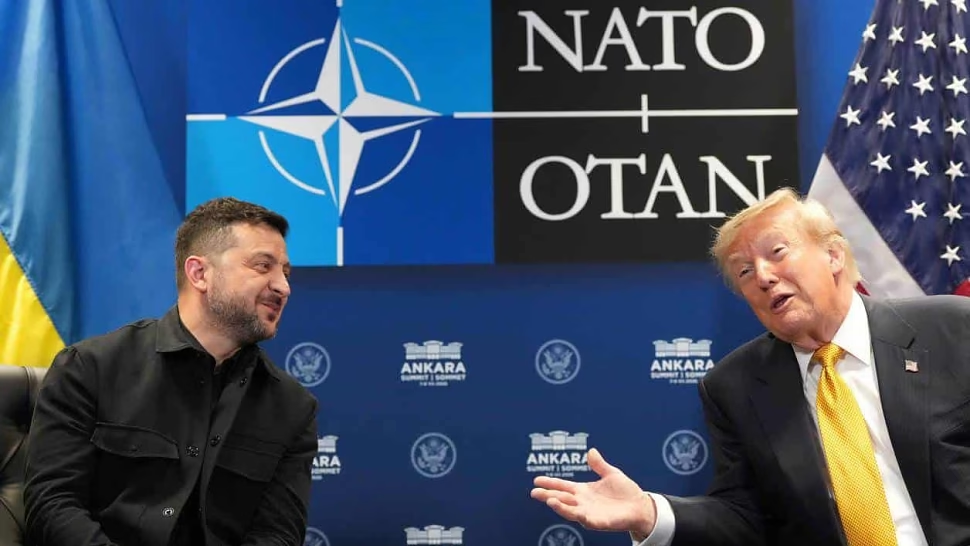
The president of the United States, Donald Trump, announced this Wednesday that his government will grant Ukraine a license to manufacture Patriot air defense systems. The move is seen as a significant step forward for kyiv in the conflict against Russia.

The announcement occurred during a meeting with Ukrainian President Volodymyr Zelenskyy at the NATO summit in Ankara, Türkiye.

Trump affirmed that Washington will share the technology necessary to produce these systems, highly valued for their ability to intercept missiles and drones. Zelenskyy had for years requested both more Patriot batteries and the possibility of manufacturing them locally, in the face of the increasing intensity of Russian offensives against cities and strategic infrastructure.

Change of tone between both leaders

The meeting showed a change from previous meetings. Trump praised Zelenskyy’s leadership and said the two have built a good relationship. He also expressed confidence that an agreement to end the war could be near. He announced that Washington is preparing a new security package to strengthen Ukraine’s defensive capabilities.

During the summit, Trump criticized some NATO allies for rejecting his intention for the United States to control Greenland and for not fully supporting the recent military offensive against Iran. He insisted that Europe must take greater responsibility for its own defense and increase military spending, while Washington reviews its presence on the continent.

For his part, NATO Secretary General Mark Rutte supported the US attacks against Iran and highlighted the increase in defense spending by the allies. Zelenskyy reiterated his call for Ukraine to be admitted to the Atlantic alliance, arguing that the experience of its armed forces would strengthen collective security in the face of the Russian threat.

Continue reading

Earthquakes in Venezuela: water crisis and massive displacement

Families in La Guaira face serious shortages of drinking water after earthquakes.

Water and sanitation crisis in La Guaira

Thousands of people affected by last month’s earthquakes in Venezuela face increasing difficulties in accessing drinking water, sanitation and hygiene. In La Guaira, the hardest hit state, entire families use the beaches to bathe and relieve themselves. Feces are now visible in areas that were previously busy.

Other people use the water left in broken water tanks to wash dishes and clean themselves. According to Venezuelan authorities, 190 buildings collapsed and 856 were damaged in the consecutive earthquakes on June 24, which left 3,811 dead. Some 18,000 victims now live in temporary shelters, sidewalks, parks and squares.

“We always have water in the tank, but with the earthquake most of the tanks broke,” said Juliani Herrera, 20 years old. “Now we wait for a cistern to arrive to fill buckets.”

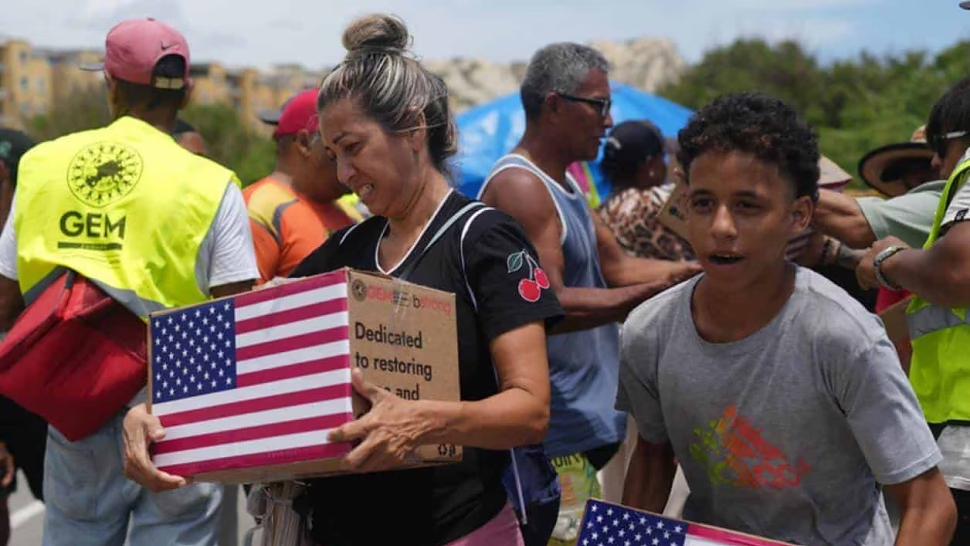
Before the earthquakes, some communities only received drinking water once or twice a month. In Maiquetía, people lined up to receive boxes with food, water and hygiene kits. Herrera received one of those boxes; He carried her several blocks with scratches on her arms and hands, the result of a motorcycle fall during the earthquake.

Government response and UN call

The acting president Delcy Rodríguez announced that they are working with experts to identify areas suitable for “building new homes and anti-seismic cities.” He also said that local and international companies were summoned for the accelerated construction of homes. Rodríguez indicated that he sent a letter to the King of England to request the release of Venezuelan gold reserves frozen in the Bank of England.

Beatriz Ochoa of the Norwegian Refugee Council said better conditions are needed to prevent disease, given overcrowding, high temperatures and seasonal rains. “I have seen families doing everything they can to maintain dignity,” he said.

The UN Office for Disaster Risk Reduction estimated direct physical damage at about $37 billion. UN humanitarian aid chief Tom Fletcher met with Rodríguez and survivors; His office issued an appeal for $300 million to assist 1.3 million Venezuelans in urgent need.

Continue reading

IMF cuts global growth estimate due to Iran conflict

The IMF reduces its global forecast to 3% in 2026 due to the conflict in Iran, although AI partially compensates.

The International Monetary Fund adjusted downwards its projections for the world economy, affected by the energy shock derived from the conflict with Iran. However, the rise of investment in artificial intelligence and other technologies partially offsets the impact.

The organization expects the global economy to grow just 3% in 2026, compared to 3.5% the previous year and the 3.1% estimated in April. By 2027, the IMF expects a rebound to 3.4%.

Effects of the conflict in Iran

After the military actions of the United States and Israel against Iran on February 28, Tehran interrupted transit through the Strait of Hormuz, through which a fifth of the world’s crude oil and natural gas circulates. Energy prices skyrocketed, putting pressure on companies and consumers. The IMF now expects oil to rise almost 32% this year and global inflation to reach 4.7% in 2026, up from 4.1% in 2025, halting two years of anti-inflationary progress.

These forecasts assume that the strait will reopen this month and that trade will normalize by March, although the White House declared on Wednesday that the ceasefire with Iran was over.

Regional overview

“The global economy has weathered the shock better than feared,” said Petya Koeva Brooks, deputy director of the IMF’s research department. The damage was limited because countries used oil reserves and exporters outside the Persian Gulf increased production.

The United States, which produces its own energy and benefits from investment in AI, will grow 2.3% this year, up from 2.1% in 2025. Trump’s tax cuts, productivity improvements and a strong stock market sustain its economy. In contrast, the eurozone — hit by high energy prices — will grow just 0.9%, compared to 1.4% in 2025.

China will expand 4.6% this year, less than the previous 5%, but driven by public works, high-tech manufacturing and exports, despite the real estate collapse. India will continue to be the fastest growing large economy, at 6.4%, supported by strong consumption.

The IMF, a credit organization for 191 countries, seeks to promote growth and global financial stability.

Continue reading