Søren Wærenskjold wins the fastest stage of the Tour de France

The Norwegian went from last to first on a historic day for the competition.

Speed record in the Tour

Norwegian cyclist Søren Wærenskjold, 26, took victory in stage 11 of the Tour de France, the fastest in the history of the race. The 161.3 km journey between Vichy and Nevers was completed at an average speed of 50.9 km/h.

Wærenskjold beat Olav Kooij and Jasper Philipsen, among others, in a close sprint. Tadej Pogacar, overall leader, arrived alongside Jonas Vingegaard and maintains his advantage of more than three and a half minutes.

RelatedVan der Poel wins stage 9 of the Tour; Pogacar maintains the lead

The Uno-X Mobility rider confessed his surprise:

“It means everything, it’s my biggest victory so far. I knew there are two or three guys faster than me, but if I’m lucky and have a good sprint, it’s possible.”

Wærenskjold had finished last in the previous stage after a crash in the mountains. At the beginning of Wednesday, he requested medical attention for his right hand. His recovery was complete.

“Sometimes I’m very confident, but other times I feel exhausted and I think it’s impossible to win here. It’s crazy that it happened today.”

Escape and outcome

Mathieu van der Poel and Valentin Paret-Peintre attacked from the start. Julian Alaphilippe, Mathis Le Berre, Nelson Oliveira and Anthon Charmig then escaped, with a lead of 1:15 with 100 km to go. Alaphilippe stayed on the Côte de Billy-Chevannes. The three leaders were caught with 5.5 km to go.

The peloton prepared for the sprint. Wærenskjold, well positioned, reacted first. He compared the feeling to his victory at the Omloop het Nieuwsblad:

“I thought it was too far back, but it opened on the right side. Incredible.”

The Tour continues this Thursday with a new stage.

Julián Quiñones criticizes Javier Aguirre for his substitution

Quiñones reveals his discontent with Javier Aguirre after the elimination.

The forward’s annoyance

Julián Quiñones was one of Mexico’s most outstanding soccer players in the 2026 World Cup. With four goals, he became the main offensive weapon of the team led by Javier Aguirre.

But in the round of 16 against England, Aguirre decided to replace him when the team was looking for a tie. Mexico lost 3-2 and was eliminated.

Days later, during his vacation at a tattoo studio, Quiñones was questioned about the change. His response went viral:

“Ahh, yes, I know…, the old man was wrong”

The Al-Qadsiah FC attacker from Saudi Arabia made his annoyance clear with the technical decision.

The statement generated reactions among fans and analysts, who debated Aguirre’s strategy and its impact on the tournament.

Continue reading

Uncomfortable early morning on the Tour: criticism for late-night anti-doping tests

They woke up the Tour leaders at 2:5 in the morning for anti-doping tests. The ITA defends the procedure.

Nighttime anti-doping tests spark debate

The International Testing Agency (ITA) defends its procedure after waking up the Tour de France leaders in the early hours of Sunday. Tadej Pogacar received the officials at 5 a.m., while Jonas Vingegaard was interrupted at 2 a.m.

Vingegaard suffered a broken collarbone in a fall near the end of the 15th stage and abandoned the race. Pogacar and Remco Evenepoel criticized the testing schedule. Evenepoel described the situation as “very disrespectful” in a press conference and asked for a response from the CPA cyclists association.

“The ITA is aware that night testing can disrupt cyclists’ rest and recovery,” the agency told The Associated Press. “However, it has the responsibility to ensure the effectiveness of the anti-doping program and the integrity of racing.”

Pogacar questioned whether Vingegaard’s fatigue played a role in his fall, but later accepted the random tests as necessary to prove cleanliness. Vingegaard told Cyclingnews.com: “I accept it if necessary, but it is a bit difficult to sleep four hours in the middle of a three-week Tour.”

The ITA explained that testing outside of daylight hours is permitted under the World Anti-Doping Code, UCI rules and French law. The selection of cyclists is based on a risk assessment, not suspicion. Sample results may take weeks. The race ends on July 26 in Paris.

Continue reading

Nearly two million welcome Spain as world champion

The Spanish team paraded through Madrid before a crowd that was estimated at 1.8 million people.

Celebration in Madrid

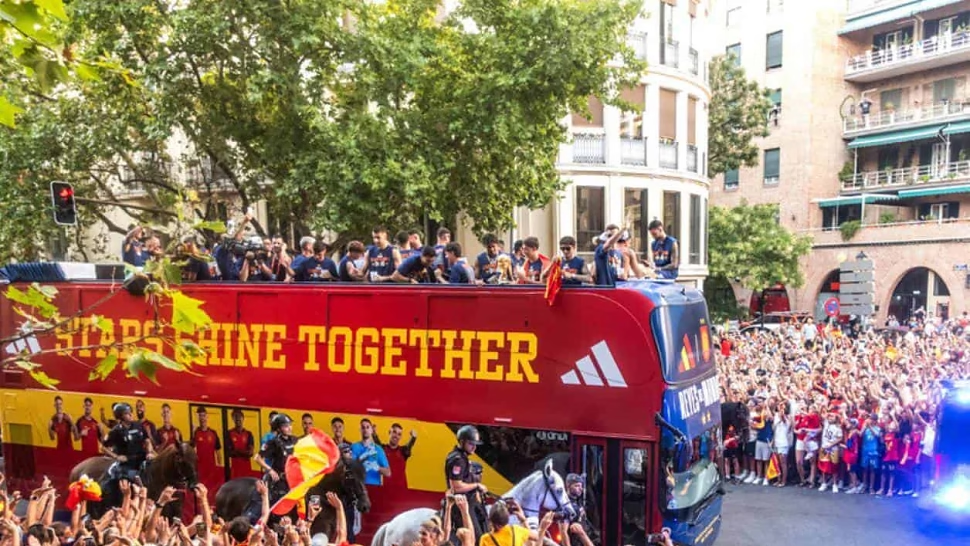
The Spanish team, world champions after beating Argentina 1-0 in the final in New Jersey, returned to Madrid on Monday. A crowd estimated at almost two million people packed the streets to welcome them.

The squad of 26 players and the coaching staff met first with the Royal Family and then with the President of the Government, Pedro Sánchez.

“Give huge thanks to the coaches and players for the style of play, the effort and the victory,” declared Sánchez. “We really enjoyed watching them play.”

Afterwards, the team boarded an open-top bus for a noisy parade through the center of Madrid. The bus carried the motto “The stars shine together” and photos of the footballers. The players, wearing the World Cup trophy and T-shirts reading “We Are Champions,” danced and interacted with the fans.

Before the parade, coach Luis de la Fuente expressed:

“We have experienced it from the emotion and pride of representing a wonderful country with dedicated fans. We are full of joy.”

The tour started from the vicinity of the Moncloa Palace to the Plaza de Cibeles, where the authorities reported about 120,000 people for the ceremony. The players were introduced one by one with songs chosen by them. Álex Baena, on his 25th birthday, entered with the trophy.

Striker Borja Iglesias acted as DJ, and his teammates danced on stage. The singers Aitana, Ana Mena and Lola Índigo entertained the event. The ceremony culminated with the entire team raising the trophy again in front of the home crowd.

The celebrations were marred by the news that a 13-year-old minor lost his life in Salamanca after a fountain he had climbed with friends collapsed.

For many young fans, it is the first time they have seen the men’s team lift the trophy. Spain today is very different from the country of 2010, besieged by a debt crisis and unemployment of 20%. Now, the economy is growing, unemployment has been cut in half and separatist tensions have cooled.

The team received congratulations from the leaders of the United States, Mexico and Canada, the co-organizers of the tournament.

Continue reading