Sonora Prosecutor’s Office links former officials for diversion of 290 million

The investigation reveals the complex mechanism of embezzlement from the treasury for four consecutive years, with more orders pending.

Detailed investigation of the embezzlement case in the SEC Sonora

The Anti-Corruption Prosecutor’s Office of the State of Sonora (FAS), under the direction of Mauricio Ibarra Romo, has provided precise data that quantifies the economic damage to state assets at approximately 290 million pesos. This amount is the result of a complex investigation that began in September 2021, which focused on alleged acts of corruption and misappropriation of public funds that occurred within the Secretary of Education and Culture (SEC) during the previous administration.

The defendants, identified as the former secretary of the agency, José Víctor ‘N’, and another high-ranking official, Francisco Alberto ‘N’, who served during the mandate of former governor Claudia Pavlovich, face charges for the crimes of embezzlement and breach of a legal duty. Currently, both are detained in a Social Reintegration Center (Cereso) under the precautionary measure of justified preventive detention, decreed by a control judge after analyzing the evidence presented.

RelatedBenny Ibarra announces his musical return with unreleased album

Mechanism and chronology of resource diversion

The analysis of the investigation folder, described by the authorities as solid and exhaustive, details a systematic mechanism for diverting funds. The resources, originally assigned to budget item 1000, intended exclusively for personal services such as payroll, labor benefits and bonuses for educational personnel, were illegally channeled to a private company. Said company, according to the investigations, completely failed to comply with the established contractual obligations.

The operation was carried out over four consecutive fiscal years: 2018, 2019, 2020 and 2021. The funds were initially deposited in bank trusts to later be transferred to a Limited Purpose Financial Company (Sofol), an entity with specific regulation and different from that of a traditional bank. This financial movement lacked the corresponding authorizations and flagrantly violated the regulatory framework of the state public administration.

Prosecutor Ibarra Romo explained that the scheme was promoted internally as a “multiple benefit plan,” a term that masked its true illicit nature. The investigation not only establishes the probable responsibility of the two officials already detained, but also indicates the participation of other former public servants and an individual, for whom arrest warrants have already been issued and are pending execution.

Procedural implications and next steps

The legal process will follow the procedural times established in the National Code of Criminal Procedures. The connection to the process is an initial stage that allows the Public Prosecutor’s Office to continue with the investigation to integrate more elements of conviction for an eventual trial. The FAS Sonora has committed to keeping citizens informed about significant advances in the case, guaranteeing transparency and adherence to the law.

This case is part of a broader effort to combat corruption and impunity in the public institutions of Sonora. Embezzlement, defined as the illegitimate seizure of State property by a public servant, carries severe criminal penalties. The methodology used by the prosecution sets an important precedent for the investigation of complex white collar crimes that involve sophisticated financial maneuvers and abuse of trust in public officials.

Citizens hope that this rigorous judicial process will contribute to the recovery of diverted resources and strengthen the control and supervision mechanisms within the state government, sending a strong message about intolerance towards corrupt practices.

Do you consider these types of investigations to be crucial to strengthening the integrity of public institutions?Share it on your social networks to encourage discussion and explore more content related to government accountability and transparency on our portal.

Sheinbaum asks FGR for information about Lozoya’s sister

The president requests information about the Agronitrogenados case and the role of Gilda Lozoya.

Sheinbaum requests clarification on the Agronitrogenados case

President Claudia Sheinbaum asked the Attorney General’s Office (FGR) for detailed information about the participation of Gilda Lozoya Austin—sister of the former director of Pemex, Emilio Lozoya—in the Agronitrogenados fraud. Gilda Lozoya recently obtained parole.

“I asked the Prosecutor’s Office to report in more detail the participation of this person, of Lozoya’s sister, in this fraud that was the purchase of a company, which at the time had been privatized for an amount much greater than what it was actually worth, to benefit the owner of Altos Hornos and some other people,” said the president from the National Palace.

Sheinbaum also recalled that Alonso Ancira, former president of Altos Hornos de México, has not finished paying the debt derived from that case. For this reason, the arrest warrant against him was revived. He indicated that he hopes that the FGR, headed by Ernestina Godoy, clearly explains the details of the process.

The purchase of Agronitrogenados occurred during the administration of Emilio Lozoya at Pemex. The operation was carried out for a value much higher than the real value, according to investigations. The case has been one of the most emblematic in terms of corruption in the Mexican energy sector.

Continue reading

Flood prevention in Edomex: 90% progress

Anti-flood works in eastern Mexico are 90% complete and four projects are already operating.

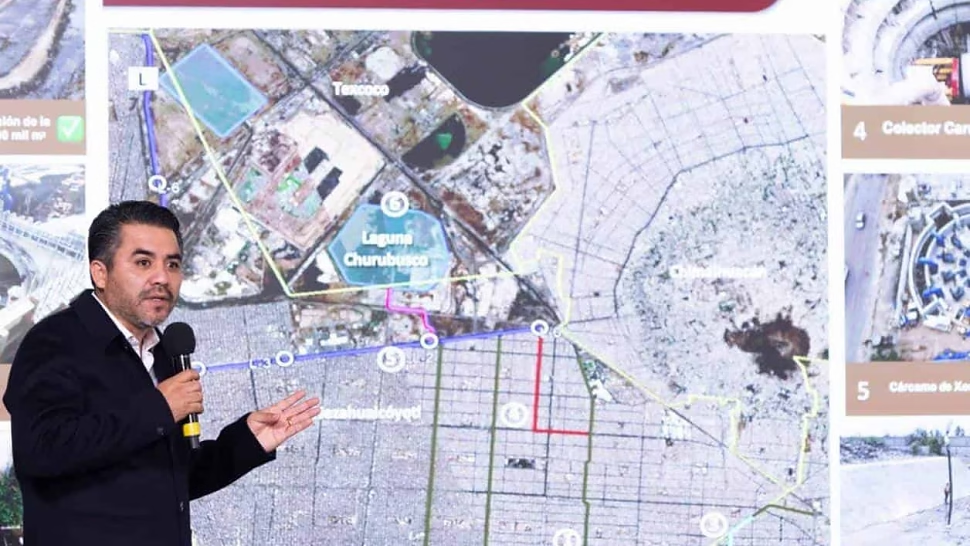
President Claudia Sheinbaum reported that the works to prevent flooding in the Eastern Zone of the State of Mexico are 90% complete. They will be ready in a maximum of 15 days, just before the peak of the rainy season.

Sheinbaum highlighted the effectiveness of the work. Four of the six projects are already operating and have reduced impact times. For example, after recent rains in Ciudad Nezahualcóyotl, the system evacuated a body of water in approximately an hour and a half.

Budget and key works

The director of Conagua, Efraín Morales, explained that 2.2 billion pesos of a national budget of 11.2 billion pesos are spent in the region that includes La Paz, Nezahualcóyotl and Iztapalapa.

Among the completed works are the expansion of the El Salado Lagoon (from 300 thousand to 400 thousand cubic meters), the Teotongo Collector, the Carmelo Pérez Collector and the Cárcamo de Xochiaca, which increased its pumping capacity to 16 thousand liters per second.

The pending works for the next two weeks are the Los Pinos Collector (88%) and the expansion of the Churubusco Lagoon channels (85%).

In addition, construction of the Chalco de Díaz Covarrubias Collector continues to resolve historical flooding in Chalco and Valle de Chalco. The microtunneling maneuvers have already advanced 3 kilometers and are expected to conclude in October.

Continue reading

Older adults: more than 1.2 million already have a health credential

Sheinbaum reports that more than 1.2 million older adults have registered for the Universal Health Service.

Advance in credentialing for the new health system

President Claudia Sheinbaum reported that the credentialing process for the Universal Health Service is advancing. More than 1.2 million older adults have already registered.

The program is scheduled to begin in January of next year. “It starts next year. There are more than one million 200 thousand older adults who have registered,” said the president during her morning conference.

Sheinbaum explained that the objective is that those who register can receive care at any IMSS, ISSSTE and IMSS Bienestar health center. Regardless of your current entitlement.

“Remember that we started with adults and older adults in the credentialing of the Universal Health Service and it is moving forward. In January this possibility of being able to share services in the three main health institutes would begin,” he said from the National Palace.

The federal government seeks to guarantee universal access to medical services. The first phase focuses on the population aged 65 and over. Authorities hope to expand coverage gradually.

Continue reading