Sheinbaum: review of the T-MEC is very advanced and closes in 2026

President Sheinbaum clarifies that the T-MEC is not renegotiated, it is only reviewed. Announces progress and upcoming results of the consultation.

It is not a renegotiation, it is a review

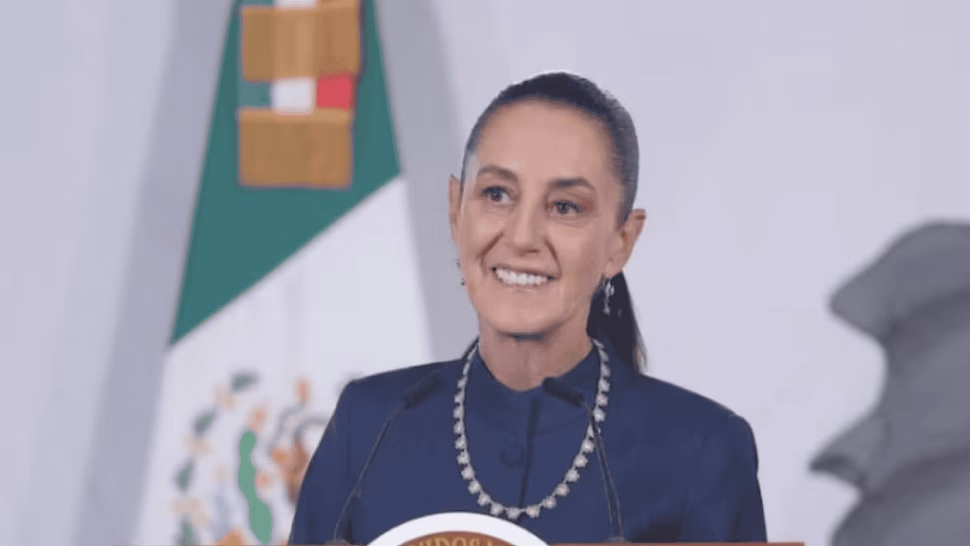
President Claudia Sheinbaum was clear this Tuesday: the Treaty between Mexico, the United States and Canada is not a renegotiation. It’s a review. And according to her, it is very advanced to close this year.

“This year, the issue of the Treaty, of the revision, will be closed, because it is not a renegotiation, it is only a revision. And it is very advanced,” he said in his morning conference.

A semantic detail that seems minor but carries a world of political meaning. Renegotiating sounds like starting from scratch. Review sounds like technical adjustments. The difference is not accidental.

RelatedEbrard anticipates high bilateral component in T-MEC review

The progress and what’s coming

Sheinbaum assured that the Secretary of Economy, Marcelo Ebrard, will soon present the results of a consultation carried out on the trade agreement. Regarding the possibility of extending it until 2042, he only repeated that the information will be made known.

Regarding the famous 54 non-tariff measures under discussion, he stated that almost all of them are “settled.” But he dropped a juicy but:

“There are some who can’t do exactly what they say.”

He mentioned the thorny case of Vulcan and competition issues, finishing with a phrase for the bronze:

“We never give in to anything that we consider violates our sovereignty, our laws or our project.”

A nod to the more nationalist base without giving concrete details of what concessions were not made. Classic.

The other front: Plan Mexico

Apart from the T-MEC, the president spoke about Plan Mexico. This Wednesday his cabinet will meet with businessmen to give a “preview” of the results after one year.

He highlighted records in foreign investment and economic growth that, he says, exceeded the expectations of financial organizations. The declared objective continues to be to boost national production.

He also announced a new Economy Digitalization Plan, the details of which he promised to reveal from the National Museum of Anthropology.

In short: a lot of official optimism on both fronts – the trilateral commercial and the internal economic front – but with the fine print still to be defined. The true test will be when Ebrard presents that consultation document and we know what that “very advanced review” really means.

Six Tabasco police officers face charges of kidnapping and extortion

Elements of the PEC were arrested after investigations for serious crimes in Tabasco.

Anti-corruption operation in Tabasco

The Attorney General’s Office of the Republic completed arrest warrants against six members of the State Highway Police (PEC) in Tabasco. They are accused of their alleged participation in kidnapping and extortion.

The detainees, assigned to the Secretariat of Security and Citizen Protection of Tabasco, were identified as Carmen N., Rubén N., Carlos Mario N., Edi N., Francisco Javier N. and Joan Darío N. The capture took place at the corporation’s own facilities.

The operation included the participation of the Olmeca Interinstitutional Tactical Reaction Force (FIRT). After their arrest, the six were placed at the disposal of a judge, who will define their legal situation.

The FGR reported that these results come from the exchange of information and operational coordination between the authorities that make up the FIRT Olmeca. He stressed that the action was carried out in accordance with legality and respect for human rights.

This case occurs in a context where Tabasco citizens have filed multiple complaints against police officers for alleged abuses. Among the recurring complaints are abuse of authority, illegal detentions, fabrication of crimes, extortion and homicide.

Continue reading

Sheinbaum: every weapon delivered is a life saved

Sheinbaum defends the voluntary disarmament program as a pacifying tool.

Results of the Yes to Disarmament program

President Claudia Sheinbaum described as “successful” the “Yes to Disarmament, Yes to Peace” program, which promotes the voluntary surrender of firearms in exchange for financial support. In his morning conference, he assured that each weapon removed from circulation represents a life that can be saved.

“It has been very successful and also everything we do to disarm peacefully is saving a life. It is removing an instrument that can cause death. It is pacifying,” he said.

Sheinbaum reported that this Thursday he will lead a day of the program in the atrium of the Basilica of Guadalupe, where it began last year. He highlighted the collaboration of the Catholic Church, which provides spaces of trust for the population to hand over their weapons.

On the occasion of the International Day for the Destruction of Firearms, the Secretariat of National Defense will present a balance of the program, as well as a report on the weapons seized and their subsequent destruction. The president stressed that voluntary disarmament contributes to the pacification of the country, since families can hand over weapons anonymously, without investigation, and receive financial support in exchange.

Continue reading

More than 12 thousand refugees access bank accounts in Mexico

Banorte and UNHCR facilitate the financial inclusion of refugees in Mexico.

More than 12 thousand refugees with a legal residence permit in Mexico have managed to open a bank account, a fundamental step for their integration into formal employment. The initiative, promoted by Banorte in alliance with the UN Refugee Agency (UNHCR), began in 2022.

Felipe Medina, executive director of Funding at Banorte, pointed out that the main obstacle was the lack of access to an account to deposit payroll. Although the regulations allow opening accounts with CURP and immigration documents, in practice many branches did not recognize this documentation.

“There were people who already wanted to work, join formal employment and could not find an account that would allow them to receive their resources,” Medina explained.

The bank designed a digital opening process in about five minutes, with a simplified file. Refugees can receive salary deposits, make transfers and use a digital debit card. The physical card is then obtained in commercial establishments, without having to go to a branch.

Banorte also collaborated with companies that hire refugees—such as FEMSA, Mabe, LEGO and Alpura—to speed up account opening during job incorporation. Human resources teams received specialized training.

Banking has allowed full integration into the formal economy. The accounts in this segment record monthly deposits between 2,000 and 14,000 pesos, an average balance of 1,900 pesos and about six digital transactions per month. Companies report lower staff turnover and higher productivity among refugee workers, many with professional experience or specialized studies.

Continue reading