Sheinbaum responds for migrants in trailer and tension with Trump

The president defends protocols for migrants after the discovery of 229 people in a trailer and addresses tensions with the United States.

The double migratory pressure: inside and outside

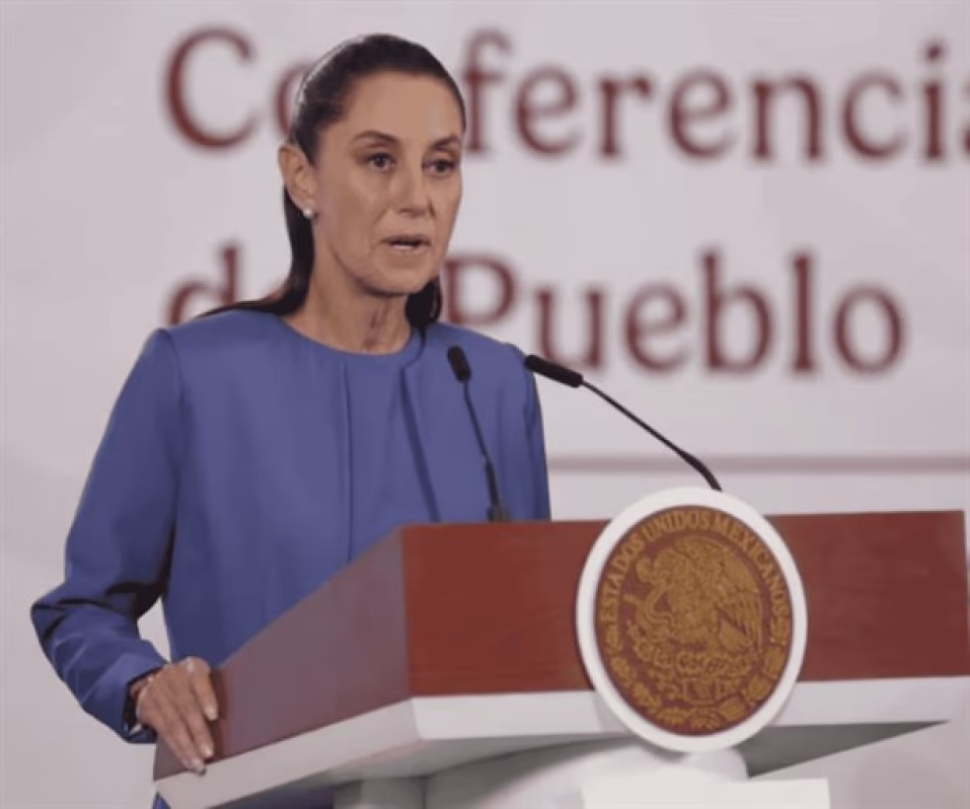
President Claudia Sheinbaum came out this Tuesday. He did so in the face of two crossfires: the discovery of 229 migrants crammed into a trailer in Veracruz and the growing complaints about the treatment of Mexicans detained in the United States. A crisis script that tests their “humanitarian care” narrative.

In front of the cameras, Sheinbaum painted a neat picture. He said that there is a permanent operation coordinated by Immigration, the Government and the National Guard for the caravans. Its central promise: that the groups stay in the south.

“In the case of all the caravans, since we came to power, they all stay in the south of the country and are even offered repatriation; many of them accept it,” he noted.

But the reality of the trailer in Xalapa exploded in his hands. How does this discovery square with a supposedly controlled system? The president presented it as proof that the revisions work. “It was thanks to the reviews that are being carried out that it was found. There is an arrest,” he stated, promising to strengthen the work against human trafficking.

RelatedThe INM redefines its migration management with a humanitarian approach after 32 years

The other border: the pending call with Trump

The second act of this conference was north. Faced with the possibility of a call with Donald Trump, Sheinbaum made his position clear. He said that in each previous conversation he has insisted on the defense of the human rights of his compatriots.

“We do not agree with these forms of detention,” he said firmly.

His message was one of continuous diplomatic pressure: US authorities have promised to investigate and Mexico will continue to insist. A silent pulse as both countries navigate a complex relationship, where each statement is a calculated move.

Between the south and the north, the president tries to maintain balance. But the trailer images and testimonies from the United States are a stark reminder: in the theater of migration, the official script often clashes with a much harsher scenario.


AT&T Mexico loses a million prepaid users due to mandatory registration

One million prepaid users unsubscribed from AT&T Mexico due to mandatory registration.

Mandatory registration of mobile lines hits AT&T Mexico

The mandatory cell line registration process had a strong impact on AT&T Mexico’s prepaid customer base. During the second quarter of 2026, the company lost one million users in that segment. At the end of June, it had 15 million 829 thousand prepaid customers, according to its financial results.

In contrast, the postpaid service reported significant growth. The company added 369 thousand new clients, an increase of 20.7% compared to the same period of the previous year. Thus, it reached a total of 7 million 457 thousand users at the end of the semester.

Since January, telecommunications companies began registering mobile lines in the national registry. However, only 43% of the lines had been registered to date. Given this, the federal government extended the deadline to complete the process. The suspension of service for those who do not comply will begin in stages between August 15 and December 31.

The general director of AT&T Mexico, Mónica Aspe, indicated that the company will concentrate its efforts on successfully concluding the linkage process during the second half of the year. For its part, the consulting firm The Competitive Intelligence Unit (CIU) attributed the reduction in prepaid lines to the mandatory registration.

Despite the decrease in prepaid users, AT&T reported total revenue of $1,224 million in the second quarter. This represented annual growth of 16.1%, driven primarily by a favorable exchange rate. In addition, the company highlighted the strengthening of its network and the deployment of 5G infrastructure in stadiums and Fan Fest areas during the World Cup tournament, as part of its growth strategy.

Continue reading

US plans 10% tariff on Mexico for forced labor

A new 10% levy would replace temporary US tariffs linked to labor compliance.

The United States is evaluating replacing the temporary tariffs that expire this week with a regional scheme focused on combating forced and child labor. The measure would impose a 10% tax on Mexican products, according to international trade specialists.

New tariff scheme

The tax would be linked to compliance with labor legislation and the prohibition of importing goods made with forced or child labor. It would also apply to inputs from third countries where these practices exist. Sanctions could hit entire regions, not just specific companies.

Adrián Castillo, partner at Von Wobeser y Sierra, pointed out that if US authorities detect signs of forced labor in a company in a certain area, trade restrictions would be extended to the entire region. He recalled that the T-MEC already includes provisions against goods produced under these conditions, and that Mexico implemented certification mechanisms since 2025.

Regional impact

Jorge Molina, a foreign trade specialist, indicated that the new tax will replace the temporary tariff established by Washington and responds to President Donald Trump’s strategy. He added that the measure seeks to prevent products manufactured with Chinese inputs from entering the US market through Mexico.

The precise details of the scheme will be known in the coming days, but experts warn that it will especially affect sectors with high exposure to the regional supply chain.

Continue reading

Dogs trained for health inspection in Central America and the Caribbean

Five canine pairs are training in Mexico to reinforce pest detection in the region.

Training of canine pairs for regional health

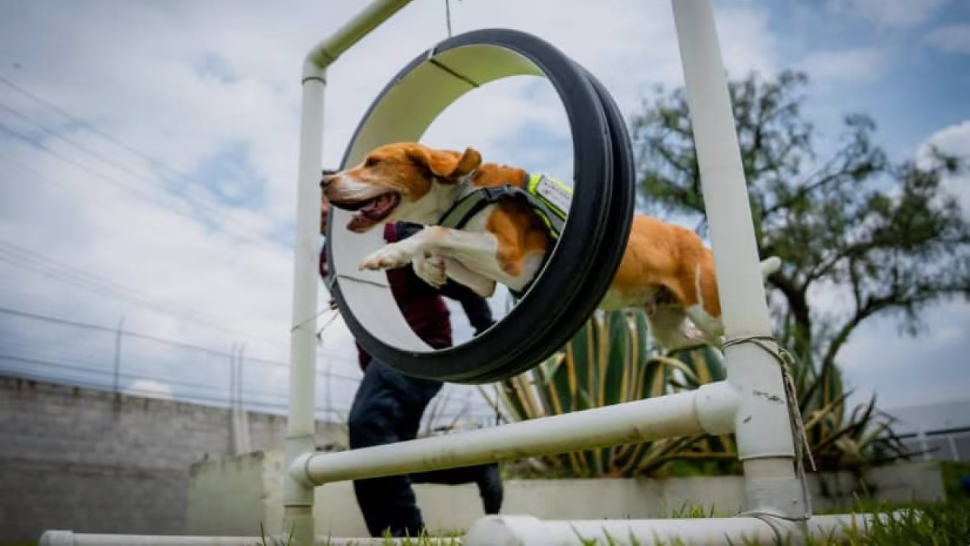
The Ministry of Agriculture and Rural Development (Sader) began the training of five canine pairs that will participate in health inspection tasks in Central America and the Caribbean. The objective: strengthen the detection of pests and diseases that affect plants and animals, and prevent their spread between countries.

The dogs, members of Generation 82 of the Canine Training Center (Ceacan), were assigned by the National Agri-Food Health, Safety and Quality Service (Senasica) to four officers from the Dominican Republic and one from Belize. For six weeks they will receive specialized training before joining inspection tasks in their respective countries.

At the welcome ceremony, Jorge Bustamante Rojano, director of Strategic Management of Quarantine Services of Senasica, highlighted that this program not only strengthens health protection, but also promotes regional cooperation. The canine teams will be key to identifying products that may represent a phytosanitary risk in ports, airports and borders.

The initiative is part of Mexico’s efforts to share its experience in agri-food health with neighboring nations. Training includes techniques for detecting specific odors of pests and diseases, as well as safe handling of animals during inspections. At the end of the course, the binomials will be certified to operate under the international standards of the International Plant Protection Convention.

Continue reading