Sheinbaum proposes a general agreement to Trump and he responds with apologies

The Mexican president seeks a comprehensive pact with the United States, while Trump admits the importance of Mexican migrants.

A call that changed everything (or maybe not)

After her brilliant participation in the G7 Summit—where surely all the world leaders were fighting to take a selfie with her—, our beloved president Claudia Sheinbaum decided that it was time to mark the most unpredictable man on the planet: Donald Trump. The reason? Propose a “general agreement” on security, migration and trade. Because, of course, when you think about “comprehensive agreements” and “Trump,” the first thing that comes to mind is… consistency.

Trump’s apology: sincerity or strategy?

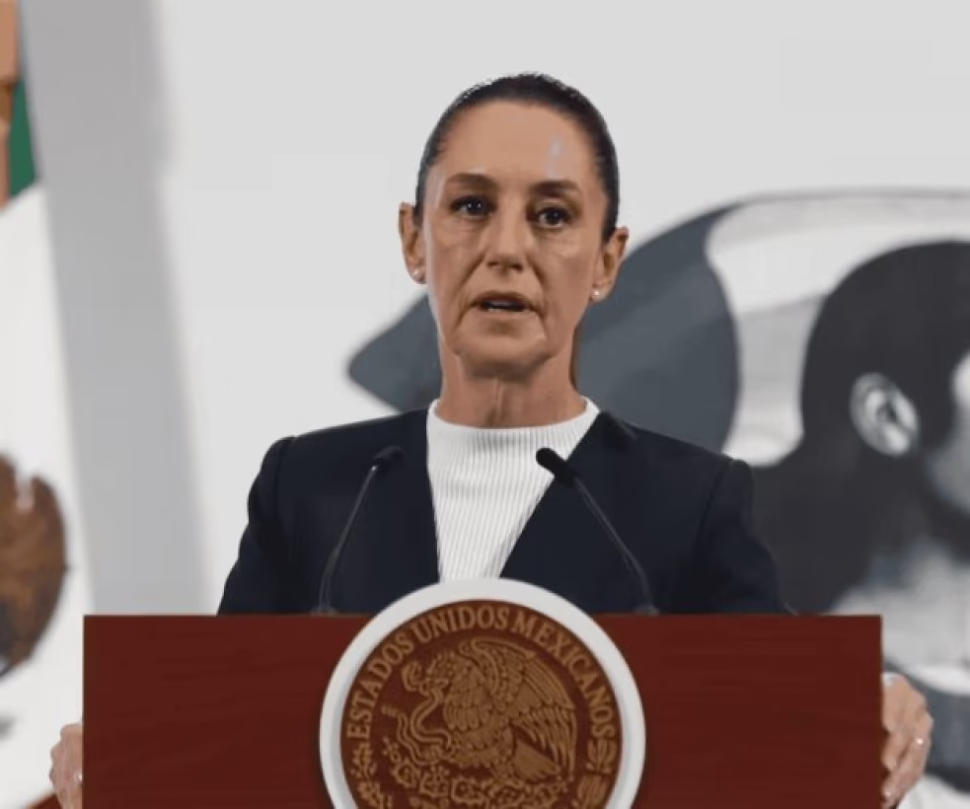
In his now legendary morning conference—that space where journalists go for coffee and leave with more questions than answers—, Sheinbaum revealed that the New York mogul apologized for abruptly withdrawing from the summit. The reason? The conflict in the Middle East, although we all know that Trump prefers personal dramas to geopolitical ones. But hey, at least he said “I’m sorry”… it’s something.

RelatedTrump anticipates a trade agreement with China in the next summit

The president wasted no time and released her star idea: a general agreement that would cover everything from border security (because a wall was not enough) to trade (just in case NAFTA gets bored of existing). Trump, in a burst of lucidity—or perhaps distracted by a pending tweet—assented and even recognized the importance of Mexicans in the US. Surprise! Apparently, someone reminded him that without them, his country would be left without avocados and without construction equipment.

“There I also mentioned the importance of recognizing Mexicans in the United States… families who have been living for years, who work for the United States,” Sheinbaum said, as if Trump had not spent years demonizing them. But, oh miracle, the man responded: “true, there are many Mexican families who work for the good of our country.”. Did he mean it or did he just want to end the call? The world will never know.

Marcelo Ebrard to the rescue (again)

To give a touch of seriousness to the matter—or at least pretend that there is a plan—, Sheinbaum announced that Marcelo Ebrard, the eternal Secretary of Economy, will fly to the US to meet with his counterpart. The goal? Move forward on those pending issues that, it seems, will always be “pending.” Of course, with the condition that the agreement includes Mexican families. Because what good is a pact if you can’t use it to score political points?

Meanwhile, somewhere in Washington, Trump has probably already forgotten the conversation and is tweeting about something else entirely. But hey, at least Sheinbaum can say he tried. Will it achieve anything concrete? Well, in politics, sometimes it’s enough for the photo to turn out well.

Did you like this scathing analysis? Share it on your social networks and don’t miss any more equally irreverent content. Because politics without humor is like a taco without sauce!

AT&T Mexico loses a million prepaid users due to mandatory registration

One million prepaid users unsubscribed from AT&T Mexico due to mandatory registration.

Mandatory registration of mobile lines hits AT&T Mexico

The mandatory cell line registration process had a strong impact on AT&T Mexico’s prepaid customer base. During the second quarter of 2026, the company lost one million users in that segment. At the end of June, it had 15 million 829 thousand prepaid customers, according to its financial results.

In contrast, the postpaid service reported significant growth. The company added 369 thousand new clients, an increase of 20.7% compared to the same period of the previous year. Thus, it reached a total of 7 million 457 thousand users at the end of the semester.

Since January, telecommunications companies began registering mobile lines in the national registry. However, only 43% of the lines had been registered to date. Given this, the federal government extended the deadline to complete the process. The suspension of service for those who do not comply will begin in stages between August 15 and December 31.

The general director of AT&T Mexico, Mónica Aspe, indicated that the company will concentrate its efforts on successfully concluding the linkage process during the second half of the year. For its part, the consulting firm The Competitive Intelligence Unit (CIU) attributed the reduction in prepaid lines to the mandatory registration.

Despite the decrease in prepaid users, AT&T reported total revenue of $1,224 million in the second quarter. This represented annual growth of 16.1%, driven primarily by a favorable exchange rate. In addition, the company highlighted the strengthening of its network and the deployment of 5G infrastructure in stadiums and Fan Fest areas during the World Cup tournament, as part of its growth strategy.

Continue reading

US plans 10% tariff on Mexico for forced labor

A new 10% levy would replace temporary US tariffs linked to labor compliance.

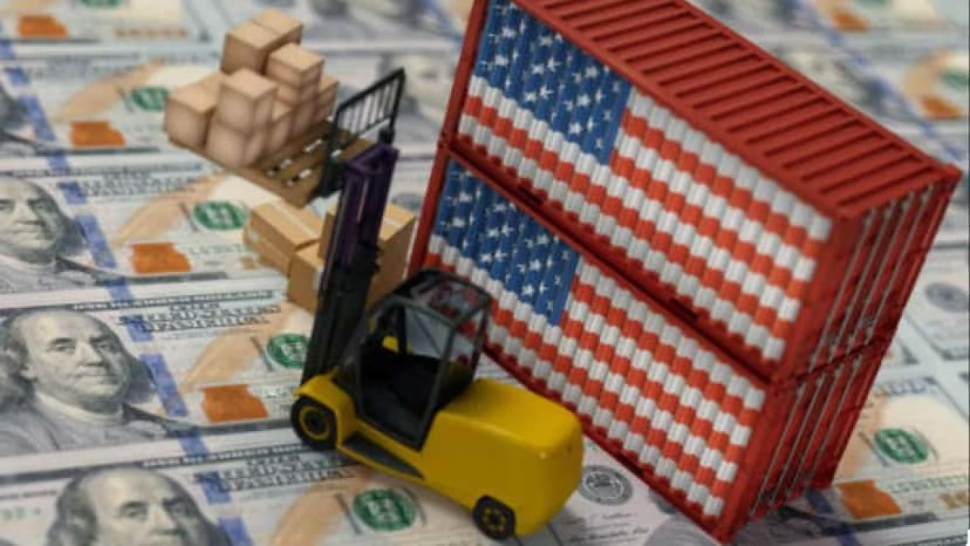
The United States is evaluating replacing the temporary tariffs that expire this week with a regional scheme focused on combating forced and child labor. The measure would impose a 10% tax on Mexican products, according to international trade specialists.

New tariff scheme

The tax would be linked to compliance with labor legislation and the prohibition of importing goods made with forced or child labor. It would also apply to inputs from third countries where these practices exist. Sanctions could hit entire regions, not just specific companies.

Adrián Castillo, partner at Von Wobeser y Sierra, pointed out that if US authorities detect signs of forced labor in a company in a certain area, trade restrictions would be extended to the entire region. He recalled that the T-MEC already includes provisions against goods produced under these conditions, and that Mexico implemented certification mechanisms since 2025.

Regional impact

Jorge Molina, a foreign trade specialist, indicated that the new tax will replace the temporary tariff established by Washington and responds to President Donald Trump’s strategy. He added that the measure seeks to prevent products manufactured with Chinese inputs from entering the US market through Mexico.

The precise details of the scheme will be known in the coming days, but experts warn that it will especially affect sectors with high exposure to the regional supply chain.

Continue reading

Dogs trained for health inspection in Central America and the Caribbean

Five canine pairs are training in Mexico to reinforce pest detection in the region.

Training of canine pairs for regional health

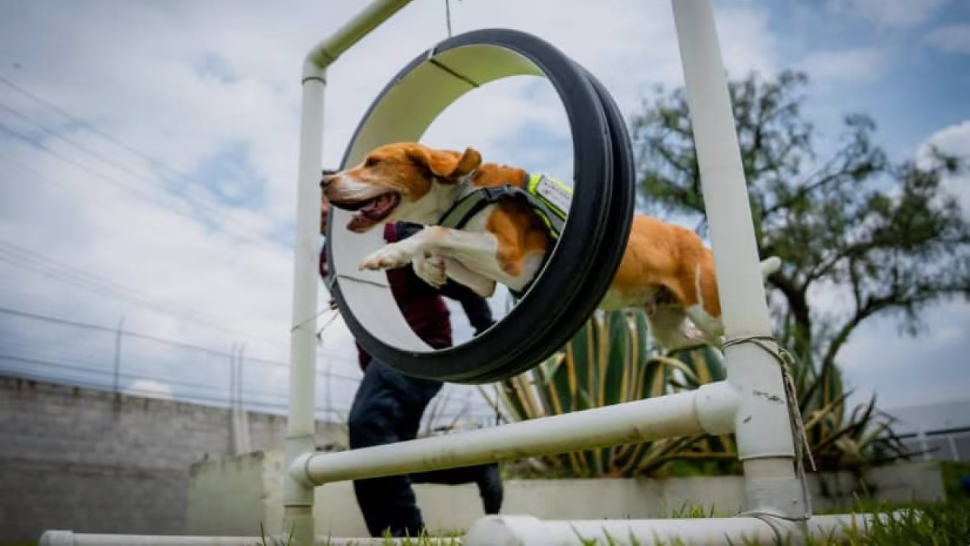
The Ministry of Agriculture and Rural Development (Sader) began the training of five canine pairs that will participate in health inspection tasks in Central America and the Caribbean. The objective: strengthen the detection of pests and diseases that affect plants and animals, and prevent their spread between countries.

The dogs, members of Generation 82 of the Canine Training Center (Ceacan), were assigned by the National Agri-Food Health, Safety and Quality Service (Senasica) to four officers from the Dominican Republic and one from Belize. For six weeks they will receive specialized training before joining inspection tasks in their respective countries.

At the welcome ceremony, Jorge Bustamante Rojano, director of Strategic Management of Quarantine Services of Senasica, highlighted that this program not only strengthens health protection, but also promotes regional cooperation. The canine teams will be key to identifying products that may represent a phytosanitary risk in ports, airports and borders.

The initiative is part of Mexico’s efforts to share its experience in agri-food health with neighboring nations. Training includes techniques for detecting specific odors of pests and diseases, as well as safe handling of animals during inspections. At the end of the course, the binomials will be certified to operate under the international standards of the International Plant Protection Convention.

Continue reading