Sheinbaum invites the Pope in the middle of the Guadalupana tide

In the midst of the massive pilgrimage, the president takes the opportunity to build a diplomatic bridge with the Vatican on a day of profound national symbolism.

A day of miracles, pilgrims and… heavenly diplomacy?

While a human tide, full of faith, fatigue and candles, flooded the streets towards the epicenter of Mexican devotion, President Claudia Sheinbaum decided that it was the perfect time for a little call. Not to a family member, but to none other than His Holiness, Pope Leo XIV himself. Because what better day to invite the highest leader of the Catholic Church to visit the country than when millions of his followers are busy walking miles, sleeping on the ground and praying for health? Impeccable timing, without a doubt.

From her official X account (previously known as that blue bird), the president released the news with the elegance of a divine press release. “Send blessings and greetings to everyone on this day of the Virgin of Guadalupe,” he wrote, as if the Pontiff had left a voice message on his cell phone. And then, the jewel in the crown of inter-institutional dialogue: a high-level coincidence. It turns out that both, the president and the Pope, “agreed” that Guadeloupe is a symbol of identity and peace. What a revelation! Who would have thought, after centuries of being the patroness of Mexico and Latin America.

RelatedCelebrities say goodbye to Pope Francis with emotional messages

The pilgrimage: faith, sweat and tears (literally)

Meanwhile, in the earthly world, the scenario was different. The Basilica of Santa María de Guadalupe became, once again, the magnet that attracts every Catholic with the strength to crawl, literally in some cases, to its doors. Gladys López, an anonymous heroine, walked 100 kilometers from San Felipe Teotlalcingo with her teenage daughter. The reason? “That the girl knew her.” Because of course, there is no better introduction to faith than a walk beyond the grave, sleeping on the pavement and collective ecstasy. She claimed that the effort was worth it, and one can only imagine her saying so while massaging her feet and smiling blissfully.

Nothing was missing: traditional dances that mixed with the murmur of prayers, pilgrims who advanced on their knees (probably inventing new physiotherapy methods in real time), and gentlemen like José Luis González Paredes, 82 years old, who has been at this annual event for more than three decades. His request is a poem of realism and hope: health to endure the journey and permission to return next year. A direct negotiation with divinity, without intermediaries.

And in the midst of this organized chaos, the civil protection authorities mounted one of their largest operations of the year. Because coordinating the security of one of the most massive pilgrimages on the planet is just a minor logistical detail, a small challenge between overflowing faith and total road collapse. Everything normal.

Tradition, of course, remembered that all this began with a Marian apparition to an indigenous peasant named Juan Diego in 1531. An event so miraculous that he even printed an image on a cloak, cutting-edge technology for the time. And for those who could not join the walk, the party was also digital: from the hymn “La Guadalupana” covered with electronic beats by a priest, to intimate interpretations in the Rarámuri language. Because devotion, in the modern era, must also be viral.

So there you have it: a country stopped by faith, a president doing Vatican diplomacy in record time, and thousands of people proving that, sometimes, the best connection with the divine requires a good dose of physical suffering. A perfect cocktail of spirituality, politics and pure street spectacle. Will Sheinbaum get the Pope to set foot on Mexican soil? Only time (and perhaps a new Guadeloupan miracle) will tell. Meanwhile, the candles remain lit and the knees of the faithful, probably, continue to hurt.

Did you love this ironic look at current events?Share this article on your social networks and make more people smile (or reflect) with us. And be sure to explore more content related to politics, culture and those absurd wonders that make Mexico unique.
One year after the discovery in a crematorium, families march for justice

One year after the discovery of 386 bodies, families demand justice and an end to corruption.

March for justice one year later

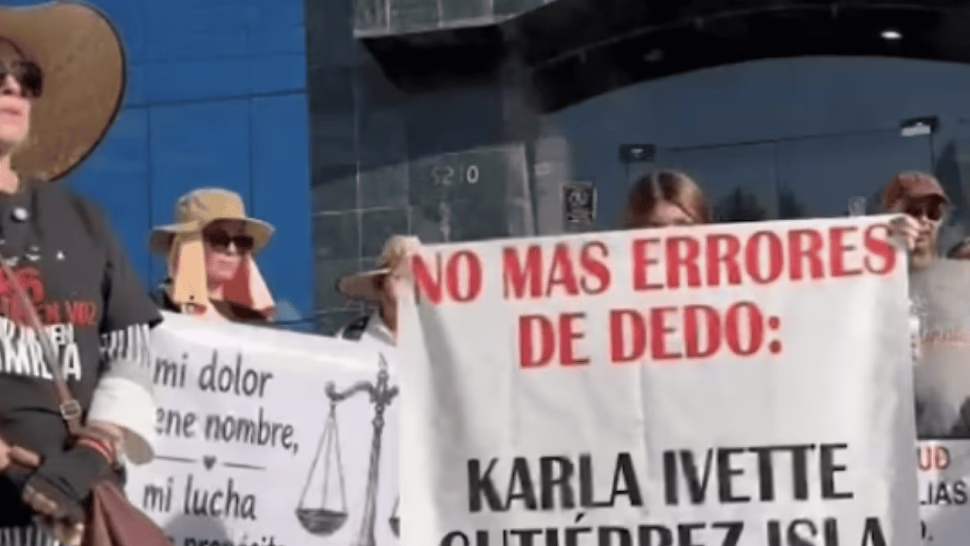
On Saturday afternoon, groups of families affected by the Plenitude crematorium case demonstrated. The discovery of 386 bodies turns one year old, and the bereaved demand answers.

The protest began at the Latinoamericana funeral home, one of those identified by family members. From there, the protesters walked towards the State Attorney General’s Office (FGE).

Dora Elena Delgado, spokesperson for the Justicia para Nuestros Deudos collective, reported that at least 1,500 families were affected. The central demand: no more impunity, no more corruption and full justice.

Actions pending by the authority

The protesters carried blankets with messages of justice. They demand action against Coespris officials involved in the case, as well as the recapture of José Luis A. C., owner of the crematorium. He was released by a federal judge, and a red card from Interpol is expected to arrest him again.

So far, of the 386 bodies found, the FGE reports that 135 remain to be identified. The identification process continues.

The collective Memory, Dignity and Justice joined the mobilization. They placed a permanent memorial in the shape of a cross outside the Prosecutor’s Office, as a reminder of the victims.

Continue reading

Sheinbaum asks to preserve native corn for national sovereignty

Sheinbaum highlights that native corn is key to food sovereignty and national identity.

President Claudia Sheinbaum Pardo reaffirmed that the governments of the Fourth Transformation defend national sovereignty in all areas. During a meeting with farmers in Pijijiapan, Chiapas, he highlighted the importance of native corn as a pillar of Mexican identity and self-sufficiency.

Defense of sovereignty through native corn

Sheinbaum presented the “Corn is the Root” program, whose objective is to improve the conditions of producers and reduce dependence on seeds controlled by large corporations.

“Conserving native corn also means defending sovereignty,” he stated.

The president warned about the risks of hybrid seeds:

“If we continue with pure hybrid corn, people will depend on buying seeds and those who sell the seeds will be a few companies.”

He stressed that preserving native varieties is essential to avoid this economic dependence.

“If we did not have native corn, we would lose a good part of food sovereignty, of what we are as Mexicans,” he said.

In addition, it extended the defense of sovereignty to the energy, cultural and food fields. She assured that the Fourth Transformation drives her “in every possible way.”

The program seeks to strengthen small farmers and conserve the genetic diversity of corn, a central element in the country’s diet and culture.

Continue reading

Mexico sends rescue team to Venezuela after earthquakes

25 specialists and 5 canine pairs travel to support search efforts in Venezuela.

Solidarity in action

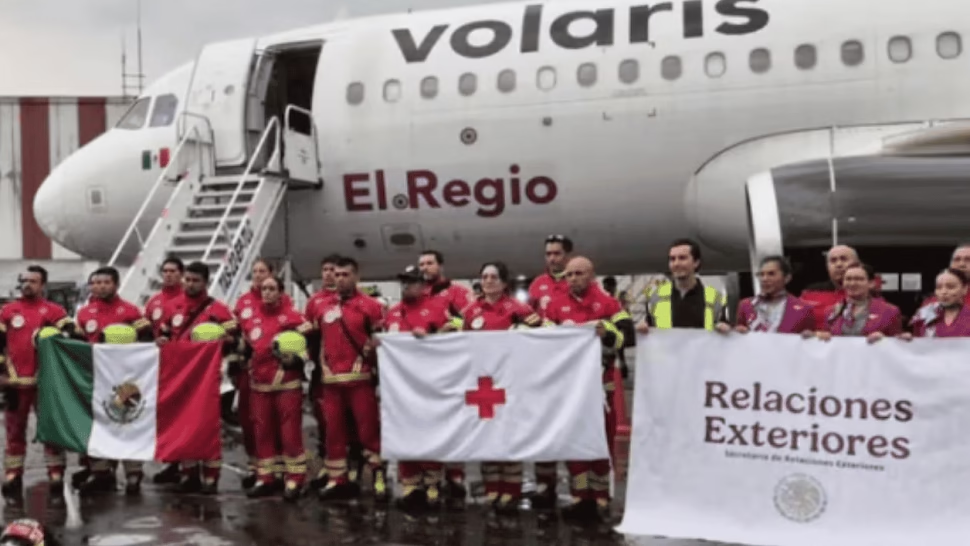
After the earthquakes of magnitude 7.2 and 7.5 registered in Venezuela on June 24, which left 1,430 dead and 3,328 injured, Mexico reinforced its humanitarian support. The Ministry of Foreign Affairs (SRE) coordinated the sending of a rescue mission with the Mexican Red Cross and the Volaris airline.

“This afternoon a support team made up of 25 specialists from the Urban Search and Rescue Unit (USAR) of the Red Cross and the Cancun International Rescue Brigade (USAR BRIC) left for Venezuela, as well as a brigade element from the Azteca Topos,” the agency indicated.

Equipment and logistics

The mission includes five canine pairs and 3.5 tons of specialized equipment for search and rescue tasks in the rubble. The shipment was transported on a Volaris flight.

“With this, Mexico reaffirms its solidarity and commitment to the Venezuelan people in these difficult times,” the SRE said in a statement. Foreign Minister Roberto Velasco heads the coordination of this aid.

Continue reading