The new General Water Law comes into force in Mexico

The new legal framework redefines water management in Mexico, establishing bases for its equitable access and sustainable use as a fundamental right.

A new legal framework for national water management

After its publication in the Official Gazette of the Federation (DOF) on Thursday, December 11, the General Water Law formally came into force this Friday, December 12. This powerful legal instrument not only establishes a new regulation, but also entails the reform, addition and repeal of multiple provisions of the previous National Water Law, marking a turning point in the country’s water policy.

From an analytical perspective, this law represents the legislative materialization of a pending constitutional mandate. It acts as a regulation of article 4, eighth paragraph, of the Political Constitution of the United Mexican States, which explicitly recognizes the human right to access, disposal and sanitation of water for personal and domestic consumption. Its structure is designed to establish the bases, supports and modalities that guarantee equitable access and sustainable use of water resources. Likewise, it precisely delimits the powers and cases of concurrence between the three levels of government: the Federation, the federal entities and the municipalities, a crucial aspect for effective coordination.

RelatedGeneral Water Law Initiative reaches the Mexican Congress

Fundamental objectives and scope of the legislation

The primary objective of this regulation is two-faceted. Firstly, it seeks to clearly define the content and scope of the human right to water, establishing the specific provisions that guarantee its equitable access and sustainable use. Secondly, it has the purpose of promoting, respecting, protecting and guaranteeing this fundamental right, aligning national legislation with international treaties on human rights to which the Mexican State is a party. This implies an obligation of results on the part of the authorities, transcending the mere declaration of principles.

The law also institutionalizes the mechanisms of government action. It formally establishes the instances, instruments and procedures for the coordinated participation of the Federation, the states and the municipalities in the protection and guarantee of the human right to water. At the same time, it defines the channels and instances of citizen participation, recognizing that the effective management of such a vital resource requires social co-responsibility. A key operational component is the strengthening of the bases for the provision of public drinking water and sanitation services, in order to guarantee equitable and sustainable access.

An in-depth analysis reveals the incorporation of transversal and innovative perspectives in water governance. The law establishes the bases for public policies that obligatorily integrate gender, disability, interculturality, intergenerational, ecosystemic and age approaches. This provision seeks to promote conditions of real equity in the management and governance of the resource, addressing the specific needs of different population groups and recognizing the interdependence between water systems and ecosystems. Finally, the regulations include an explicit mandate to promote water culture, a fundamental educational element for the long-term conservation and responsible use of the resource.

The implementation of this law poses considerable logistical and institutional coordination challenges, but its entry into force constitutes a structured and necessary step towards a fairer, more sustainable water management model aligned with human rights. Its success will depend on the allocation of resources, the technical capacity of the operating organizations and the rigorous monitoring of its provisions.

Are you interested in understanding how this new law impacts sustainability and environmental rights?Share this analysis on your social networks and explore more specialized content on legislation and natural resource management on our site.

Jóvenes Construyendo el Futuro: 3.5 millones de beneficiarios en ocho años

Sheinbaum detalla los alcances del programa social en Xalapa, Veracruz.

La presidenta Claudia Sheinbaum informó que el programa Jóvenes Construyendo el Futuro ha beneficiado a más de 3.5 millones de personas entre 2019 y 2026. El anuncio lo hizo durante una asamblea en el Museo Kaná de Xalapa, Veracruz.

Cifras del programa

El programa ofrece un año de experiencia laboral pagada por el gobierno. Los participantes son considerados aprendices y reciben un apoyo mensual equivalente al salario mínimo, además de seguridad social.

“Ese año de experiencia a los jóvenes les ha permitido encontrar de mejor manera un empleo”, afirmó Sheinbaum.

La subsecretaria de Empleo, Quiahuitl Chávez Domínguez, precisó que la inversión total supera los 170 mil millones de pesos en los últimos siete años.

RelatedYoung People Building the Future opens 45 thousand training places

Inversión educativa

Sheinbaum también destacó que su administración trabaja en la creación de 200 mil nuevos espacios para Educación Media Superior y 330 mil para Educación Superior, a través de instituciones públicas.

A la reunión asistió la gobernadora de Veracruz, Rocío Nahle García, quien reconoció el impacto de la estrategia en la entidad. El beneficiario Diego Armando Gallardo Castillo agradeció la continuidad del apoyo económico para el sector de las artes escénicas.

Continue reading

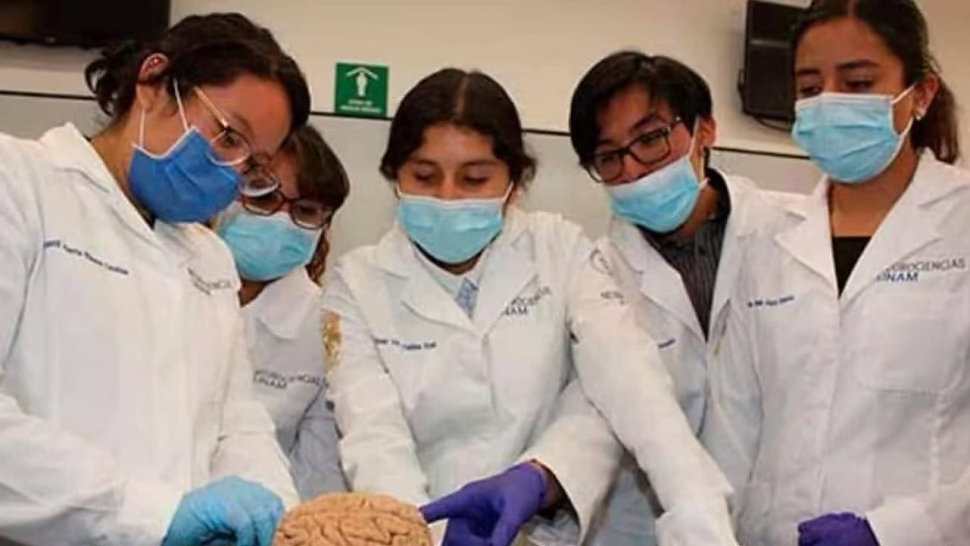
70% de alumnas en medicina, pero solo 30% en puestos directivos

Persisten brechas de género en el sector salud pese a la feminización de la matrícula.

La matrícula de la Facultad de Medicina de la UNAM está compuesta en un 70% por mujeres. Sin embargo, en los puestos directivos del sector salud apenas alcanzan el 30%. Así lo informó la directora de esa entidad, Ana Carolina Sepúlveda Vildósola.

Al encabezar la graduación de la primera generación del Programa de Formación de Liderazgos de Mujeres Médicas, señaló que persisten barreras estructurales que limitan el acceso femenino a la toma de decisiones.

“La medicina se está feminizando”, subrayó.

El programa, impulsado junto con Aúna y Roche, capacitó a 48 médicas y profesoras de pregrado y posgrado para fortalecer su liderazgo. Sepúlveda Vildósola las invitó a proyectarse como futuras directoras de hospitales, jefas de servicio y diseñadoras de políticas públicas.

RelatedUNAM protects its Faculty of Medicine from attempted takeover

La directora general de Roche México, Mónica Palomanes Seoane, destacó la relevancia de incorporar más liderazgos femeninos en un sector donde la participación de las mujeres es cada vez mayor. Su directora médica, Maryet Pérez Barahona, señaló que el programa busca mejorar la atención a pacientes y fortalecer equipos de trabajo.

Mónica Tapia Álvarez, coordinadora estratégica de Aúna A.C., consideró que México vive un momento favorable para ampliar la presencia femenina en liderazgo, gracias a generaciones con mayor escolaridad y participación en espacios públicos.

Continue reading

Profeco advierte: no descuides tus finanzas en el Mundial 2026

Profeco emite guía para evitar deudas durante la Copa Mundial 2026.

A meses del Mundial 2026, la Procuraduría Federal del Consumidor (Profeco) lanzó una serie de recomendaciones para evitar que la emoción del torneo afecte tu bolsillo.

Compras responsables

La dependencia sugiere fijar un presupuesto antes de adquirir artículos, boletos o servicios relacionados con el evento. Comparar precios es clave. Para ello, está disponible la plataforma Quién es Quién en los Precios, donde se revisan costos de distintos productos.

RelatedProfeco demands that Sony show PlayStation prices in pesos

Evita compras impulsivas. Define cuánto puedes gastar y qué realmente necesitas.

Cuidado con el crédito

Profeco recuerda que las tarjetas de crédito generan intereses. Si usas promociones a meses sin intereses, el total no cambia. Evalúa tu capacidad de pago antes de comprometerte.

“Los pagos mensuales pueden parecer reducidos, pero el monto total de la compra permanece sin cambios”, advierte el comunicado.

Cumple puntualmente con las fechas de pago para evitar recargos.

Canales de atención

La institución mantiene su correo y líneas de atención habituales para recibir reportes, consultas o denuncias relacionadas con el Mundial.

Proteger tu economía también es parte del juego.

Continue reading