The Digital Siege: A Year Under the Fire of Disinformation
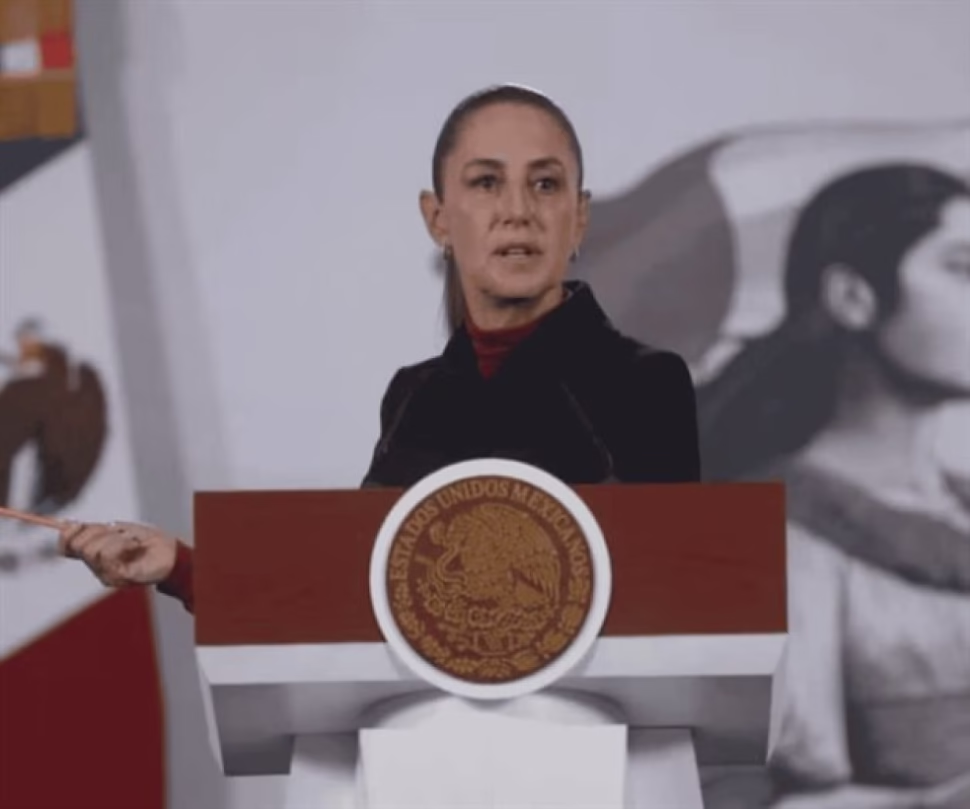
In the heart of the vibrant and always tumultuous Mexico City, President Claudia Sheinbaum Pardo raised her voice to reveal a truth that shakes the foundations of the public sphere. His government, he stated with the serenity of someone who has fought a silent battle, faced during the tortuous year 2025 a media offensive of epic proportions and an unstoppable epidemic of fake news that poisoned public debate. This deluge of manipulation, arising primarily from the dark depths of social media, was unleashed with fury, despite the most recent polls showing it standing tall with levels of citizen approval exceeding a staggering 70%!
Questioned about this paradox, the President, with her gaze fixed on a horizon of challenges, clearly recognized that the cycle that had just concluded was marked by calculated information attacks and by vast disinformation campaigns that became tangled like toxic weeds around each national event. “We had a year, the 25th, of a lot of media offensive and on networks as well,” he declared during his conference, in a phrase that resonated like the echo of a conflict waged on a thousand digital fronts.
The Poison of Lies and the Resistance of Facts
Sheinbaum warned, with the gravity of a prophecy, that the phenomenon of informative falsehoods not only persisted, but had intensified to become one of the most formidable challenges to public life and the nation’s fragile democracy. “The amount of fake news that there is on the networks, of notes, of information, is increasing,” he said, painting a panorama where the truth struggled to breathe under an ocean of fabricated lies. But the plot thickened with a sinister technological twist.
In this context of perceptual war, the President launched a chilling warning about the impact of the perverse use of artificial intelligence. This tool, born of human ingenuity, has become the favorite weapon for manipulation of content and the construction of deceptive narratives so perfect that they defy reality itself. “With artificial intelligence and the way people show themselves, it is something for everyone to debate,” he expressed, inviting urgent collective reflection in the face of a future where seeing will no longer be believing.
The head of the Executive then raised the central challenge of this era: how to guarantee the sacred right of citizens to truthful information in the midst of this orchestrated chaos? Faced with the storm, he maintained that his administration’s response, the secret to maintaining that high public valuation, did not lie in counterattacking with the same coin, but in something deeper and more human: “it is by being close to the people, by not losing the principles.” It was the direct connection with the people, the anchor in values, the trench from which to resist the siege.
The battle for the story, for control of the truth, has moved to a digital playing field where the rules are rewritten every day. This confrontation between government management and information poisoning operations marks a turning point in contemporary politics. The institutional credibility and the democratic health of the country hang by a thread, challenged by algorithms that amplify the noise and sophisticated tools capable of creating alternative realities. Sheinbaum’s warning is not just a diagnosis; is the first chapter of an epic fight for the soul of public debate, where every click, every share, can be an act of resistance or betrayal of the truth.
Are you ready to be part of the solution? Help break the chain of misinformation. Share this analysis to raise awareness about the value of verified information and explore more content that unravels the great challenges of our time.