
Another alleged person responsible for the robbery at the DIF Oaxaca falls

The seventh person involved in the 3.6 million peso assault was captured in the capital of Puebla.

A new blow to the gang that attacked the payroll of the Oaxaca State DIF. The State Attorney General’s Office reported the arrest of J. S. M. A. in the city of Puebla. With this, there are now seven people insured for the theft of three million 600 thousand pesos that occurred on April 26 on Avenida Universidad de Oaxaca in Juárez.

This is how the criminal cell operated

According to the investigations, those involved arrived in Oaxaca one day before the robbery. They stayed in a hotel in the Historic Center to coordinate logistics. The authorities traced the escape route, identified vehicles, telephone lines, security areas and financial movements linked to the network.

RelatedOperation Northern Border secures 2,495 weapons and tons of drugs

The first six detainees were captured on May 4 in Infonavit San Bartolo, Puebla: I. M. L., R. D. P. and M. A. S. V. A day later, on May 5, A. I. T. M. — identified as the operational leader — and J. C. C. were captured. The main organizer of the gang, identified as A. M. S. R., would have obtained and provided strategic information to commit the crime.

The seventh arrest occurred on July 17 on Segunda Cerrada street on 5 Norte, San Rafael Oriente neighborhood, in Puebla. The Prosecutor’s Office continues investigations to completely dismantle the structure and bring all those responsible to justice.
Los Chapitos financial operator captured in Mazatlán

Blow to the finances of Los Chapitos: their operator in Mazatlán is captured.

Detention in Mazatlán

The Security Cabinet reported on the arrest of Ricardo ‘N’, alias ‘El Tío’, alleged financial operator and leader of a criminal cell linked to Los Chapitos. The arrest occurred in Mazatlán, Sinaloa.

In the operation, carried out in a coordinated manner by the Secretariat of the Navy, the Secretariat of Security and Citizen Protection, the Attorney General’s Office and the National Intelligence Center, another five people were arrested.

The authorities seized firearms, chargers, cartridges, drugs and vehicles. The information was disseminated in the agency’s official accounts.

The Security Cabinet reiterated its commitment to continue working together to weaken criminal structures and stop those responsible for violence.

Continue reading

Reopening of borders to Mexican livestock after 14 months of blockade

14 months without selling to the US left losses of 592 million dollars.

End of the blockade of live cattle

After 14 months without being able to export live cattle to the United States, Mexican producers are preparing to resume sales. The gradual reopening will begin on August 24. During the blockade – from May 2025 to July 2026 – 1,974 million head of cattle were stopped being shipped.

According to the Agricultural Market Consulting Group (GCMA), the lost opportunity represented 592 million dollars. Exporters had to sell in Mexico for 900 dollars per head, compared to the 1,200 they would have obtained in the US market.

The damage could have been greater thanks to the increase in beef exports. Between January and June 2026, US$1,618 million worth of this product was sold to the US, although the figure is lower than what was generated before with live cattle.

Effects in the United States

The Mexican cattle shortage hit American feedlots. Meat production fell by 731 thousand metric tons. This skyrocketed prices: ground beef is around $7 per pound; the Sirloin exceeds 14 dollars.

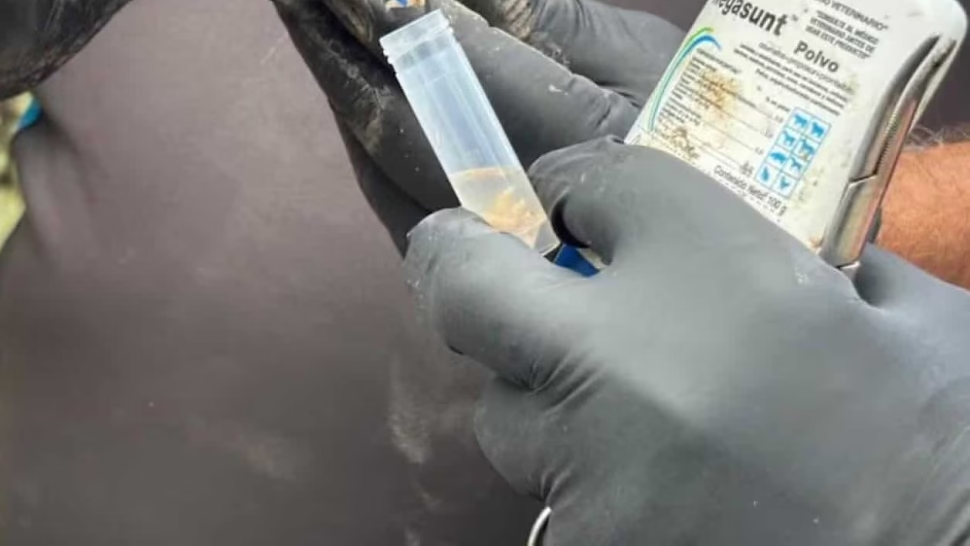
The blockage was due to cattle screwworm. The Mexican Meat Council (Comecarne) celebrated the reopening and highlighted that it strengthens the value chain between both countries.

The National Agricultural Council (CNA) recognized that, despite limited resources, the Ministry of Agriculture and Senasica implemented surveillance and control measures for the worm. He noted that collaboration with US health authorities allowed for a joint Action Plan based on technical criteria.

Key advances: the sterile fly breeding plant in the south of the country, which will accelerate the eradication of the screwworm, according to the CNA.

Continue reading

Sheinbaum defends self-determination in Nicaragua

Sheinbaum defends self-determination in Nicaragua but rules out similar measure in Mexico

Sheinbaum’s position regarding the cancellation of elections in Nicaragua

President Claudia Sheinbaum was questioned about the decision of Daniel Ortega’s government to cancel the elections in Nicaragua, a measure that seeks to prevent the opposition from gaining power.

The Mexican president avoided issuing direct criticism and chose to defend the principle of non-intervention:

“It is the self-determination of the people, what the people of Nicaragua decide, and we always agree with democracy, in all its terms.”

Sheinbaum also responded if he would approve a similar measure in Mexico. His response was clear:

“No, here there is even a revocation of the mandate. Democracy, democracy, democracy. Each country decides, each people decides. We are in favor of democracy, but each country decides how it is organized.”

The presidential position reflects the Mexican tradition of respecting the sovereignty of other nations, although in this case the cancellation of the elections has been condemned by international organizations such as the OAS and the UN. Sheinbaum, however, did not join these criticisms and avoided describing Ortega’s action as a democratic setback.

Analysts point out that the response seeks to maintain cordial relations with the Nicaraguan regime, a historical ally of the Mexican left. The Mexican Foreign Ministry has not issued an official position beyond what the president said.

Continue reading