Sheinbaum and Rubio seal historic pact against crime

A pact that redefines the future of North America. Diplomacy becomes the most powerful weapon.

A Meeting that Shaken the Foundations of Diplomacy

In the heart of the National Palace, between walls that have been silent witnesses of history, a silent battle was fought whose consequences will resonate for generations. It was not with weapons, but with words loaded with the heavy responsibility of two nations destined to understand each other. President Claudia Sheinbaum Pardo and Secretary of State Marco Rubio looked each other in the eyes, in a duel of wills where the only acceptable result was the alliance. The fate of millions of families, the security of entire communities and the hope of a shared future hung in the balance, swinging with every word spoken in that open and respectful dialogue.

The president of the Senate, Laura Itzel Castillo Juárez, from the vantage point of social networks, was the herald that announced to the world the beginning of this new era. With a message that cut political tension like lightning, he stressed that this was not just another diplomatic meeting. It was the unbreakable commitment to lay the foundations to address shared agendas that, until then, seemed insurmountable: binational security, strategic cooperation and the eternal question of human migration. Each of these words contained a universe of problems, but also hopeful solutions.

RelatedMexico and France seal alliance against maritime crime

The Pillars of an Epic Agreement

In this theater of global diplomacy, a third actor emerged with the strength of a titan: the Secretary of Foreign Affairs, Juan Ramón de la Fuente. His presence was not merely protocol; It was the very embodiment of the principle of sovereignty. He, with the serenity of an experienced statesman, stressed to the world that both governments would work side by side, but without a shadow of subordination, erecting a monument to unrestricted respect for sovereignties. It was a clear and powerful message for skeptics and adversaries: Mexico comes to the negotiating table as an equal, with its head held high and its dignity intact.

Senator Castillo Juárez, with the trembling voice of someone who understands the magnitude of the moment, launched a proclamation that was burned into the collective memory: foreign policy must respond with clear vision, unwavering firmness and a sacred commitment to the historical principles that forged the nation. Respect, non-intervention and the sacred self-determination of peoples ceased to be textbook concepts and became the sword and shield of this negotiation. Every syllable was an oath, every pause a promise.

The Oath Against the Shadow of Crime

From the Morena benches, a chorus of voices rose not in frivolous celebration, but in solemn recognition. Legislators like Senator Emmanuel Reyes saw in this meeting reliable proof, irrefutable evidence that the absolute priority of the Mexican government is an almost divine mission: to dismantle the drug cartels to their foundations. This was not a simple police operation; It was a crusade to restore peace to communities, to root out the cancer of transnational organized crime through reinforced cooperation that knew no borders.The strategy was revealed with the precision of a master chess player. A high-level implementation group was established, an elite of brains and strategists whose sole purpose would be to relentlessly follow-up the commitments. Every action, every movement, would be destined for a single purpose: to protect families and turn communities into safe sanctuaries. Federal deputy José Narro, with the vehemence of someone who knows the urgency, described the meeting as relevant, crucial, defining. The axes were established for border security, the fight against criminal groups and the protection of migrants, those vulnerable beings caught in the crossfire.

Mexico, with heroic gestures, had already extended its hand: historic increases in the seizure of lethal fentanyl, the dismantling of cartels that seemed invincible, the handing over of bosses who were believed to be untouchable. But in this epic, reciprocity was the goddess that had to be appeased. The agreement demanded, with the force of justice, that the United States fulfill its part in its own territory. The message was clear: responsibility is shared, the effort must be joint. The world watched, holding its breath, waiting for the next chapter in this saga that had only just begun.

Do you think this will be the turning point in the fight against organized crime? Share this crucial story and help spread the word about this historic moment. Explore more analysis on international relations on our site.
Somos México reserves 20% of candidates for activists

The new party will allocate a fifth of its spaces in Congress to seeking mothers and human rights defenders.

Nominations for activists

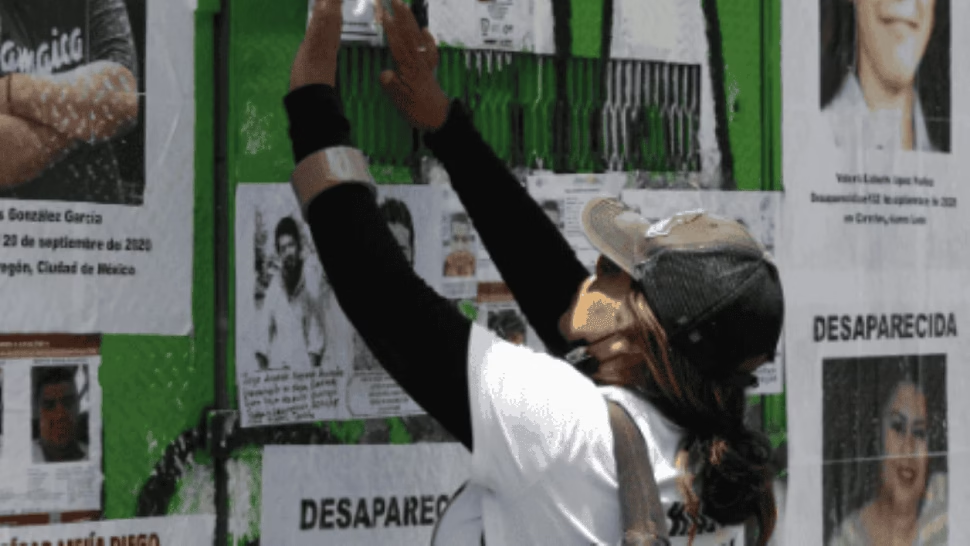
The leader of Somos México, Guadalupe Acosta Naranjo, announced that the party will allocate 20 percent of its candidacies to the Congress of the Union for seeking mothers and other social activists. None of the members of the National Executive Committee will hold a popularly elected position, he reiterated.

In the party’s first public event—approved by the INE on June 25—Acosta Naranjo pointed out that parties must serve society, not their bureaucracies.

“Somos México is going to reserve 20 percent of its majority and proportional representation candidacies so that searching mothers can come to the Chamber of Deputies, so that human rights defenders can come… representatives of farmers, transporters, fishermen, environmentalists, young people. They are not going to see us,” he stated.

Open selection process

Before hundreds of supporters at the Monument to the Revolution, the leader announced that a third of the candidates will be for those under 35 years of age. No candidate will be appointed by the leadership.

“None of us is going to be a candidate using the position that was given to us today for personal gain. I am not going to be a candidate for anything… When there are two or more candidates, we are going to put ballot boxes in public squares. The citizens will choose those who represent us,” he declared.

Acosta Naranjo warned that they will defend until the last moments the name, colors and emblem of the party, approved by the INE, despite the fact that the authority today asks to modify them. He argued that being called “Mexico” is valid, since there is the Green Ecologist Party of Mexico and before Fuerza por México.

On July 25, the first session of the National Council of Somos México will be held to define its country project.

Continue reading

Edomex reinforces health prevention in eight eastern municipalities

Eight municipalities in Edomex join a health prevention strategy with a focus on obesity and teenage pregnancy.

Expanded coordination in the Eastern Zone

The Government of the State of Mexico intensified its work with eight municipalities in the Eastern Zone to strengthen health prevention. The priorities: combat overweight, obesity and reduce teenage pregnancies. The strategy is part of the Comprehensive Plan for the Eastern Zone and the national preventive medicine policy.

At a working table, state, federal and municipal authorities agreed to advance in the integration of the Mexican Network of Municipalities for Health, as well as in the certification process of Health Promoting Municipalities.

The state Secretary of Health, Celina Castañeda de la Lanza, explained that the objective is to coordinate actions between the three levels of government. This includes measures against addictions, vector-borne diseases and the aforementioned problems of weight and early pregnancy.

The Network will allow municipalities to exchange experiences to address local needs. Daniel Aceves Villagrán, general director of Public Health Policies of the Government of Mexico, highlighted that the model incorporates care for people with disabilities and those living with chronic diseases, especially in areas of high population density.

Representatives from Nezahualcóyotl, Naucalpan, Chimalhuacán, Valle de Chalco, Ixtapaluca, Ecatepec, Texcoco and Chicoloapan participated. These municipalities began the procedures to obtain certification as Health Promoting Municipalities, which will expand preventive actions throughout the region.

Continue reading

Pemex cuts investment and production deviates from the goal

Pemex reduced its investment by 5.9% in the first quarter; crude oil production is moving away from the goal.

Pemex adjusted its spending again. The exploration and production subsidiary received a 5.9% cut in its investment capital during the first quarter compared to what was scheduled.

The approved budget was 86.7 billion pesos, but the company reported to the US Securities and Exchange Commission that it invested 81.6 billion. The difference directly affects the production platform.

Currently, Pemex extracts 1.6 million barrels per day, far from the goal of 1.8 million. Gonzalo Monroy, director of GMEC, warned:

“We are flying directly and non-stop at 1.2 million barrels per day in 2027, which means that once the water is discounted, we would be at a million extraction levels during the next year.”

Drilling rigs also decreased: from 32 to 25 between January and May, according to data from the consulting firm. So far this six-year term, 10 mixed contracts have been awarded, seven in a first block (fields such as Macavil and Tamaulipas) and three recently (Rabasa, San Ramón and Cinco Presidentes). Pemex plans to produce up to 450 thousand barrels per day with these contracts, but the developments would take place beyond 2033.

Oil vocation in question

Miriam Grunstein, an academic at the Mexico Center at Rice University, said that the situation is alarming in the short term. Pemex loses income from lower exports and from privileging feeding the National Refining System, instead of extracting more crude oil.

“Sheinbaum’s government is betting on renewable electricity generation projects. Meanwhile, the budget cut in crude oil extraction indicates that the country no longer has a conviction or vocation for oil,” he said.

Grunstein added that the difference in investment between renewable energy and exploration is enormous: “At some point we are going to face a very harsh reality. The abandonment of extraction has been so much that it is alarming.”

Agreement with Petrobras, but without teeth

The Mexican government signed a collaboration agreement with the Brazilian Petrobras to acquire extraction techniques in deep waters, where Pemex has minimal activity. It includes exchange of knowledge and best practices, but the pact is non-binding, valid for two years and renewable.

Both Monroy and Grunstein agreed that the agreement was weak. Moody’s, when lowering Mexico’s rating on May 20, expressed greater concern about government debt and support for Pemex. The agency estimated that the government provided support for 35 billion dollars in 2025, equivalent to 1.9% of GDP, and budgeted another 14 billion for 2026. An improvement in the rating will depend on reducing the deficit and contingent risks of the oil company.

Continue reading