Mexico and France seal alliance against maritime crime

A transatlantic pact that promises to change the rules of the game in the surveillance of the oceans against criminal networks.

It’s not ‘John Wick’, but almost: Mexico and France join forces against crime

It seems that international diplomacy is having its spy movie moment, but without the elegant suits of 007. In a move that reminds us that the world is a handkerchief (and crime knows no borders), Admiral Raymundo Pedro Morales Ángeles has just signed a Letter of Intent with Jean-Noël Barrot, the French minister who has a title so long that it seems like the name of a song by reggaetón: Minister of Economy, Finance and Industrial, Energy and Digital Sovereignty. The goal? Strengthen maritime security against transnational organized crime. Basically, it’s like when you and your friend team up to find your lost keys, but on a geopolitical scale and against cartels. With this movement, Mexico and France not only strengthen cooperation, but also enhance their joint capabilities to patrol those waters that, let’s be honest, are busier than a WhatsApp group on a Sunday afternoon.

The context: Macron comes down to earth (and gets serious)

So that this does not seem to come out of nowhere, it turns out that just this Friday, November 7, the president of France, Emmanuel Macron, decided to make a whirlwind visit to Mexico and sat down with Claudia Sheinbaum. It wasn’t to have a coffee and talk about the latest TikTok trend, but they agreed to cooperate to combat drug trafficking. This meeting, which has more weight than your New Year’s resolution, underlines the importance of international collaboration in the fight against organized crime, an issue that has climbed positions on the political agenda of both countries faster than a viral reel. Because, let’s be clear, in a world where everything is globalized, even illicit activities have their own version of “international collaboration”, so we have to respond in the same coin.

RelatedMexico and the United States establish security cooperation program

The signing of this Letter of Intent is a significant step in Mexico‘s strategy to face maritime security challenges. The authorities, with a hope that rivals that of a fan waiting for the launch of a new video game, trust that this collaboration will improve response capabilities against organized crime and strengthen security in territorial waters. France’s participation in this effort is seen as crucial support in the fight against drug trafficking and other illicit activities. Basically, it’s like when you call your friend who is good at something to help you with a complicated project: France arrives with its expertise and resources, offering that “boost” that could make the difference in a scenario that sometimes seems like a labyrinth with no exit.

And now what? The possible consequences of this geopolitical ‘match’

The agreement between Mexico and France could have a positive impact on maritime security, by allowing an exchange of information and resources that, in millennial terms, is like sharing notes for a final exam, but with classified data and naval patrols. International cooperation is essential to tackling organized crime effectively, and this agreement could lay the foundation for future collaborations in other areas of common interest. Imagine: if this works, we could see more strategic alliances that address everything from cybersecurity to species trafficking, because in the end, crime is a monster with many heads and they all have to be cut off. This is not a magic solution, but it is a step in the right direction, demonstrating that when countries come together, they can create synergies that will hopefully make life more difficult for criminal groups. In an ideal world, this will translate into safer waters and a more coordinated response, because, let’s face it, transnational crime is the annoying neighbor that no one wants, and we need to work as a team to keep it at bay.

Does this alliance seem relevant to you? Share this note on your social networks and help us make the importance of international cooperation viral. And if you want to stay up to date with more analysis on geopolitics and security, be sure to explore our related content.

Former Pemex director investigated for alleged assault on his wife

The Morelos Prosecutor's Office is investigating Víctor Rodríguez Padilla for alleged assault on his wife.

Investigation in progress

The Attorney General’s Office of the State of Morelos initiated an investigation file against Víctor Rodríguez Padilla, former director of Petróleos Mexicanos, after the dissemination of a video in which he is seen allegedly attacking his wife, María Felicia Jiménez. The recording, which circulates on social networks, shows Rodríguez Padilla repeatedly hitting the victim inside a home in the municipality of Emiliano Zapata, adjacent to Cuernavaca. According to the metadata of the video, the attack occurred on March 15.

The state agency reported that since Friday it has been exchanging information with the Women’s Secretariat of the Government of Mexico to guarantee the protection of the victim.

“The Attorney General’s Office of the State of Morelos initiated an investigation folder for the probable criminal acts derived from the dissemination of a public complaint through a video, where an act of violence against a woman is seen,” cited the FGE.

Protection actions

The Morelos Prosecutor’s Office specified that the investigation was opened in full respect for the rights of women, girls, boys and adolescents. The statement indicates that the events probably occurred on March 15 inside a home in Emiliano Zapata, with the alleged participation of a former federal official.

The institution assumed the commitment to exhaust all measures to determine responsibilities and guarantee a life free of violence for the victim. So far, no precautionary measures have been reported against Rodríguez Padilla, and the investigation is still ongoing.

Continue reading

Sheinbaum supervises progress of IMSS-Wellbeing with governors

Sheinbaum leads meeting with 23 governors to evaluate progress in the health system.

Advances in public health

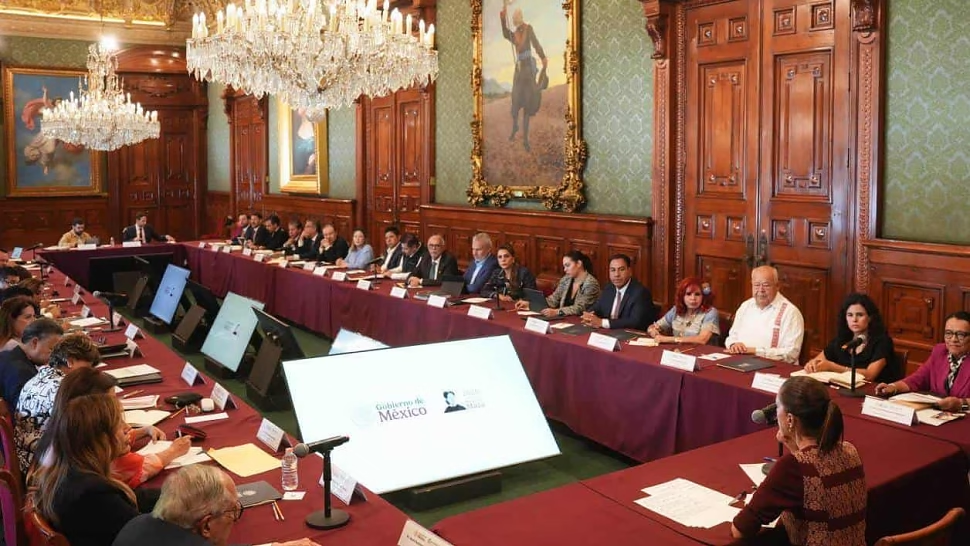
At the National Palace, President Claudia Sheinbaum led a follow-up meeting on the IMSS-Wellbeing model. Governors of the 23 entities integrated into the program participated.

“The objective is to guarantee quality, universal and free medical care for the people of Mexico.”

The federal cabinet was attended by Rosa Icela Rodríguez (Government), David Kershenobich (Health), Luisa María Alcalde (Legal Department), Eduardo Clark (Undersecretariat of Health), and the directors of IMSS-Bienestar (Alejandro Svarch), IMSS (Zoé Robledo) and Issste (Martí Batres).

The state leaders present were: Marina del Pilar Ávila (Baja California), Víctor Castro (Baja California Sur), Layda Sansores (Campeche), Eduardo Ramírez (Chiapas), Clara Brugada (CDMX), Indira Vizcaíno (Colima), Delfina Gómez (State of Mexico), Evelyn Salgado (Guerrero), Julio Menchaca (Hidalgo), Alfredo Ramírez (Michoacán), Margarita González (Morelos), Miguel Navarro (Nayarit), Salomón Jara (Oaxaca), Alejandro Armenta (Puebla), Mara Lezama (Quintana Roo), Ricardo Gallardo (San Luis Potosí), Yeraldine Bonilla (Sinaloa), Alfonso Durazo (Sonora), Javier May (Tabasco), Américo Villarreal (Tamaulipas), Lorena Cuéllar (Tlaxcala), Rocío Nahle (Veracruz), Joaquín Díaz (Yucatán) and David Monreal (Zacatecas).

The meeting is part of the periodic supervision to consolidate free coverage of health services in the country.

Continue reading

Morena dismisses youth commissioner after attack

Morena removed Jaime Castillo from his position after a video that shows him attacking a driver.

The National Executive Committee of Morena announced the dismissal of Jaime Castillo Castillo, who served as Youth Commissioner in Zacatecas. The decision was made after a video linked him to an act of violence against a driver during the celebrations for the victory of the Mexican National Team.

Facts and reaction

The images, spread on social networks, show the now former leader attacking the woman while his vehicle was surrounded by fans in the Historic Center of Zacatecas. The victim has already filed a complaint with the State Prosecutor’s Office.

In a statement, the party stated that in the movement “there is no place for any form of violence,” especially against women. Morena described the separation as an act of congruence and supported the actions of the state committee.

Castillo’s departure seeks to reinforce the institutional position against conduct that violates third parties, in a context where gender violence continues to be a sensitive issue in the public sphere.

Continue reading