Morena dismisses youth commissioner after attack

Morena removed Jaime Castillo from his position after a video that shows him attacking a driver.

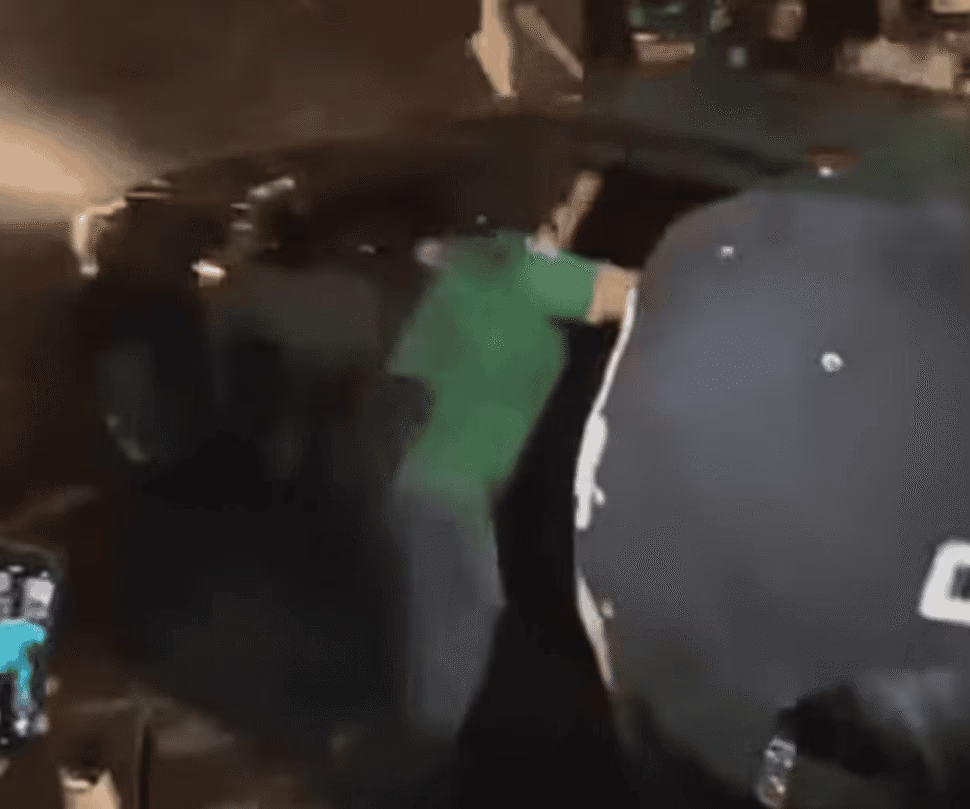
The National Executive Committee of Morena announced the dismissal of Jaime Castillo Castillo, who served as Youth Commissioner in Zacatecas. The decision was made after a video linked him to an act of violence against a driver during the celebrations for the victory of the Mexican National Team.

Facts and reaction

The images, spread on social networks, show the now former leader attacking the woman while his vehicle was surrounded by fans in the Historic Center of Zacatecas. The victim has already filed a complaint with the State Prosecutor’s Office.

RelatedMorena dismisses leader in Guerrero for alleged excessive expenses

In a statement, the party stated that in the movement “there is no place for any form of violence,” especially against women. Morena described the separation as an act of congruence and supported the actions of the state committee.

Castillo’s departure seeks to reinforce the institutional position against conduct that violates third parties, in a context where gender violence continues to be a sensitive issue in the public sphere.
Sheinbaum supervises progress of IMSS-Wellbeing with governors

Sheinbaum leads meeting with 23 governors to evaluate progress in the health system.

Advances in public health

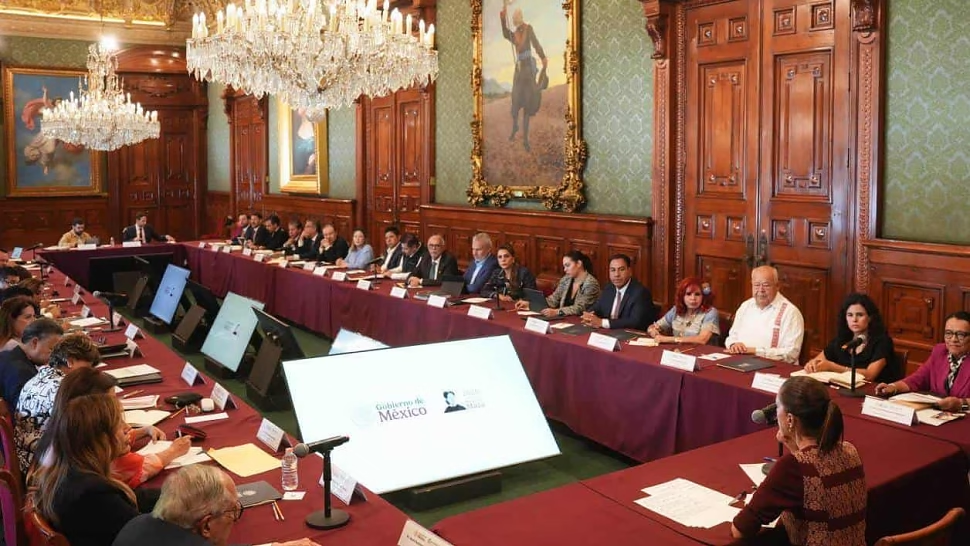
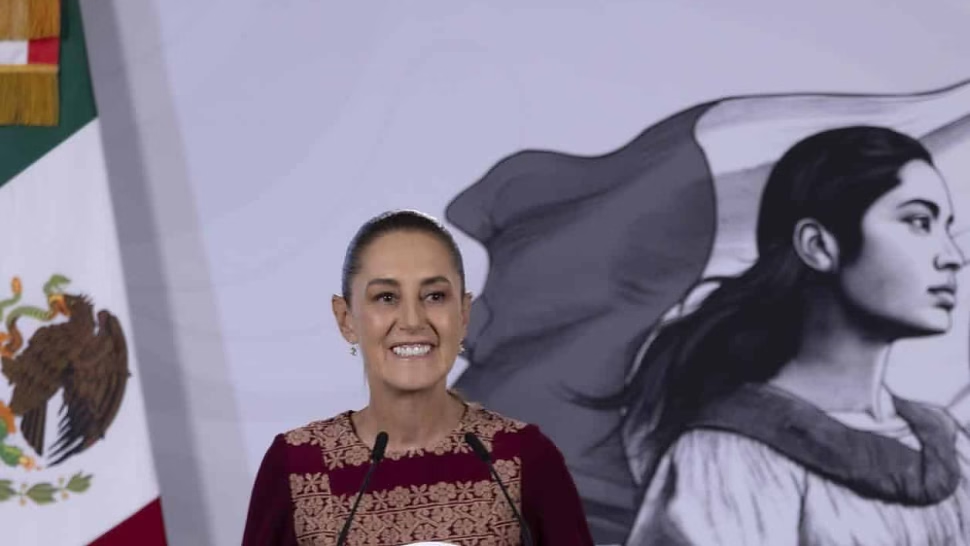
At the National Palace, President Claudia Sheinbaum led a follow-up meeting on the IMSS-Wellbeing model. Governors of the 23 entities integrated into the program participated.

“The objective is to guarantee quality, universal and free medical care for the people of Mexico.”

The federal cabinet was attended by Rosa Icela Rodríguez (Government), David Kershenobich (Health), Luisa María Alcalde (Legal Department), Eduardo Clark (Undersecretariat of Health), and the directors of IMSS-Bienestar (Alejandro Svarch), IMSS (Zoé Robledo) and Issste (Martí Batres).

The state leaders present were: Marina del Pilar Ávila (Baja California), Víctor Castro (Baja California Sur), Layda Sansores (Campeche), Eduardo Ramírez (Chiapas), Clara Brugada (CDMX), Indira Vizcaíno (Colima), Delfina Gómez (State of Mexico), Evelyn Salgado (Guerrero), Julio Menchaca (Hidalgo), Alfredo Ramírez (Michoacán), Margarita González (Morelos), Miguel Navarro (Nayarit), Salomón Jara (Oaxaca), Alejandro Armenta (Puebla), Mara Lezama (Quintana Roo), Ricardo Gallardo (San Luis Potosí), Yeraldine Bonilla (Sinaloa), Alfonso Durazo (Sonora), Javier May (Tabasco), Américo Villarreal (Tamaulipas), Lorena Cuéllar (Tlaxcala), Rocío Nahle (Veracruz), Joaquín Díaz (Yucatán) and David Monreal (Zacatecas).

The meeting is part of the periodic supervision to consolidate free coverage of health services in the country.

Continue reading

Sheinbaum asks King Felipe VI to apologize to indigenous peoples

Sheinbaum apologizes to indigenous peoples; king listens and agrees on cultural exhibitions.

Request for forgiveness and culture

President Claudia Sheinbaum expressed to King Felipe VI the importance of Spain complying with the request for an apology to the indigenous peoples of Mexico. “Fortunately, 28 million Mexican men and women recognize themselves as indigenous; 68 languages ​​are spoken in Mexico,” he noted.

The president stressed that the recognition of pre-Hispanic civilizations and the resistance of these peoples are fundamental for national identity. “We said no to racism, classism and any discrimination,” he said. The monarch listened and proposed including the topic at the indigenous peoples’ table during the Ibero-American summit in November in Madrid.

As a result, they agreed to send three exhibitions to Spain: one on Mayan culture, another on Spanish refugees, and one dedicated to Sor Juana Inés de la Cruz. Sheinbaum highlighted that the meeting was possible thanks to the king’s previous visit to an exhibition on indigenous women in Madrid, where he recognized “abuses committed during the arrival of the Spanish.”

Both leaders also discussed trade, economics and the United Nations Charter. “It was a very cordial meeting; he’s a very down-to-earth person,” Sheinbaum said. After the dialogue, they visited the mural “The Epic of the Mexican People” by Diego Rivera. The king then left for Guadalajara to attend the Spanish team’s match.

Continue reading

They capture someone involved in the kidnapping of a journalist in Veracruz

Family of the kidnapped journalist demands official information after the arrest of José N.

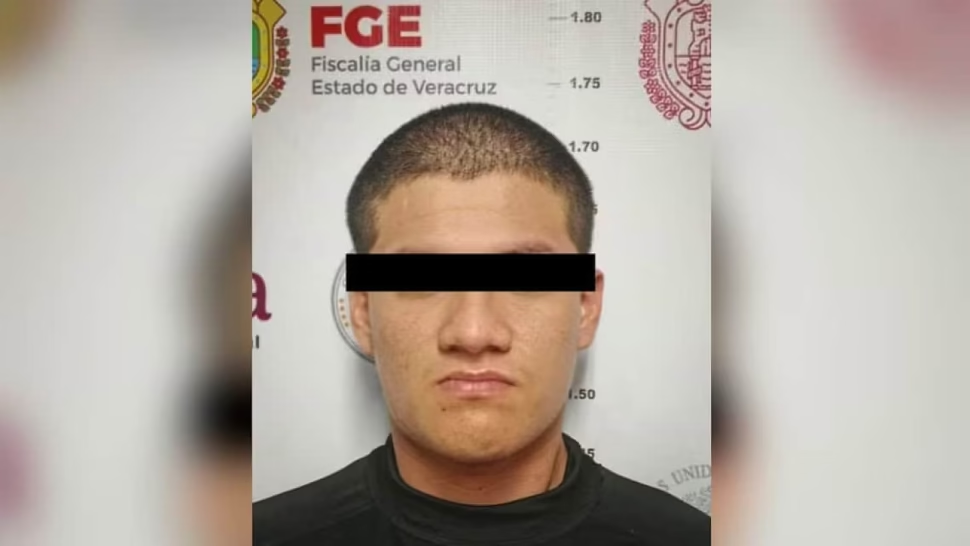
The Veracruz Prosecutor’s Office arrested José N, identified as one of the alleged perpetrators of the kidnapping of journalist Roxana Guzmán, founder of the medium Pulso Informativo del Sureste. The capture was confirmed this Tuesday, although the victim’s family assured that they have not yet received complete official information about the progress of the investigation.

The events of June 2

The attack occurred on June 2 in Nanchital, in the south of the state. An armed group broke into the Guzmán family home during the early hours of the morning. At least four men subdued the family members and also entered the journalist’s brother’s house.

Roxana’s mother, Rubicelia Ramírez, fully identified the detainee in a video released after the kidnapping. “He was at my house,” he declared.

Video that documented the attack

In a 35-second recording, the attackers are seen trying to force entry into a home while a person warns them that there are minors inside. The attackers managed to take Roxana Guzmán, as well as the family’s cell phones, and put her in a vehicle before fleeing.

Witnesses indicated that those responsible falsely stated that the victim would be transferred to a “command office.”

Reactions and expectations of justice

The arrest of José N represents progress in the investigation of the case, which has generated broad solidarity in the journalistic field and society. Roxana Guzmán’s family hopes that the necessary measures will be taken to guarantee the safety of all those involved and that justice will be done.

Continue reading