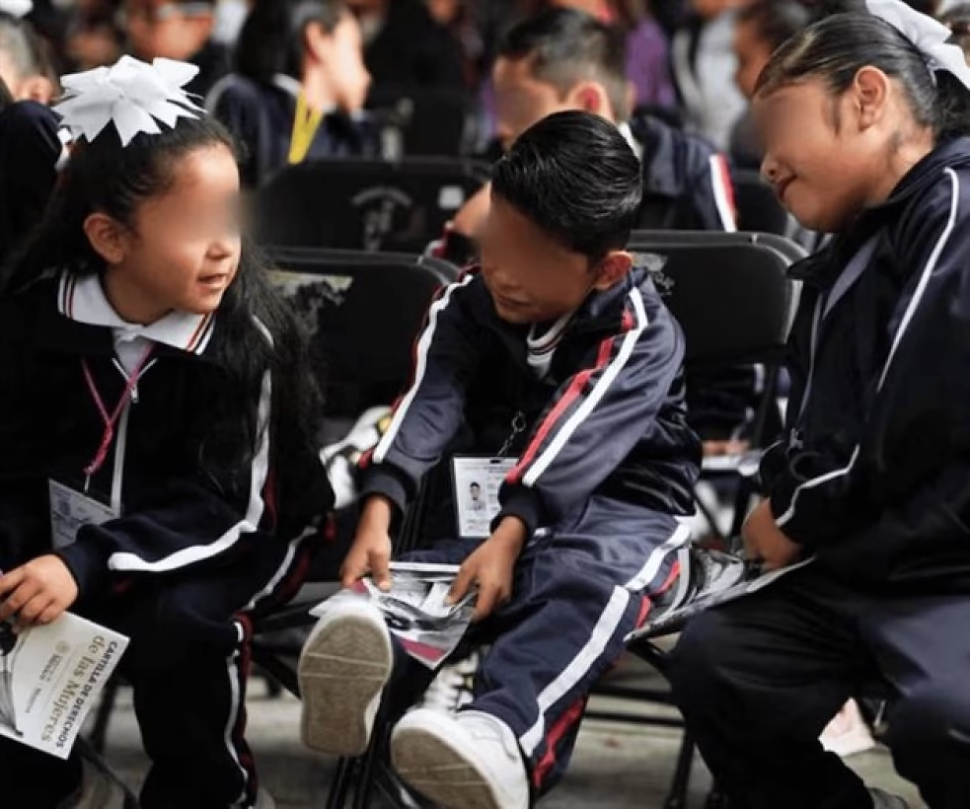
SEP implements national protocols against school sexual abuse

Criteria are unified throughout Mexico to protect students and create safe educational environments free of violence.

A Firm Step Towards Educational Transformation

Hello, transformative community! Today we have news that fills us with hope and determination. The incredible Noemí Juárez, Undersecretary of Basic Education of the Ministry of Public Education, shares with us a monumental advance. Imagine a Mexico where every classroom, every playground, is a sanctuary of security and growth. We are building that future together right now!

During the morning conference of President Claudia Sheinbaum Pardo at the National Palace, it was revealed that since May there have been official guidelines to eradicate abuse and sexual violence in basic education schools. This is not just a document; It is the materialization of an unwavering commitment to our most precious well-being: childhood.

RelatedSEP reveals alarming number of sexual abuse in minors

Harmonizing Forces for a Common Objective

Here comes the most powerful part! At this very moment, all the protocols of the 32 federal entities are being harmonized. Pioneering cities such as Mexico City and Michoacán have already published their guidelines. The Undersecretary of Basic Education is providing strategic support for this crucial unification, which integrates not only these guidelines, but also clear information about the municipal and state bodies that can be consulted. Every action counts, every step adds up!

But this goes beyond the protocols. An awareness day has been incorporated about the seriousness of child sexual abuse and violence, with the vision of it becoming a permanent campaign in all basic education schools. Visualize this: future generations growing up with a deep understanding of respect and personal boundaries. That’s real prevention!

Integrating Values into the Heart of Education

And there is more good news that we celebrate. The gender perspective and the eradication of violence are not just additional subjects; They are fundamental principles that already form an integral part of the curricular contents in basic education. We are sowing seeds of respect, empathy and equality from the first years of training. We are transforming not only policies, but mentalities!

Each of these advances represents a collective triumph. It reminds us that when we come together with clear purpose, we can create environments where our children and young people flourish without fear. This is the kind of epoch-making systemic change that builds solid foundations for a more just and compassionate society.

It’s your time to be part of this transformative wave! Share this incredible news on your social networks to inspire more people. Together we can amplify this message of protection and hope. Do you want to continue exploring how education is evolving to create a better world? Discover more related content and join this vital conversation. Your voice and your action matter!
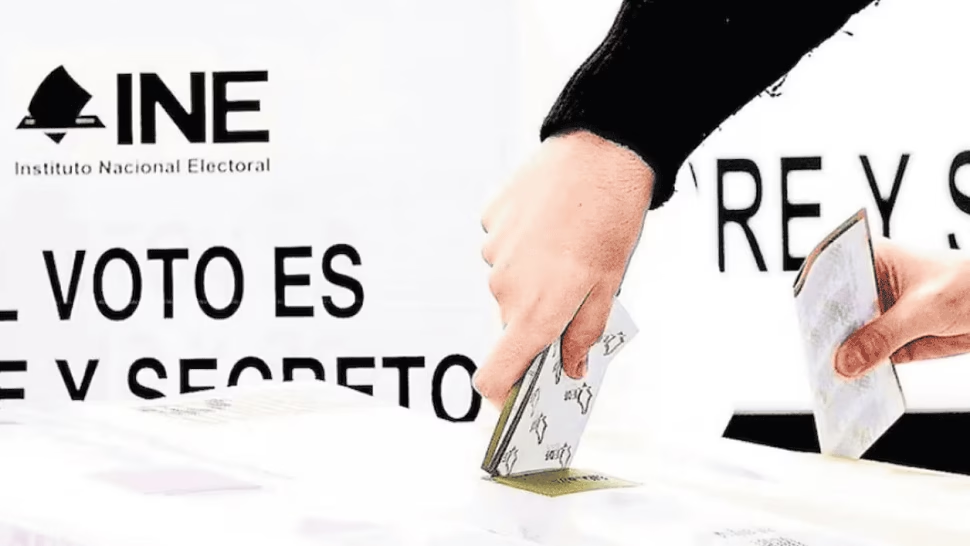
Direct vote for plurinominales: the Espadas proposal in the INE

Councilor Uuc-kib Espadas proposes that citizens directly elect proportional representation deputies.

Two tickets for deputies

The electoral advisor Uuc-kib Espadas Ancona will present a key proposal to the General Council of the INE: allow citizens to vote directly for multi-member deputies in the 2026-2027 federal process.

The initiative proposes dividing the election into two ballots. One will contain the relative majority candidates; the other, the group names of those who the parties nominate as proportional representation.

Espadas announced that he will present his model to his fellow councilors at the end of September or beginning of October.

Cost and logistics

The counselor acknowledged that issuing an extra ballot would imply an additional expense of between 200 and 250 million pesos, within the usual INE printing package. However, he pointed out that, after the experience of the election of the Judiciary in 2025, it would be possible to put both ballots in the same ballot box and do the counting separately, as is already done.

No need for legal reform

Espadas clarified that the INE has the power to implement this change without a legal reform. According to him, the April electoral reform was the right time to legislate it, but the authority can act on its own.

“The electoral authority does have the possibility of implementing two ballots for the election of deputies even without this legal reform, I insist, since this would fully guarantee the freedom of voting through the two current election methods,” he explained.

The debate is just beginning, but the proposal opens the door to a transformation in the way federal legislators are elected.

Continue reading

Sheinbaum reserves opinion on CNDH recommendation for Ayotzinapa

The president awaits more progress from the Prosecutor's Office and the Truth Commission before setting a position.

President Claudia Sheinbaum avoided immediately taking a position on recommendation 208VG/2026 of the National Human Rights Commission (CNDH) in the Ayotzinapa case. The president said that she will wait for the Truth Commission and the Prosecutor’s Office to present greater progress.

Sheinbaum explained that he asked the Secretary of the Interior, Rosa Icela Rodríguez, to carry out an exhaustive analysis of the CNDH document, headed by Rosario Piedra Ibarra. The objective is to define a government position based on the new findings.

“I prefer that it be reported what the data is, what the investigation that has been done, what are the new lines of investigation that were initiated after our arrival to the government (…) and that within that framework an opinion could be presented,” said the head of the Executive.

No participation of the Government in the report

Sheinbaum clarified that the Federal Government did not participate in the preparation of the CNDH report. He reiterated his administration’s commitment to the fathers and mothers of the 43 missing normal students to achieve truth, justice and locate the students.

Continue reading

FGR assures that Ruffo Appel is not persecuted for his ideas

The FGR presented 96 pieces of evidence against former governor Ruffo Appel for alleged fuel smuggling.

FGR details the evidence against Ruffo Appel

The Attorney General’s Office (FGR) stated that the former governor of Baja California, Ernesto Ruffo Appel, is not being investigated for political or ideological reasons. The agency detailed that 96 pieces of evidence have been integrated against him, related to his alleged participation in a hydrocarbon smuggling network.

In a statement, the FGR stressed that all procedures are carried out in accordance with due process and respect for the presumption of innocence. The evidence includes expert opinions in chemistry, mechanical and electrical engineering, as well as criminalistics studies and technical photography.

“Photographic opinions, to technically document the findings and investigative acts carried out; criminalistics opinions, aimed at fixing, preserving, analyzing and correlating the located evidence; and identification opinions, to know the type of hydrocarbon, whether gasoline or diesel,” stressed the FGR.

The link with the Ingemar company

The investigation also focuses on the company Ingemar S.A. de C.V., where Ruffo Appel is a shareholder. The company was established in August 2018 in Mexico City. Two months later, Ruffo joined the company’s variable capital. By 2021, he was already listed as a shareholder and secretary of the Board of Directors, participating in strategic decision-making together with José Merino Valdés Cuervo.

Continue reading