Sedena calls for national unity against crime

A historic call for social cohesion from the highest military pulpit in an unprecedented celebration.

A Strategic Call for Social Cohesion

In the framework of the commemoration of the 125th Anniversary of the Independence of Mexico, an event of profound historical and patriotic significance, Division General Ricardo Trevilla Trejo, head of the Secretariat of National Defense (Sedena), issued a proclamation of considerable strategic weight. From Mexico City, the highest military authority in the country urged national unity as the fundamental pillar to eradicate antisocial behavior that, in a systemic way, damages the social fabric of the nation. His speech, delivered during the first Civic Military Parade chaired by President Claudia Sheinbaum Pardo, outlined a collective action plan against scourges such as organized crime, discrimination, drug addiction and violence.

The analysis of his intervention reveals a multidimensional approach. General Trevilla did not limit himself to identifying the problems; proposed a positive social construct based on the active promotion of prosocial values ​​and activities. He explicitly urged citizens to promote education as a basis for development, equality and equity as guiding principles, civility as a standard of conduct, and care for the environment as an intergenerational obligation. Likewise, he emphasized the relevance of work and sport as mechanisms of inclusion and personal development. This discourse transcends the scope of traditional public security, positioning the Armed Forces as an actor promoting comprehensive social change, where the strengthening of family unity and citizen participation are considered essential components for the construction of a more resilient nation.

RelatedSheinbaum highlights the role of the Navy in the defense of sovereignty

A Historical Event with a Gender Perspective

An aspect of notable analytical relevance, highlighted by the Secretary himself, was the historical nature of the ceremony. General Trevilla Trejo expressed the institutional pride of the Armed Forces for participating in this parade under a command that breaks with a secular tradition. He highlighted, with factual precision, that for the first time in the history of Mexico, a woman holds the position of Head of State and Supreme Commander, presiding over the civil-military parade. This fact is not merely symbolic; It represents a tangible evolution in national power structures and aligns the military operation with the national gender equality policy promoted by the federal government.

The materialization of this policy was quantified in the unprecedented participation of female troops. The Secretary of National Defense provided concrete information: of the approximately 16 thousand elements deployed in the event, more than 5 thousand women, that is, about a third of the contingent, participated, worthily representing the Army and the Armed Forces as a whole. This figure not only reflects numerical integration, but also symbolizes a profound transformation in the composition and culture of Mexican military institutions, projecting an image of modernity and inclusion towards the society they serve.

The conjunction of both elements—the call for broad national unity and the celebration of a milestone in gender equality within the military—constitutes a powerful message. On the one hand, it seeks to mobilize the entire society in a common front against threats to security and public peace. On the other hand, the commitment of one of the most traditional institutions to social transformation and equality is demonstrated with facts. This discourse, therefore, can be interpreted as an effort to reposition the role of the Armed Forces in contemporary Mexico, not only as guarantors of national security in the face of external and internal threats, but also as active agents in the construction of a stronger, more cohesive and fair social capital.

Do you think this comprehensive approach is crucial for national security? Share this analysis on your social networks and generate conversation about the future of Mexico. Explore more content related to security and social development strategies on our portal.

The Museum of Teotihuacan Grandeza reopens after 20 years

After two decades closed, the museum reopens with unpublished pieces and an investment of 7 million pesos.

A museum that resurfaced

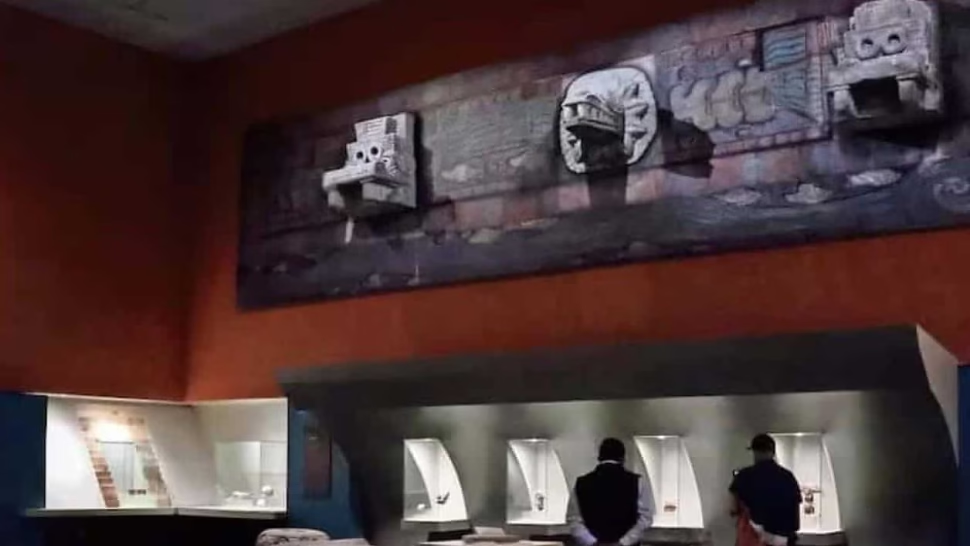
After two decades without activity, the Museum of Teotihuacan Grandeza reopened its doors last June. Its reopening is part of an INAH strategy to recover the museum spaces within the archaeological zone.

Joel Omar Vázquez Herrera, general director of INAH, reported that 7 million pesos were invested in this renovation. The objective, he explained, was to achieve a museography that allows “imagining the slopes and, of course, the feathered snakes.”

Pieces never seen before

A relevant fact: 80% of the collection exhibited is unpublished. “That is, they had never shown it before,” said Vázquez Herrera.

Among the most notable pieces is a 3,500-year-old rubber ball. Since its opening on June 9, the museum has received 25 thousand 15 visits, both national and international. The official described the response as “very important.”

Support for textile art

Marina Núñez Bespalova, Undersecretary of Cultural Development, highlighted the launch of the Original Workshop. This space seeks to train and accompany artisans in the textile field, strengthening a tradition that coexists with the archaeological legacy.

With this reopening, Teotihuacán recovers a key site to understand the greatness of one of the most emblematic civilizations of Mexico.

Continue reading

Sheinbaum asks FGR to clarify Gilda Lozoya’s legal situation

President asks FGR for a public report on the criminal proceedings of Gilda Lozoya and the debt of Alonso Ancira.

Sheinbaum calls for transparency in the Lozoya case

President Claudia Sheinbaum asked the Attorney General’s Office (FGR) to publicly report on the judicial resolution that allowed Gilda Susana Lozoya Austin to continue on provisional release for money laundering. Questioned in her morning conference about the decision of a federal judge who refused to order prison, Sheinbaum pointed out that the FGR must explain the status of the case.

“The Prosecutor’s Office has to inform, in this case,” he responded.

The president revealed that she has already requested a report from the agency on the matter. He even addressed the issue with the prosecutor during a meeting of the Security Cabinet, whom he asked to issue a statement to make the procedural situation known.

Pending debt of Alonso Ancira

Sheinbaum also recalled that the former owner of Altos Hornos de México (AHMSA), Alonso Ancira, still maintains a debt derived from the reparation agreement reached with the authorities.

“There is still a last payment derived from the reparation agreement that was made at the time,” he said.

The president asked the Prosecutor’s Office to report on the fulfillment of that commitment so that citizens know the status of the case. Given the possibility that legal actions will continue, he maintained that the process will continue.

“Yes, of course. Yes, because there is still recourse that is owed,” he stated.

On July 6, Sheinbaum had already requested a detailed report from the FGR on the implications of Gilda Lozoya in the Agronitrogenados case. In addition, he announced that an arrest warrant was reactivated against Alonso Ancira, former owner of AHMSA, the company that sold the Agronitrogenados plant to Petróleos Mexicanos (Pemex).

Continue reading

Cofepris alert: five beaches not suitable for swimming this summer

Five Mexican beaches not suitable for vacationers due to high bacterial levels.

Contaminated beaches: health risk in five destinations

The Federal Commission for the Protection against Sanitary Risks (Cofepris) reported that five beaches in the country are not suitable for receiving vacationers due to high bacterial concentrations.

The designated areas are: Tijuana Beach, in Baja California; Cuale Beach, in Puerto Vallarta/Bahía de Banderas, Jalisco; Main Beach, in Puerto Escondido, Oaxaca; and José Martí and Tumbao Beaches, in Veracruz.

“Cofepris recommends that bathers refrain from swimming activities or other direct contact recreational uses on beaches designated as unsuitable. Preserving these healthy environments and protecting collective health is a shared commitment,” the Commission said in a statement.

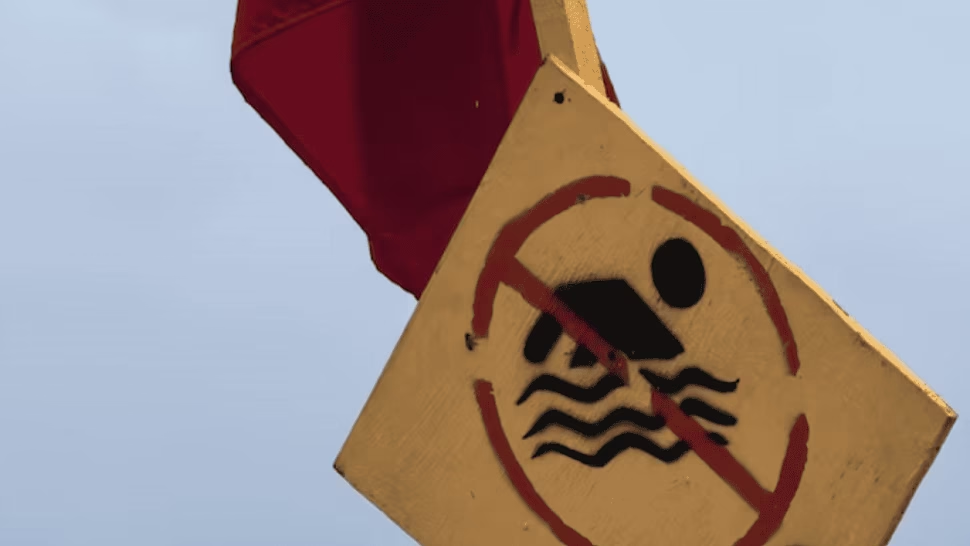
Together with the Clean Beach Committees and local authorities, prevention and intervention efforts are coordinated to implement urgent sanitation actions in these five coastal areas, in addition to placing preventive signs.

Almost all Mexican beaches are safe

In contrast, the quality of sea water on 284 beaches — 98.3% — is suitable for recreational use during the summer of 2026, Cofepris detailed.

Between June 15 and July 1, 2,279 seawater samples were collected and processed at 393 strategic verification points, distributed in 76 tourist destinations of the 17 entities with a coastline.

The authorities remember that pollution can affect the health of bathers, so they ask you to follow the recommendations to avoid problems during the holiday season.

Continue reading