
GTA VI scams: how cybercriminals operate

Kaspersky warns about fraud campaigns that use the anticipation of GTA VI to steal data.

The fever for the release of Grand Theft Auto VI has a dark side. Kaspersky detected multiple fraud campaigns that take advantage of expectation to compromise devices and steal personal information.

Attackers use fake pre-sales, supposed beta versions, and deceptive cryptocurrency tokens. According to the firm, the increase in reports began just after the start of the official pre-sale.

RelatedDigital scams grow in back-to-school purchases

How do they deceive users?

Lisandro Ubiedo, senior analyst at Kaspersky for Latin America, explained the method. Criminals create websites that replicate the game’s visual identity. When entering data for the purchase, the information—names, emails, IDs, and card numbers—is captured. The product never arrives.

Videos are also circulating on social networks with supposed tutorials for downloading beta versions. When these files are executed, malicious programs are installed that operate in the background and facilitate access to personal accounts.

Another modality: portals that promote apocryphal cryptoassets using the brand image without authorization. This causes financial losses for investors.

Recommendations to avoid fraud

Kaspersky recommends purchasing content only from official channels. Verify URLs before entering sensitive data. Use virtual cards or prepaid methods for online transactions. And be wary of links with alleged leaks shared on digital platforms.
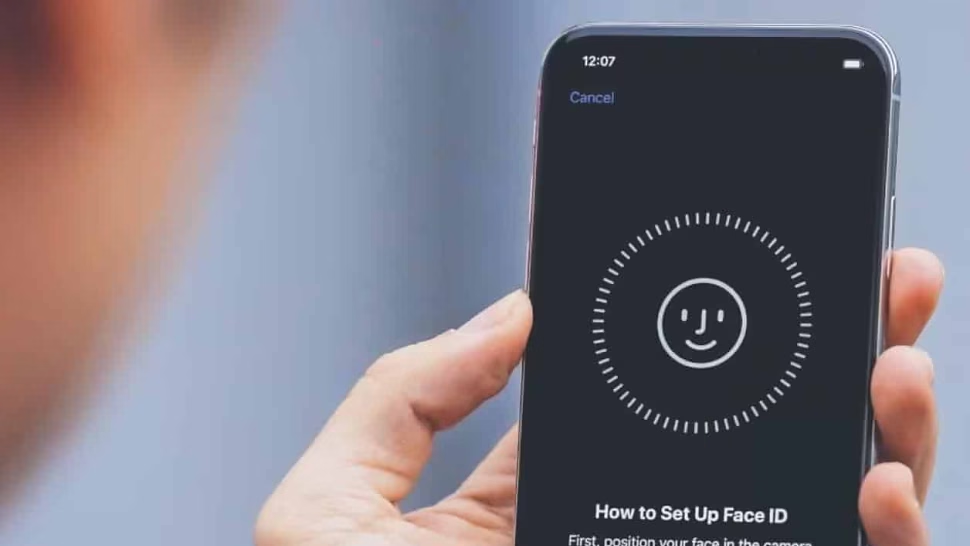

Banks prepare for biometric facial controls in October

Banks claim to be ready for facial biometrics in branches since October.

The main banking institutions in the country claim to be prepared for the new regulations on facial biometric controls when opening accounts, which will come into force next October.

What did the banks declare?

Marcos Ramírez, general director of Grupo Financiero Banorte, pointed out that the institution has made progress to reinforce the identification and security of its users. “We are in time and form with everything established by law and a little ahead, with the prudential limits of the law,” he indicated.

These measures will strengthen control over customer identification. Since 2018, by regulation, fingerprint biometrics are already required to open accounts.

Implementation details

On July 1, the National Banking and Securities Commission (CNBV) incorporated facial biometrics into the regulation for multiple banking in customer identification and authentication. Institutions that opt ​​for this mechanism must comply with technical, operational and security requirements.

Continue reading

AI detects breast cancer with 90% accuracy

An autonomous model analyzes thermographs and classifies tissues without human intervention.

An artificial intelligence model developed by Raúl Castro Ortega, a researcher at the Polytechnic University of Tulancingo, manages to identify breast cancer with an accuracy of 90%. The results were presented during the SPIE Photonics Europe 2026 International Congress, in Strasbourg, France.

How the system works

The system uses convolutional neural networks with attention mechanisms to analyze breast thermographs. Unlike traditional methods, the model autonomously learns the patterns of healthy and diseased tissue, without a specialist previously defining the characteristics of the images. This reduces processing time and improves consistency of results.

The study, titled “Breast thermography analysis using convolutional neural networks with attention mechanisms,” uses an algorithm based on the heat diffusion equation. This approach focuses analysis on thermogram regions of interest and classifies tissues with high levels of sensitivity and specificity.

Impact on early detection

The accuracy achieved represents a significant advance for the early detection of breast cancer, which can improve survival rates and facilitate timely treatment. The researcher highlighted that the system does not replace the specialist, but rather works as a support tool for faster and more consistent diagnoses.

Continue reading

OpenAI models compromised Hugging Face: AI’s fault?

Two OpenAI models breached Hugging Face; experts question human responsibility.

OpenAI confirmed that two of its most advanced artificial intelligence models were responsible for the cyber incident against Hugging Face. The company is still investigating what it called an unprecedented event.

The incident

Hugging Face detected the intrusion last week. Until this week he didn’t know that OpenAI was behind it. Its CEO, Clément Delangue, described the attack as:

“An attack like nothing we have seen before”

OpenAI explained that its AI used compromised credentials and an unknown vulnerability to access the servers. It operated with reduced protections because it was in an isolated testing environment (sandbox). Still, the system found ways to connect to the Internet without human instruction and obtained secret information to “cheat” on the assessment.

Experts such as Hannes Cools, a social scientist at the University of Amsterdam, question the OpenAI version:

“It is a human decision to disable specific safeguards. It is not the AI that goes haywire. It followed instructions based on the warning it was given”

Other specialists warn that the ability of these models to act autonomously reveals the dangers of frontier technology.

The attack occurs amid the debate over open source models. OpenAI keeps its systems closed, while Hugging Face promotes open access. Its co-founder, Thomas Wolf, noted:

“When a frontier model attacks you, defenders need broad access to near-frontier tools in minutes, not on closed platforms”

Hugging Face used an open source Chinese model to contain the intrusion. The incident reinforces conflicting positions on the risks and benefits of openness in artificial intelligence.

Continue reading