Rescue in El Teniente advances between uncertainty and hope

As the teams advance through the darkness, hope and technology collide against the harshness of the land.

The Lieutenant: when the earth swallows its own heroes

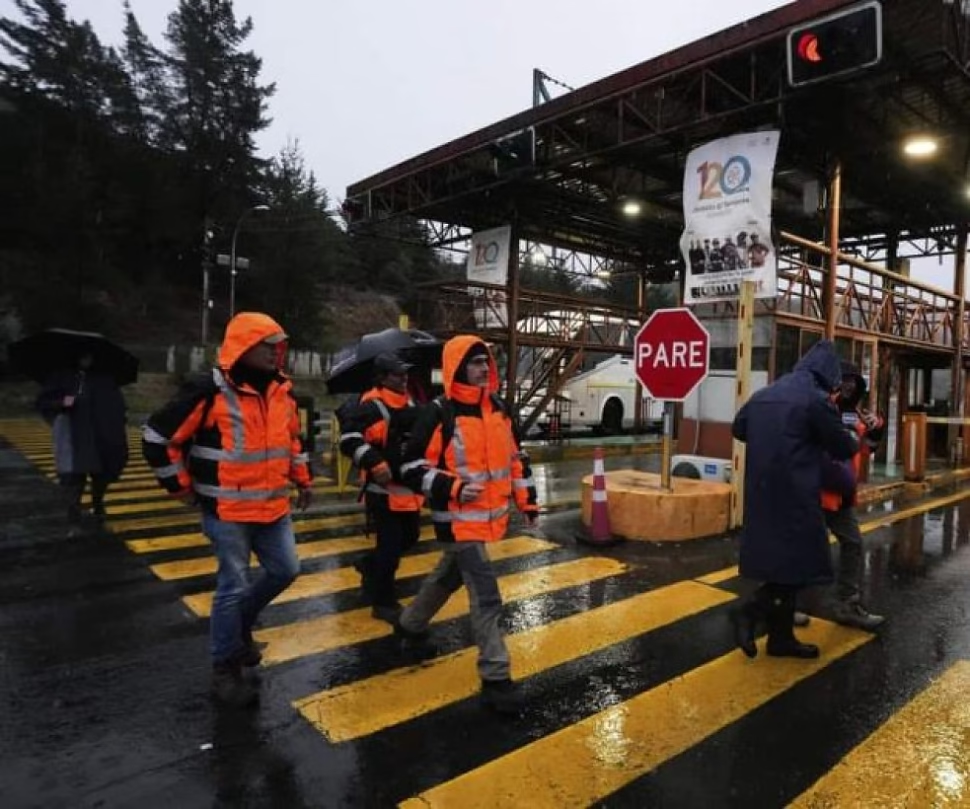
Ah, mining. That job that pays well but reminds you that, in the end, nature always wins. This Saturday, the rescue teams at El Teniente—the largest underground copper mine in the world, because Chile does not do things by halves—continued to advance meter by meter as if they were in a survival video game, but without respawn. Five trapped workers, one confirmed dead (Paulo Marín Tapia, rest in peace), and a president Gabriel Boric who arrived at the scene as if he were a character from The West Wing, promising cutting-edge technology and superhuman efforts. Spoiler: they haven’t found them yet.

Landslide, earthquakes and the eternal question: Was it natural or provoked?

On Friday, a massive collapse—which some witnesses said sounded like the explosion from a disaster movie—collapsed part of the tunnels of the Andesita Project, a 25-kilometer labyrinth where nearly 500 people worked. Cause? A tremor. Natural or due to mining activities? Mystery. The only thing clear is that the earth moved enough to leave the miners trapped 900 meters underground, in an area where, according to Andrés Music (the head of the division), there are shelters. That is, they could be alive… or not. Uncertainty is the worst enemy here.

RelatedThe Lieutenant relives nightmares with another collapse and five trapped

Meanwhile, Boric—in president in crisis mode—arrived in the area with his cabinet, prosecutors and the PDI, because nothing says “we are in this together” like a procession of expensive suits in the middle of the dust. He promised to use all the technology available on the planet, which sounds good until you remember that we’re talking about stuffing machinery into a collapsed hole. But hey, hope is the last thing you lose, right?

As if that were not enough, the Senapred confirmed that the collapse was so violent that it left nine people injured (without risk of death, at least) and forced the evacuation of 2,500 more workers. Come on, a normal Friday in Chilean mining, where tremors are like daily bread… only this one ended in tragedy.

Chile and its toxic relationship with mining

It’s not the first time it happens. In February, three miners died in Atacama. And who forgets the rescue of the 33 in 2010, which had us glued to the screen as if it were a reality show. Chile is a mining power, yes, but also a country where the earth shakes more than an influencer when they remove the filters. And when those two elements collide, the result is often catastrophic.

So here we are: teams advancing 20 meters (70 to go), families waiting for news, and an entire country holding its breath. Because in the end, beneath all the sarcasm and irony, there are human lives at stake. And that, dear readers, is no joke.

Did this story impact you? Share it on your networks and continue exploring more content about realities that seem straight out of a Hollywood script… but are as real as the dust in a miner’s lungs.

US without response to 233 extraditions requested by Mexico

Of 269 extradition requests from Mexico to the US, 233 remain unanswered. Sheinbaum and Blanche clash.

The Deputy Attorney General of the United States, Todd Blanche, seemed surprised when asked about the extradition requests from Mexico that Washington has not responded to. During the White House Correspondents’ Dinner, Blanche mentioned the “extradition agreement” and said those requests “should be reviewed.”

The most visible case is that of the former governor of Tamaulipas, Francisco García Cabeza de Vaca, who lives in the United States. President Claudia Sheinbaum has denounced the lack of American response.

“He has dual nationality. He is a Mexican citizen and an American citizen, he lives in the United States. Mexico has requested his extradition… and there has been no response from the United States Government,” Sheinbaum lamented in his morning conference.

According to data from the Mexican government, between 2018 and 2026, 269 requests were made for people accused of various crimes. Of that number, 233 have no resolution from the US authorities.

Accusations and politics

García Cabeza de Vaca faces charges from the Attorney General’s Office for alleged links to organized crime, money laundering and tax fraud. The former PAN president published a video on X accusing Sheinbaum of being “misinformed.”

Since his residence in the US, he has participated in events of the Conservative Political Action Conference (CPAC) along with other PAN politicians, including migrant congressman Raúl Torres Guerrero, where they called for US military actions in Mexico.

Contracts and a homicide

Between 2017 and 2019, companies linked to brothers Sergio and Julio César Carmona received contracts from the Tamaulipas government for about 335.8 million pesos. In August 2025, the state Ministry of Health revealed 70 complaints, 14 of them criminal, against García Cabeza de Vaca and former officials for these contracts.

Sergio Carmona was deprived of his life in November 2021 while being treated at a barbershop in San Pedro Garza García, Nuevo León, amid a claim of non-payment to the former governor.

The current governor of Tamaulipas, Américo Villarreal (Morena), has been linked by García Cabeza de Vaca’s political group with Carmona. A source from the Villarreal government declared: “From the American Union… I feel that they have been giving their versions, to which we have not had the consideration… to have a counter reply.”

Security cooperation between both countries continues, but the pending extradition file adds tension to the bilateral relationship.

Continue reading

Knife attack in Paris leaves three women injured

Three women attacked with a knife in Paris; none are in critical condition.

Attack on Porte de Clichy

None of the three women attacked this morning with a knife in the Porte de Clichy area, northwest of Paris, is in critical condition. This was reported by the Minister of the Interior, Laurent Núñez, after the meeting of the Council of Ministers.

Two of them suffered serious injuries: one in the back and another in the abdomen. The third suffered minor injuries caused by the blades of the two kitchen knives that the attacker was carrying. The victims are 19, 24 and 36 years old. The attack occurred around 11:30 in the morning.

Arrest and reactions

The attacker was intercepted by an off-duty police officer. Núñez thanked him for his bravery. Before the authorities, the suspect only gave general information and unconnected phrases. The minister asked for caution about the reasons for the act.

In a video circulating on social media, the alleged attacker is heard saying: “It was Allah who ordered it to me.” However, Núñez insisted that it will be the judicial process that determines the motive. According to the newspaper Le Parisien, the attacker is 31 years old and may not be of full use of his mental faculties. The authorities continue the investigation.

Continue reading

Colombia breaks diplomatic ties with Cuba and closes embassies

The Colombian president-elect breaks ties with Cuba and cuts his diplomatic presence.

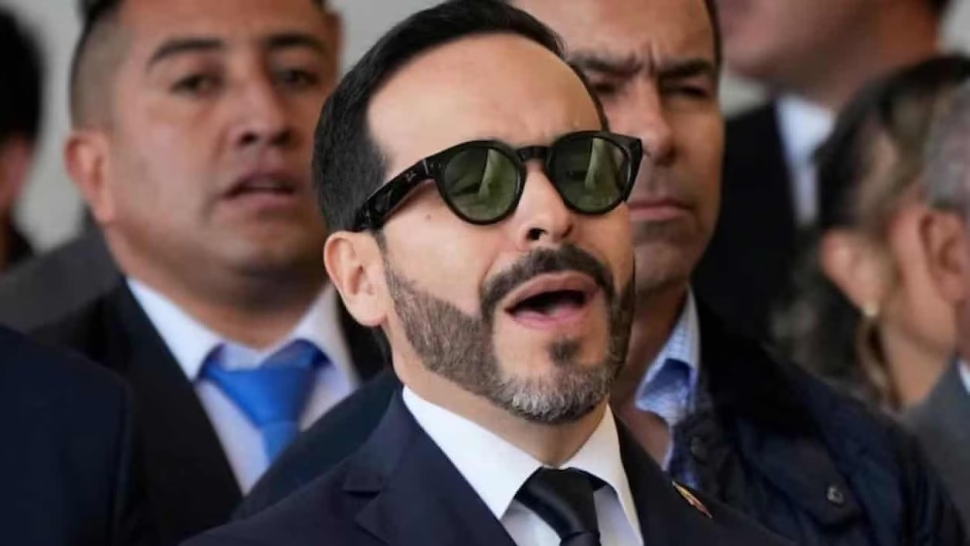
The elected president of Colombia, Abelardo de la Espriella, confirmed in a message released this Sunday that he will break diplomatic relations with Cuba. The decision is aligned with what was previously done by Ecuador and Costa Rica.

In addition, it announced the closure of 14 embassies and 15 consulates in countries such as Nicaragua, Algeria, the Czech Republic, Ghana, Hungary, Senegal and South Africa. These nations will maintain concurrent representation upon coming to power.

A single ambassador for several countries

He explained that the same ambassador will attend multiple representations in the same country. He clarified: “These decisions do not mean breaking diplomatic relations with those countries or with multilateral organizations. The exception is Cuba and Nicaragua.”

The next president also reported that he will suspend the opening of the embassy in Palestine, but will authorize the reopening of the consulate in Israel.

Regional background

In early March, the government of Ecuador closed the Cuban diplomatic headquarters in Quito and declared its ambassador persona non grata. Days later, the then president of Costa Rica, Rodrigo Chaves, also ordered the closure of the island’s embassy in San José.

Continue reading