The Public Hearing that Nobody Asked for but We All Need
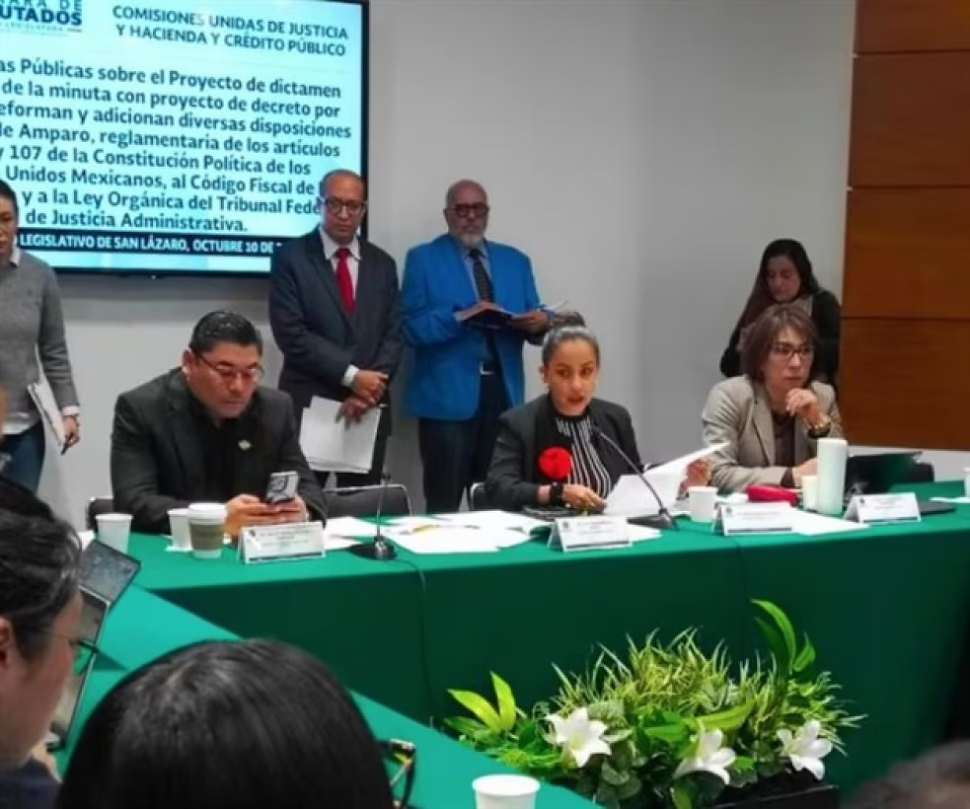
Well, it turns out that in the Congress of the Union they decided to do something that sounds super productive: a public hearing. But not just any audience, no. This was the first of three obligatory appointments to analyze the reform to the Amparo Law regarding inadmissibility. Which in Christian means: “let’s see how we can make it more difficult for people to protect themselves against our shenanigans.”
The thing is that of the 15 experts they had on the guest list – imagine, like for a birthday party – only nine showed up. Nine brave constitutionalists and legal specialists who, instead of applauding the modifications proposed by the Executive, came to tell the truths of the neighborhood: that this is pure weakening of justice in Mexico. Basically, instead of facilitating access to protection, they are turning it into a more bureaucratic procedure than obtaining a university scholarship.
The Voices Nobody Wanted to Hear
One of those who raised his voice was Juan Pablo Gómez Fierro, a retired magistrate who must know what he is talking about because he no longer owes favors to anyone. The good man was clear as day: if they take away the force of the suspension, the amparo trial becomes a useless procedure, something like filing a complaint with Telmex customer service. He literally said – and here comes the part that hurts – that “it would cease to be an instrument for the protection of Human Rights… we would all be exposed to arbitrary acts of authority.” In other words, we become cannon fodder for the whims of power.
But the best was when he dropped the pearl of the century: “The protection does not belong to the judicial power, the protection belongs to the people.” Does it sound familiar to you? Like when they tell you that the subway belongs to everyone but it always arrives late. The point is that this man put his finger on the sore spot: if they take away the protection of protection, they are killing him. And not with bullets, but with bureaucracy, which hurts more.
And then came article 128, the new villain of the movie. It turns out that it introduces the concept of public interest, which sounds nice to gain likes, but in reality it is just another obstacle to not being protected. Gómez Fierro explained it with the patience of someone teaching a child: it is an additional concept that the judges will have to interpret, and it will basically serve to classify certain acts as “of public interest” and deny your suspension. In other words, they put one more obstacle in your way, like when you want to renew your passport and they ask for a certified birth certificate from the year of the year.
Not far behind was Magdaleno Villanueva Flores, a specialist in labor law, who must be used to seeing how they complicate the worker’s life. The man pointed out that in article 107 of the Amparo Law the causes of inadmissibility are increased, which instead of facilitating the process, makes it more technical and complicated. He said with disbelief – and who doesn’t – that the reform proposal, already approved in the Senate, far from helping, reduces the origin of the protection and expands the catalog of grounds for inadmissibility. In other words, more doors are closed to you than you already had closed.
More Reforms, Same Problems
Then appeared José Barrios Moreno, another constitutional lawyer who seems to have clear rules of the game. He said if the federal government really wants to prevent injunctions from being used to delay trials, it should also review other laws. Because, let’s be honest, the problem is not just the protection, it is the entire system. He mentioned the General Law of Alternative Dispute Resolution Mechanisms and its application in administrative and fiscal matters. Basically, he suggested that we need to pay attention on all fronts, not just this one. Like when they tell you to fix the bathroom but the kitchen flooded.
And it could not be missing Luis Curiel Piña, vice president of the National Board of Directors of the National Association of Business Lawyers, who proposed that in the reform to the Amparo Law the means of guarantee not be reduced. He said that they should leave all the means that are already in the Federal Tax Code, such as the letter of credit, the bond, the seizure of bank accounts, etc. Because, according to him, giving those means would be more than enough. It sounds reasonable, but in a world where reason is sometimes conspicuous by its absence, who knows.
To close with a flourish, Carol Antonio Altamirano, president of the Morena Finance and Public Credit Commission, explained that the general meaning of the reform is to avoid endless procedures. In other words, if you have already exhausted the appeals and the matter is final, don’t keep screwing around. According to him, it is so that justice is applied effectively. What he didn’t say is that sometimes “effective justice” means that it is applied quickly, but badly.
In summary, this reform to the Amparo Law appears to be another attempt to disguise control under the mantle of efficiency. Experts have said it clearly: it weakens justice and complicates access to rights. And meanwhile, we, the ordinary citizens, are left watching how our guarantees are played with as if they were poker chips. So, if you are worried that your rights will disappear like your followers in a bad streak, share this information on your social networks and explore more related content so as not to be left in the dark. Because, in the end, protection is the only thing we have left when everything else fails.