Reform to the Amparo Law alters the balance of power

Legal experts warn about a legal modification that alters the procedural balance and weakens a fundamental pillar of justice in Mexico.

Analysis of the Reform of the Amparo Law and its Constitutional Implications

A proposal to modify the Amparo Law, promoted by the Executive Branch, has generated an intense debate in the national legal sphere. According to the consensus of specialists who participated in the third Public Hearing on the matter in the Chamber of Deputies, the initiative represents a structural change that unbalances the procedural fairness inherent to the rule of law. The reform, in essence, establishes specific parameters of action for judges, which, in practice, is interpreted as a guideline that loads the dice in favor of the government authority. This technical analysis breaks down the critical points of a minute that, if approved, could radically redefine the protective function of the amparo trial.

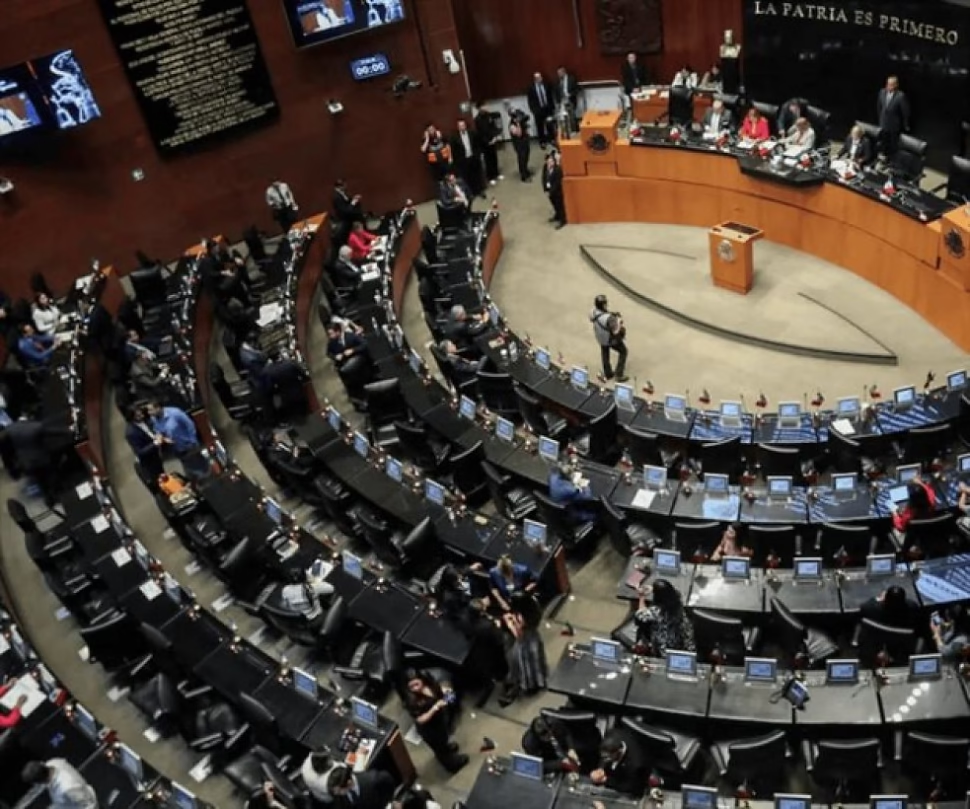
The hearing, convened by the joint Justice and Finance and Public Credit commissions, served as a platform for nine jurists to present their arguments against the reform. The central concern revolves around the distortion of the figure of suspension, a provisional mechanism designed to protect the governed from presumably illegal acts of authority while the substance of the matter is resolved. The experts agreed that the new wording generates institutional distrust towards judges by restricting their ability to grant this precautionary measure through the imposition of criteria that systematically privilege the interest of the public administration.

RelatedThe Senate debates on fast track the reform of the Amparo Law

The Erosion of the Principle of Procedural Equality

José Ángel Santiago Ábrego, president of the National Association of Business Lawyers Bar Associations, argued precisely that the regulatory design should avoid creating undue advantages for any of the parties in a dispute. He stressed that the current minutes violate this fundamental principle. “If the minutes are approved in their terms,” explained Santiago Ábrego, “it would be enough for the judges to verify that there is harm to the social interest or to public order provisions for the suspension to be denied almost automatically.”

The core of the problem lies in the introduction of the element of public interest as a determining factor to deny the precautionary measure. This criterion, apparently laudable, creates an insurmountable conflict of interest. “When the analysis of public interest is introduced, frequently equated to the interest of the Administration, the underlying message is that the suspension should be denied when its granting could affect the government,” the expert explained. The paradox is evident: the government is, precisely, the counterparty in the amparo trial. By giving preponderant weight to their interest, the reform turns the authority into judge and party, breaking the procedural balance mandated by article 17 of the Mexican Constitution, the International Covenant on Civil and Political Rights (article 14) and the American Convention on Human Rights (article 8).

Contradictions with the Constitutional Text and Legal Setbacks

The Circuit Judge, Ileana Moreno Ramírez, expanded the analysis towards the constitutional inconsistencies of the proposal. He noted that the reform seems designed to restrict the possibility of granting the suspension in a wide range of cases. A point of extreme gravity, according to the judge, is the resurrection of a requirement that the Constitution had already eliminated. “Article 128 of the minutes establishes that the complaining party must prove that the granting of the suspension will not cause damage that is difficult to repair… however, the tenth section of article 107 of the Constitution no longer establishes as a requirement for the suspension to prove a damage that is difficult to repair,” said Moreno Ramírez.

This change represents a regulatory setback of considerable proportions. By reinstating a burden of proof that the Magna Carta had suppressed, the secondary law places itself in a position of clear contradiction with the higher constitutional framework. The judge warned that, if this provision were to prosper, it would be going against the constitutional text, which would create a fertile field for legal uncertainty and endless controversies.

The historical perspective was provided by former senator Roberto Gil Zuart, who did not hesitate to describe the initiative as “one of the biggest legal setbacks that the amparo trial has suffered.” Gil Zuart intelligently connected the implications of this reform with other recent changes in the justice system, such as the limitation of the general effects of the amparo and the so-called constitutional supremacy clause. Taken together, these modifications constitute a structural redesign of the balance of powers that significantly weakens the control and balance mechanisms of the citizen vis-à-vis the State.

The suspension in the amparo trial is not a mere formality; It is the practical tool that makes the entire process effective. Without the possibility of stopping a potentially illegal act of authority, the amparo can become a futile process, where a final ruling in favor of the complainant arrives too late, when the damages are already irreversible. By eroding this figure, the reform not only impacts the procedure, but denaturalizes the very essence of amparo as a guarantor of individual rights and as a pillar of the Mexican constitutional justice system. The minutes, in their current state, represent a transfer of power from the Judiciary to the Executive, a move that demands rigorous public and legislative scrutiny to preserve the foundations of the democratic rule of law.

Do you consider that it is essential to protect judicial independence and citizen defense mechanisms? Share this analysis on your social networks to inform your community and explore more content about the evolution of the justice system in our country.

FBI alerta y rescate en León: detenido por agresión sexual infantil

FBI detectó video en dark web; operativo binacional rescató a víctima en León.

Una alerta del Buró Federal de Investigación (FBI) de Estados Unidos desencadenó un operativo que culminó con la detención de Óscar “N” y el rescate de una persona menor de edad en León, Guanajuato. La Unidad Especializada en Combate a la Trata de Personas y Corrupción de Menores (UECOT) encabezó la llamada “Operación Valkiria”, en coordinación con corporaciones nacionales e internacionales.

La investigación comenzó cuando el FBI detectó la circulación de un video en la dark web que registraba la producción de material de agresión sexual. Las autoridades internacionales señalaron que, por las características físicas y el idioma, la víctima y el agresor podrían ser mexicanos.

“Las agencias internacionales advirtieron que, por las características fisonómicas y el idioma observado en la grabación, la víctima y el agresor podrían ser de nacionalidad mexicana”.

Detalles de la operación

La Fiscalía General del Estado (FGE) explicó que peritos realizaron un análisis forense de la escena digital, examinando objetos y elementos visibles en el entorno del video. Ese trabajo se complementó con la inspección de múltiples hoteles en León hasta localizar la habitación exacta donde ocurrieron los hechos.

RelatedFBI director defends his management in tense senatorial hearing

Además, especialistas en informática hicieron análisis antropométricos y comparativas fotográficas del rostro visible del agresor. Con información de la Secretaría de Seguridad y Protección Ciudadana (SSPC) federal y el Centro Nacional para Niños Desaparecidos y Explotados (NCMEC), se identificó al presunto responsable como usuario activo de un grupo cerrado en Facebook dedicado a la comercialización de ese material ilícito.

El Grupo Especial de Reacción Inmediata (GERI) ejecutó la captura. Un juez de control vinculó a proceso a Óscar “N” y le impuso prisión preventiva. La víctima recibió atención médica y psicológica inmediata, así como resguardo en un proceso integral de rehabilitación. La FGE destacó la alta complejidad tecnológica y el alcance transnacional de esta acción.

Continue reading

Guanajuato activa vigilancia epidemiológica para el Mundial 2026

Guanajuato se prepara para recibir 1.8 millones de visitantes durante el Mundial 2026 con filtros sanitarios.

A días del inicio de la Copa Mundial de Fútbol 2026, Guanajuato refuerza su sistema de vigilancia sanitaria. El secretario de Salud estatal, Gabriel Cortés Alcalá, aseguró que la entidad está lista para detectar y atender enfermedades como el ébola.

Preparativos ante la llegada masiva de visitantes

La Secretaría de Turismo estima que 1.8 millones de personas visitarán el estado durante el torneo. Muchos se hospedarán en municipios turísticos para ver las transmisiones de los partidos o desde ahí viajarán a Jalisco y Ciudad de México, sedes oficiales.

RelatedMéxico aplicará vigilancia epidemiológica contra ébola en el Mundial 2026

En plazas públicas de León, Yuriria y Dolores Hidalgo se proyectarán todos los encuentros. La ubicación estratégica de Guanajuato facilitará el flujo de aficionados nacionales y extranjeros.

Cortés Alcalá explicó que en los aeropuertos internacionales operan filtros sanitarios para identificar personas con fiebre o síntomas de enfermedades transmisibles. Estas medidas también se implementan en los países de origen, siguiendo protocolos internacionales.

El funcionario destacó que Guanajuato es líder nacional en vigilancia epidemiológica. Mantienen activos protocolos de monitoreo, búsqueda intencionada y respuesta rápida ante cualquier eventualidad.

“Contamos con infraestructura hospitalaria suficiente, personal especializado y capacidad de respuesta para atender casos sospechosos, garantizando la protección de la salud de la población y de los visitantes”, afirmó.

Continue reading

Sheinbaum defiende autodeterminación ante advertencias de EE.UU.

Sheinbaum defiende derecho de cada país a decidir su rumbo frente a advertencias de EE.UU.

México reitera su postura frente a presiones externas

La presidenta Claudia Sheinbaum respondió a las amenazas de Estados Unidos de retirar visas a quienes intenten manipular la segunda vuelta electoral en Colombia, el próximo 21 de junio. Desde Coatzacoalcos, Veracruz, durante la conferencia matutina del 5 de junio, recordó el principio constitucional mexicano.

“Como dice la Constitución: la autodeterminación de los pueblos, esa siempre va a ser nuestra posición. Los pueblos del mundo, cada pueblo tiene que decidir quién los gobierna, cómo se gobierna y cómo resuelven sus problemáticas.”

Sheinbaum subrayó que esta postura no responde a una simple convicción, sino que está establecida en la Carta Magna.

RelatedElectoral Tribunal of Bolivia makes runoff official for October 19

Declaraciones de Washington sobre Colombia y Bolivia

El secretario de Defensa de Estados Unidos, Pete Hegseth, advirtió en redes sociales que su país está vigilando la crisis en Bolivia. Afirmó que “Bolivia no debe permitir que el viejo status quo de dominio del crimen organizado en la región vuelva a imponerse”. Hegseth ofreció aumentar la ayuda de emergencia y apoyo logístico al gobierno de Rodrigo Paz, en medio de bloqueos de distintos sectores por la escasez de alimentos, medicinas y combustibles.

Por su parte, el vicesecretario de Estado, Christopher Landau, lanzó una advertencia directa a quienes busquen alterar el proceso electoral colombiano:

“Aquellos tentados a socavar o manipular el proceso democrático, ya sea comprando votos o de otra manera, están advertidos de que están poniendo en riesgo sus visas, y las de sus familias.”

La segunda vuelta en Colombia enfrenta al candidato de izquierda Iván Cepeda y al de derecha Abelardo de la Espriella. Mientras tanto, la postura de México se mantiene firme en defensa de la soberanía de los pueblos.

Continue reading