Recurrent blackouts in Monterrey due to overloading of the electrical system

Neighbors demand solutions to prolonged outages that affect quality of life and daily activities.

Detailed analysis of power outages in the metropolitan area

The metropolitan area of Monterrey faces a series of interruptions in the electricity supply since Wednesday night, with documented effects in at least six neighborhoods and three municipalities. According to citizen reports compiled by this medium, the towns of Colonia Residencial and Fuentes de Escobedo in Escobedo have recorded more than 18 continuous hours without service, while in Cadereyta, Juárez and Ciénega de Flores intermittent failures were detected during the morning of Thursday.

Technical causes and contextualization of the phenomenon

Energy infrastructure experts consulted identify three concurrent factors:

RelatedNew electrical regulation limits private sales to CFE
  1. Thermal overload: Temperatures above 38°C recorded this week increased the use of air conditioning by 23% compared to the same period in 2023, according to data from the Federal Electricity Commission (CFE).
  2. Obsolete infrastructure: 68% of the transformers in the affected areas exceed their useful life of 25 years, as revealed by an internal diagnosis of the parastatal obtained through a transparency request.
  3. Disorganized urban growth: The aforementioned colonies have doubled their population in the last decade without a proportional expansion of distribution capacity.

A study by the UANL Energy Research Center warns that this pattern of failures could extend to 14 other neighborhoods with similar demographic characteristics during the next 15 days, coinciding with the seasonal peak of consumption.

Socioeconomic impact and institutional response

The lack of electricity has caused losses estimated at 12.7 million pesos in local businesses, according to calculations by the Nuevo León Chamber of Commerce. In the domestic sphere, 41% of affected households reported damage to appliances due to voltage variations, according to a rapid survey carried out by consumer associations.

The CFE issued a statement acknowledging “specific technical failures” and claimed to have 14 crews working on the repair. However, anonymous union sources revealed that only 3 of them have specialized equipment for diagnosing faults in underground networks, which represent 60% of the reported cases.

“We are facing a structural problem that requires immediate investment in modernization, not just temporary repairs,” said Dr. Rodrigo Mercado, energy policy specialist at ITESM, who proposes a five-year plan with public-private participation to renew the distribution network.

Recommendations for the affected population

  • Report failures through the CFE Contigo App with active geolocation
  • Disconnect sensitive equipment for the first 2 hours after reset
  • Check the status of the protection devices on the meter

To delve deeper into this topic, we share a comparative analysis with other Mexican cities that faced similar challenges and the solutions implemented. Spread this information on your social networks to keep your community informed and follow our special on sustainable urban infrastructure.
Earthquake in La Guaira: 2,295 dead and thousands missing

Families seek to identify their loved ones in the rubble before mass graves.

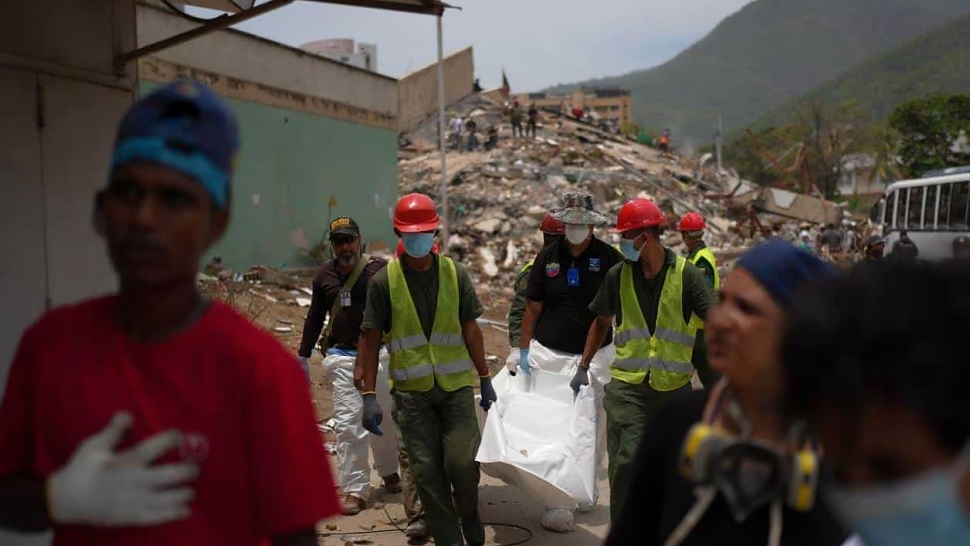
The tragedy of the June 24 earthquake in the Venezuelan state of La Guaira leaves at least 2,295 dead. Thousands of people remain missing. Hundreds of families tour hospitals and makeshift morgues to identify bodies before they are sent to mass graves.

Number of victims and rescue efforts

The forensic teams, led by technician Joel Mirabal, work tirelessly. According to specialists, between 60 and 70 percent of the victims are recognized by family or neighbors. The advanced state of decomposition complicates tasks. Refrigerated containers have been installed due to the increase in bodies. The authorities do not rule out opening mass graves.

Around the port of La Guaira and the temporary morgues, dozens of families remain formed for hours. They use tattoos, scars or clothing to confirm identities. The uncertainty about the fate of the missing aggravates the pain.

The drama of families

Rosa López recounted the difficult process of finding the body of her son-in-law, José Antonio Toledo, who died when the building where he worked as a security guard collapsed. After visiting several sites, the family managed to identify his remains. Without resources for a funeral service, the mayor’s office gave them a free space to bury him.

Rescuers estimate that recovery efforts will last at least three months due to the number of collapsed buildings. Thousands of volunteers have joined the search, hoping that families can say goodbye to their loved ones.

Continue reading

Sheinbaum announces investment of 4 billion pesos for the Purépecha people

The president detailed new commitments in health, education and security during her visit to Michoacán.

Justice Plan for the Purépecha people

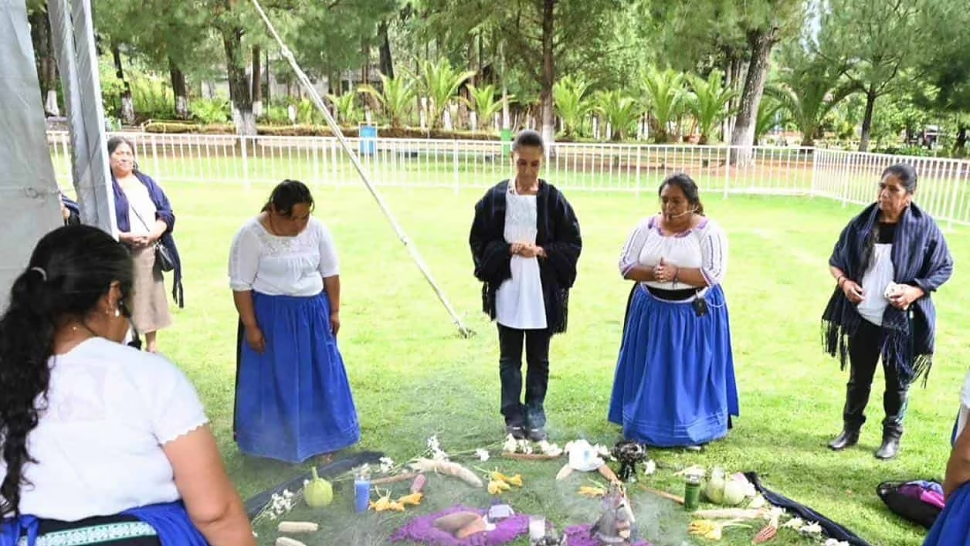
From Cherán, Michoacán, President Claudia Sheinbaum highlighted the progress of the Justice Plan for the Purépecha people. One year and two months after its implementation, more than 4 billion pesos (mp) have been allocated for health, education, roads and security.

“How are the Justice Plans made? With you. They are not made in an office of the federal government, of the State Government, they are made in assemblies,” said Sheinbaum.

The president recalled that, with the Second Floor of the Fourth Transformation, the Constitution was modified to recognize indigenous and Afro-Mexican peoples as subjects of public law. In addition, the Contribution Fund for the Social Infrastructure of Indigenous and Afro-Mexican Peoples (FAISPIAM) went from 12 thousand million pesos in 2025 to 13 thousand 500 million pesos by 2026, with the objective that this resource is established in the Constitution so that it increases each year.

The director of INPI, Adelfo Regino Montes, detailed the distribution of the investment: 27 artisanal paths (74.34 km, 485.01 million pesos), School Houses and Canteens for 527 children, 21 Community Houses of Indigenous Languages, and 161 communities benefited from FAISPIAM (212.74 million pesos in 2025 and 234.47 mdp in 2026).

Sheinbaum announced new commitments: improve the Cherán Hospital with a hemodialysis area, fix the Sports Unit, open degrees in Medicine and Nursing, strengthen community businesses, build a C2 in the community and hold a meeting on security in Mexico City.

The Undersecretary of Sciences and Humanities, Violeta Vázquez-Rojas, reported other advances: construction of an ISSSTE hospital, studies for an IMSS Bienestar hospital, hiring of 646 doctors and more than a thousand nurses, a National Guard barracks for 150 elements, remodeling of 17 highway sections, delivery of 27 thousand efficient stoves, and translation of the Women’s Booklet into Purépecha.

The governor of Michoacán, Alfredo Ramírez Bedolla, supported the initiative and highlighted the defense of the uses and customs of the native peoples.

Continue reading

Colombians arrested for training in the manufacture of explosives in Michoacán

Colombian detainees linked to the manufacture of explosives in Michoacán.

The Security Cabinet has arrested Colombian citizens linked to the training and manufacturing of improvised explosive devices in Michoacán. This was reported by the Secretary of Security and Citizen Protection, Omar García Harfuch, during the morning conference on Friday, July 3 in Morelia.

These arrests are part of investigations that identified the entry of several people involved into the country, mainly through the Mexico City International Airport and other air entry points. The National Intelligence Center monitored these movements.

The entry of foreign people by land was also detected, who allegedly collaborate in the training of members of criminal groups to install these devices. García Harfuch pointed out that there is an ongoing investigation to locate the leaders of these networks in Michoacán, including alleged high-level members of the Jalisco Nueva Generación Cartel.

The head of the SSPC confirmed the participation of citizens from different countries, mainly from Colombia. We are working in coordination with Colombian authorities to strengthen the investigations. In the coming days, the exact number of people arrested related to the manufacture and use of these explosives will be specified.

Continue reading