Restoration of Electrical Service After Weather Emergencies
The Government of Mexico, acting through the Federal Electricity Commission (CFE), reported significant progress in the recovery of the states impacted by the intense rainfall recorded between October 6 and 9. At the 6:00 a.m. cutoff on Thursday, October 16, a 93 percent restoration of the electricity supply had been achieved, directly benefiting 243,762 users in the states of Veracruz, Hidalgo, San Luis Potosí, Puebla and Querétaro. This percentage represents substantial progress in mitigating the effects of the meteorological contingency.
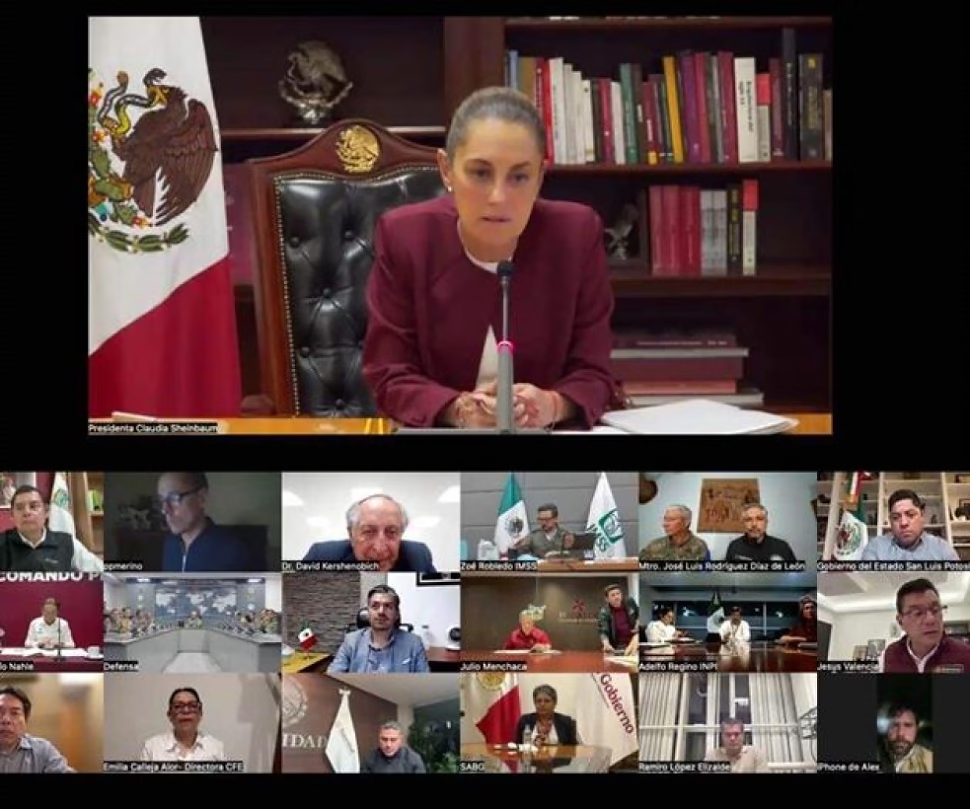
The President Claudia Sheinbaum Pardo explicitly recognized the dedication, conviction and sacrifice of the workers of the State productive company. He stressed that, during this emergency situation, CFE personnel have ensured that even communities that remain in isolation have electricity service. Within the framework of her morning conference, “Las mañaneras del pueblo”, the president defended the public company model, arguing that, under a privatized scheme of the national electrical system, the recovery actions that are currently being deployed would not be carried out.
“Fortunately, we have a public company. If the electrical system were privatized, what the CFE does today would never be done. The conviction, the dedication, the sacrifice of the workers, the electrical workers, is something extraordinary. Imagine, 60 emergency electrical plants from CFE’s own strategic reserve to be able to transport them to the isolated communities by helicopter so that they can have electricity,” he highlighted.
From Huauchinango, Puebla, through a link in the press conference, the general director of the CFE, Emilia Esther Calleja Alor, provided a detailed breakdown of the situation. He specified that, in addition to the 243,762 users whose service has already been normalized, there are 19,700 more who are in the active process of restoration, which implies continuous repair work on damaged infrastructure. Likewise, he reported on a complementary measure of great social impact: “And finally, to inform you, President, that we are delivering the 13 thousand chips, which CFE is distributing free of charge to be able to communicate via cell phone and have internet in the communities that were affected.” This action seeks to alleviate the digital communication gap in the most affected areas.
Analysis of the Reform of the Amparo Law
In a completely different area, but of equal relevance to the national legal framework, the Head of the Federal Executive referred to the reform of the Amparo Law approved by the Senate of the Republic. President Sheinbaum Pardo pointed out that the primary objective of this legal modification is to continue protecting the people of Mexico against any unjust act by the authority. The reform seeks to convert this legal resource into a more expeditious and accessible instrument, facilitating more efficient access to justice for citizens.
The president emphasized that the amendment scrupulously respects Article 14 of the Political Constitution of the United Mexican States, which establishes the principle of non-retroactivity of the law to the detriment of any person. “The people of Mexico are being protected against any unjust act by the authority, that does not change in the slightest; on the contrary, it is strengthened. So, whoever speaks against the Amparo Law and lies saying that ‘retroactivity is not being respected’—that constitutional right—is a liar; they are either lying deliberately or they simply have not read and act on instructions, the truth. It’s that simple, plain and clear,” he stated forcefully.
The general coordinator of Politics and Government, Arturo Zaldívar Lelo de Larrea, supported this position, describing as absolutely false the statements that indicate that the reform is regressive or that it limits people’s defense. On the contrary, he explained that the initiative seeks to streamline the procedure, shorten processing times and take a decisive step towards digital justice. “It will be a more modern, closer, more accessible justice, that is the primary purpose of the amparo trial in this reform,” he added. He stressed that with this reform a full and comprehensive defense of fundamental rights is maintained.
Zaldívar Lelo de Larrea delved into the specific modifications related to the figure of suspension. He explained that the regulatory adjustments are intended to prevent the abuse of this precautionary measure, particularly in cases that could make difficult or hinder the fight against complex crimes such as money laundering. Simultaneously, safeguards were incorporated to protect those people whose bank accounts have been blocked due to an error, establishing mechanisms so as not to affect those who can prove the lawful origin of their financial resources. This reflects a deliberate balance between the effectiveness of the administration of justice and the protection of the property rights of citizens.
The simultaneity of these two events – the response to a climate emergency and the approval of a substantial judicial reform – illustrates the operation of the Mexican State on two critical fronts: immediate attention to the needs of the population in the face of natural disasters and the modernization of its legal institutions to strengthen the rule of law. The reestablishment of basic services such as electricity and telecommunications is a primary function of the State in crisis contexts, while the evolution of legal tools, such as the amparo trial, is essential to ensure the validity and defense of human rights and individual guarantees in the long term. Both actions, although different in nature, converge in the common objective of providing security, well-being and justice to citizens.
Did you find this analysis of the government’s emergency response and legal reforms useful? Share this article on your social networks to keep your community informed and explore more content related to public policies and national news on our site.