Protesters reject Telecommunications law due to threat to freedom of expression

Citizens mobilize to defend their digital rights in the face of a controversial legislative initiative.

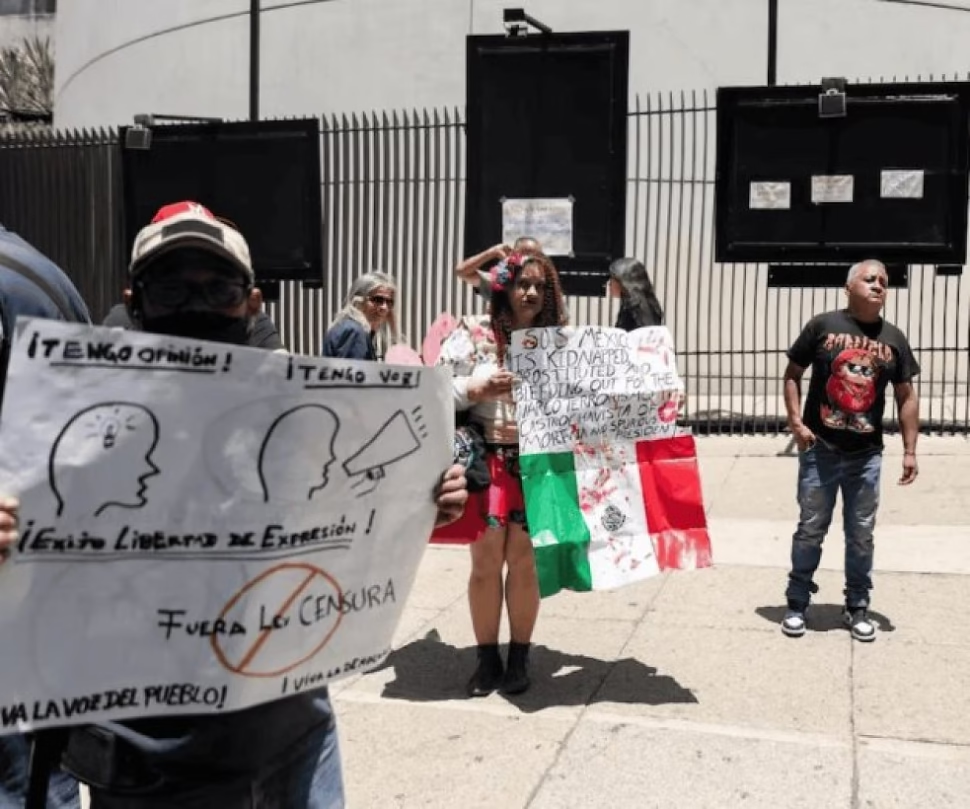
Protest in front of the Senate against reform of the Telecommunications law

A group of protesters gathered in front of the main steps of the Senate of the Republic to demand transparency in the legislative process and denounce what they described as an attempt at censorship by the federal government. The attendees, carrying signs and slogans, pointed out that article 109 of the reform project seeks to restrict freedom of expression on digital platforms.

Accusations of censorship and authoritarianism

During the event, participants harshly criticized the initiative, directly linking it to the administration of President Claudia Sheinbaum. “This law bears the seal of Morenoist authoritarianism. We will not allow millions of citizens to be silenced,” declared Rolando Solís, one of the speakers. The most repeated phrases referred to the government’s supposed intention to control public discourse on the Internet.

RelatedCrisis in Nepal due to protests against censorship on social networks

Among the attendees, the presence of former federal deputy Fernando Belaunzarán stood out, known for his critical stance towards the policies of the current government. Their participation reinforced the tone of transversal rejection of the initiative, which according to the protesters, “aims to legalize censorship” under arguments of technological regulation.

Political analysts have pointed out that this type of mobilization reflects the growing polarization around legal reforms linked to digital communication. Digital rights experts warn that, if approved without modifications, the law could set a dangerous precedent for digital democracy in Mexico.

The climate of tension is framed in a context where social platforms have become key spaces for public debate. According to INEGI data, 78% of Mexican users consider networks to be their main source of political information, which explains their sensitivity to any attempt at regulation.

What’s next? The legislative commissions plan to discuss the ruling in the coming days, while civil organizations announce new legal and protest actions. The controversy has crossed borders, with international observers expressing concern about the possible impact on human rights.

Share this information and join the debate about the future of digital freedom. Explore more content on civil rights in the technological age.

Source: El Universal (referential image)
Former Pemex director arrested for family violence

Former director of Pemex was arrested in Narvarte after a complaint from his wife for physical attacks.

The arrest

Víctor Rodríguez Padilla, former head of Petróleos Mexicanos, was arrested on the afternoon of Tuesday, July 7, in the Narvarte neighborhood, Benito Juárez mayor’s office. Elements of the Attorney General’s Office of Mexico City arrested him at 5:32 p.m. on 20 Monte Albán Street, in front of a cafe, according to the National Detention Registry.

The former official, 1.78 meters tall, with white skin and white hair, was wearing a white shirt and dress pants. He was placed at the disposal of the Common Public Prosecutor’s Office without the crime being specified in the record.

The complaint

Rodríguez Padilla is accused of family violence. His wife, nuclear engineer María Felicia Jiménez Lavie, reported the physical attacks she suffered and requested protection through a video broadcast on the networks. In her testimony to EL UNIVERSAL, she reported that the attack on March 15 — captured on recordings — was not an isolated event, but rather the highest point of an escalation that began in 2022 with verbal and physical abuse, including an incident where her husband stabbed her with a pen in her hand.

“First there were verbal insults, then a slap, pushing, but like this one, which was very brutal, I even had a lot of pain when walking for several days,” said the complainant.

On June 29, President Claudia Sheinbaum Pardo called for the full weight of the law to be applied to complaints of family violence. He pointed out that, since the events occurred in Morelos, the Attorney General’s Office of the State of Morelos will investigate the case and determine the criminal sanction. “No one will be protected from an act like this,” said the president.

Continue reading

Revocation of mandate in Veracruz: 750 thousand signatures and new deadlines

Congress of Veracruz approves reform for revocation with 750 thousand signatures and defined deadlines.

The details of the reform

The Congress of Veracruz approved a constitutional reform that specifies the mechanisms for the Revocation of Mandate. The measure could be applied from 2028, as long as at least 750 thousand citizen signatures are collected.

The vote was 39 votes in favor, 5 against and 2 abstentions. Subsection B) of section VI of Article 15 of the local Constitution was reformed.

The procedure establishes that during the month prior to the close of the third year of the government, those promoting the revocation must gather signatures equivalent to 10% of the state’s nominal list, that is, 750 thousand supports. Furthermore, this percentage must be distributed in at least half plus one of the Veracruz municipalities, and in each of them represent at least 3% of the registered voters.

Once collected, the request is presented to the Local Electoral Public Body, which will have 30 calendar days to verify the signatures and, if complied with, issue the call.

Morena’s deputy, Luis Vicente Aguilar Castillo, defended the reform:

“Citizen participation is not measured by the ease of activating a procedure, but by the ability to demonstrate that there is a collective, authentic and widely supported will by the people.”

In contrast, the Citizen Movement deputy, María Elena Córdova Molina, voted against. He considered that the reform reduces the time to gather signatures and that the rules are adjusted as appropriate.

“The men and women of Veracruz demand effective and transparent mechanisms to express their voice and feelings,” he said.

PRI member Ana Rosa Valdés Salazar also criticized the new requirements:

“It is almost impossible to meet the new requirements,” considering that they increase the list of signatory voters and require distribution in half plus one of the municipalities.

The reform seeks to define the rules for a process that, if the conditions are met, could be activated in 2028.

Continue reading

More than a ton of cocaine seized on a merchant ship

Joint operation prevents more than two million doses from reaching the streets.

Elements of the Secretariat of the Navy (Semar) and the Maritime Customs of Lázaro Cárdenas, Michoacán, located and seized 20 packages with more than a ton of cocaine on board a merchant ship.

The inspection was carried out with the support of canine teams specialized in detecting illicit substances. The packages with possible cocaine were made available to the Public Ministry, which will be part of the investigation folder.

With this assurance, more than two million doses, with a value of more than 250 million pesos, were prevented from reaching the streets. The Attorney General’s Office (FGR) and the Secretariat of Security and Citizen Protection (SSPC) also participated in the operation.

Inter-institutional coordination

The Security Cabinet highlighted that the result reflects the effectiveness of the coordination between maritime and customs authorities to strengthen security in national ports, through permanent maritime, port, air and land surveillance operations.

The Wan Hai A20 merchant ship docked at the Multipurpose Terminal II. His possible link with a criminal organization is being investigated. The troops inspected 36 containers with the same shipping origin of the alerted container in Puerto Quetzal, Guatemala.

Continue reading