Serena Williams seeks to play the US Open after injury

The 44-year-old tennis player plans to compete at the US Open after her injury at Wimbledon.

Serena Williams aims for the US Open

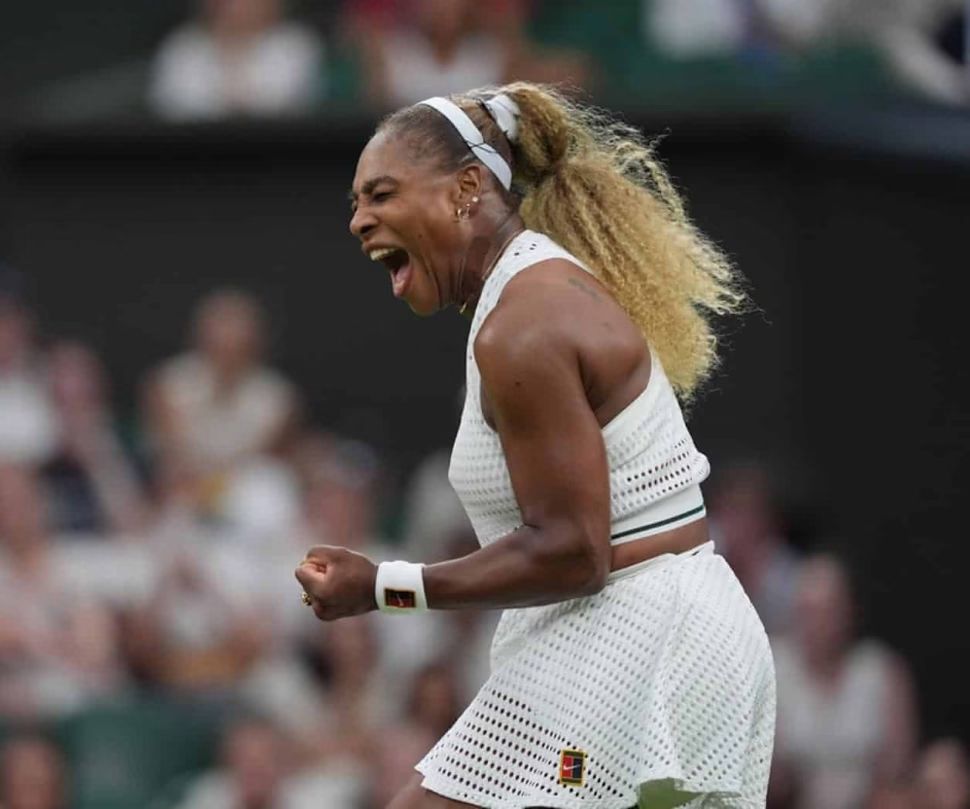
Serena Williams, 44, could return to the US Open in August, four years after her last appearance. This was indicated by her coach Rennae Stubbs during Wimbledon, where Williams lost in the first round of singles to Maya Joint.

Stubbs said: “His intention is to continue playing, including the US Open.”

RelatedSerena Williams returns to singles at Wimbledon

Williams suffered a right knee injury during that match, forcing her to withdraw from doubles with her sister Venus. On Instagram he shared images of syringes with fluid extracted from his knee. Even so, Stubbs assured that his level was high before the injury.

“She whispered: ‘I would have won if I had a good knee.’ In the run-up, she beat players who are still in the tournament,” she said.

The US Open main draw begins on August 30. Williams could receive invitations to preparatory tournaments in Toronto and Cincinnati. James Blake, former tennis player and commentator, highlighted the impact of the possible return.

“It’s going to be huge. She deserves it because she’s the best of all time in women’s tennis,” Blake told The Associated Press.

Caroline Wozniacki, a friend of Williams, noted that her movement on grass was already good and she expects improvement on hard courts.

Williams has already shown his power with serves over 120 mph. The US Open, a tournament he has won six times in singles, could be favorable for him.
France faces Morocco in the World Cup quarterfinals

France is seeking the semifinals against Morocco, which is seeking revenge in 2022.

Moroccan revenge on the horizon

France and Morocco will meet on Thursday in the World Cup quarterfinals. The duel relives the 2022 clash in Qatar, when Morocco made history as the first African team in the semifinals. That time, France won 2-0.

Now, the African team is the only one from its continent still in contention in North America. Les Bleus want to confirm their favoritism and reach their third consecutive semi-final.

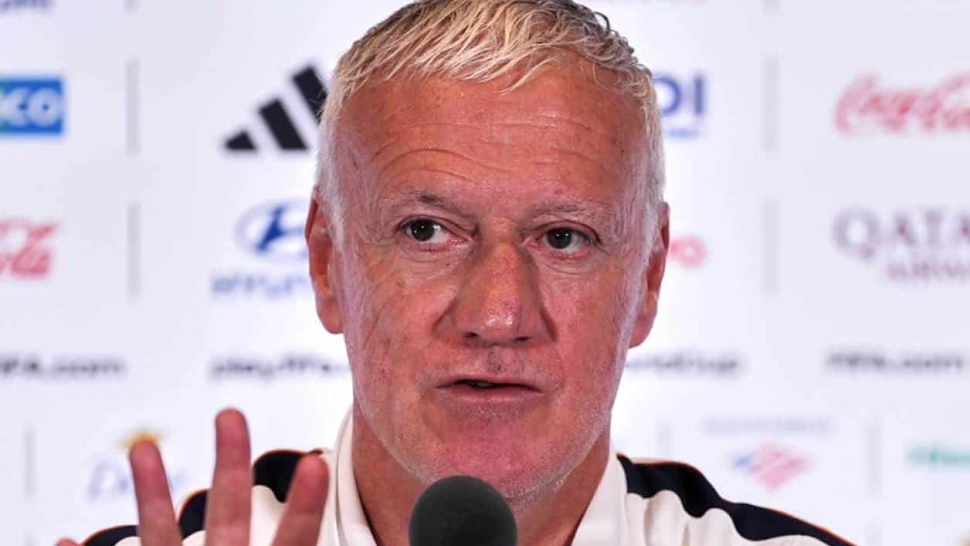
Didier Deschamps, French coach, anticipates a complex match. “Morocco’s profile is not that of Paraguay. They are an excellent team, with top-level individuals. They are not here to play just to play. They are here to win,” he declared on Tuesday.

Olise’s appeal, unsuccessful

FIFA rejected France’s appeal on Wednesday for the yellow card Michael Olise received against Paraguay. The card was shown at 97 minutes due to a struggle with Matías Galarza Fonda. Replays showed Olise holding the opponent’s jersey.

Deschamps confirmed the news: “There was no change regarding Olise’s yellow card. We received this morning the decision from FIFA that it would stand.” If Olise receives another yellow card on Thursday, he would miss a possible semi-final.

The case drew comparisons with US President Donald Trump’s intervention before Gianni Infantino so that Folarin Balogun was not suspended. FIFA lifted the sanction, but the United States lost 4-1 to Belgium and was eliminated.

Mbappé, on the margins of the controversy

Deschamps also addressed Paraguayan senator Celeste Amarilla’s insults against Kylian Mbappé on social networks. The French prosecutor’s office investigates hate speech. “Kylian is strong and nothing affects him. He is at a high level,” said the coach.

Regarding the refereeing – three yellow cards for France and none for Paraguay in the round of 16 – Deschamps was cautious: “It is out of our control. I trust the refereeing. Our rival is Morocco, not the referee.”

Asked about his future after the tournament, as he will leave the national team after 14 years, he responded: “I’m not thinking about that. I’m focused on the Moroccan team to win that match.”

Continue reading

The World Cup ball: technology that you cannot take home

Why should fans return the ball? Technology and tradition explain it.

A memory that gets out of hand

The World Cup balls have made headlines for their technology, but also for a rule that surprises many: fans must return them to the field immediately. Curiosity is great, especially for those who spend fortunes on trips and tickets.

“With the amount of money I spent, I should definitely be able to keep a ball,” said England fan Jack Goodwin, who used his house down payment to travel with his father from London.

In football, the tradition is different from baseball, where catching a ball is a lifelong memory. One Congo fan summed it up: “We didn’t come here for an award, we came to see our country.”

Why does FIFA demand to return them?

FIFA did not officially respond, but historian Charles Cutton points to economic reasons and the pace of play: “In the past there used to be only one ball per game. You had to recover it to continue.”

Official balls cost between $60 and $180 in stores, but the real cost of match balls is higher due to their technology. The Adidas Trionda of this World Cup has a 500 Hz motion sensor that sends data to the VAR to determine offsides and goals.

Professor Jud Ready of Georgia Tech explains: “They have evolved from leather to polyurethane. It doesn’t absorb moisture, it improves performance.” His colleague Manos Tentzeris adds that the sensor has 99.99% accuracy and works with cameras to locate any point on the field.

Technology that does not work outside the stadium

Ready points out that the ball depends on the stadium infrastructure to communicate. Additionally, it must be charged before the game with a wireless system similar to that of a smart watch. This makes it almost impossible for a fan to take advantage of it as a functional souvenir.

“The balls have radio frequency transmitters and accelerometers,” details Ready. But outside the stadium, those components are useless.

Although some dream of keeping one, FIFA remains firm in its policy. The ball, for now, only shines on the court.

Continue reading

Rafael Márquez takes over as coach of the Mexican National Team

After the 2026 World Cup, the historic former defender takes the reins of the Tricolor heading to 2030.

The Mexican Football Federation (FMF) made official the appointment of Rafael Márquez as the new technical director of the National Team. The announcement comes after Mexico’s participation in the 2026 World Cup and continues the Sports Project 2030, presented in August 2024.

Mikel Arriola, commissioner of the FMF, was the one who confirmed the movement. Márquez, who was part of Javier Aguirre’s coaching staff since 2024, now takes the baton. Aguirre leaves the bench as planned.

The challenge of the ‘Kaiser’

Márquez begins his management ahead of the 2030 World Cup. His experience as an assistant during the recent process gives him knowledge of the group. The FMF is committed to the continuity of the project.

The former defender built a remarkable career with the Tricolor. He played in five World Cups, always as captain. He won the 1999 Confederations Cup and the 2003 and 2011 Gold Cups.

At club level, he starred for AS Monaco, Barcelona, New York Red Bulls and Hellas Verona. With Barcelona he won two Champions Leagues, four Spanish Leagues, a Club World Cup, a European Super Cup, a Copa del Rey and three Super Cups. In Mexico he was a two-time Liga MX champion with León and debuted and retired with Atlas.

Before joining Aguirre’s coaching staff, Márquez coached in the youth ranks of Real Alcalá and at the head of Barça Atlètic.

His appointment marks the beginning of a new era for Mexican soccer, with its sights set on the World Cup in four years.

Continue reading