Impact of Wellbeing Programs on poverty reduction
The President of Mexico, Claudia Sheinbaum Pardo, highlighted that the Wellness Programs represent a social investment of approximately 850 billion pesos (mdp) in 2025. According to data from the World Bank, this strategy has allowed 9.5 million Mexicans to overcome poverty between 2018 and 2023. This achievement marks the most significant decrease in four decades, attributed not only to direct economic support, but also to the increase in the minimum wage and the labor reforms implemented during the administration of President López Obrador.
Expansion and consolidation of social support
The programs, now guaranteed as a constitutional right, include new initiatives such as the Women’s Wellbeing Pension, the Rita Cetina Gutiérrez Scholarship and Salud Casa por Casa. It is projected that by 2026 the investment will reach one trillion pesos, directly benefiting 30 million families. This approach not only improves the quality of life of citizens, but also boosts the national economy by redistributing resources.
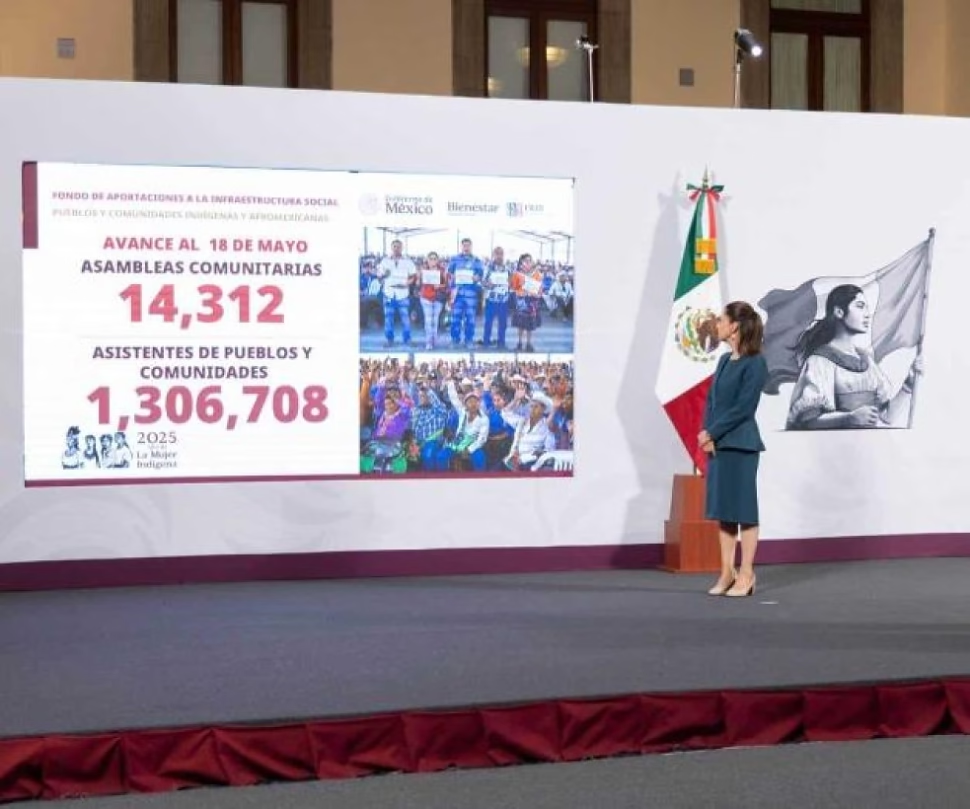
The Secretary of Welfare, Ariadna Montiel Reyes, reported that 8.7 million beneficiaries (with surnames from A to L) have already received their payments corresponding to the May-June two-month period, with an investment of 44,500 million pesos. Deposits for the rest of the beneficiaries (M to Z) will be made between May 20 and 30. In addition, 14,312 assemblies have been held in indigenous and Afro-Mexican communities for the implementation of the Social Infrastructure Contribution Fund, with the participation of more than 306,000 people.
Tangible results in education, housing and employment
In the educational field, universal scholarships such as Rita Cetina, Benito Juárez García and Jóvenes Escribiendo el Futuro benefit more than 13 million students, with a bimonthly investment of 23,974 million pesos. On the other hand, the The School is Our program allocated 25,000 million pesos this year, impacting 8.1 million students and 74,100 educational institutions.
In terms of employment, the Youth Building the Future program has supported 3.1 million people between 18 and 29 years old since 2019, with a historic investment of 139,000 million pesos. According to the Secretary of Labor, Marath Baruch Bolaños, 70% of the participants found employment or a productive occupation.
Emergency response and care for vulnerable communities
The Government of Mexico has also allocated significant resources to address impacts caused by natural disasters. 301,076 supports were delivered to victims of Hurricane Otis, with an investment of 15,275 million pesos, and 6,168.9 million pesos were allocated to assist 66 municipalities impacted by Hurricane John in Guerrero and Oaxaca.
In the health sector, the La Clínica es Nuestra program will allocate 4,707 million pesos this year to modernize medical centers, with allocations ranging from 400,000 pesos for small clinics to 1.2 million for expanded service centers (CESSA).
Diplomatic relations in a complex context
In another area, President Sheinbaum received the credentials of Ronald Johnson, the new United States ambassador to Mexico. This meeting occurs in a scenario of bilateral tensions, marked by trade disputes, border security and immigration agreements. The appointment of Johnson, who previously served as ambassador to El Salvador, could mark a new chapter in the relationship between both countries.
Are you interested in learning more about how social programs transform lives? Share this note and discover more content about economic development and public policies on our social networks.