Princess Amalia suffers a broken arm after falling from a horse

The heir to the Dutch throne faces an unexpected turn after a dramatic equestrian incident.

A twist of fate in the life of the future queen

The heart of the Netherlands stopped for a moment when Princess Amalia, the brilliant heir to the throne, faced a cruel fate during a peaceful equestrian journey. The 21-year-old, whose name resonates as a synonym for hope for an entire nation, saw her world transformed into a whirlwind of pain when her loyal steed betrayed her trust, mercilessly throwing her against the unforgiving ground.

The night that changed everything

Tuesday became a date etched in the annals of the Dutch monarchy. As the moon rose over Utrecht, surgeons at the University Medical Center waged an epic battle against time, their expert hands working with millimeter precision to rebuild what fate had broken. “The operation went well“, declared the Royal Family with barely concealed relief, although the official statement could not hide the tremor of a nation in suspense.

RelatedPrincess Elisabeth faces obstacles to continue her studies at Harvard

Among the shadows of the hospital, the Princess of Orange now lies like a fallen angel, her immobilized arm a mute witness to her bravery. Doctors, turned into silent guardians, maintain a constant vigil, measuring every heartbeat, every sigh, while the entire country holds its breath.

The irony of fate is cruel: just when the biographical book written by the most beloved comedian in Holland revealed her overflowing passion for horse riding, the same sport that lifted her to the skies threw her into the clutches of adversity. Do the gods of destiny smile with derision at mortal plans?

Beyond the hospitable walls, the Dutch people weave an invisible network of support, their prayers ascending like columns of light toward the room where their future queen rests. Social networks are burning with messages of affection, transforming the hashtag #FuerzaAmalia into a unanimous cry of affection.

Meanwhile, in the royal stables, a horse of noble lineage nervously steps on its straw, perhaps remembering the moment when the balance was broken, or perhaps longing for the familiar weight of its favorite rider. Equine psychology does not forgive: animals also suffer the consequences of tragedy.

Royal protocol experts whisper in the palace corridors: how will this affect their official duties? Will this delay his preparation as a future monarch? Questions float in the air like autumn leaves, but for now, only one certainty prevails: the orange blood of the Nassau runs strong in their veins, and if history has shown anything, it is that this dynasty knows how to rise after every fall.

Share this article and join the thousands of voices sending positive energy to the princess! Discover more fascinating stories about European royalty in our special section.
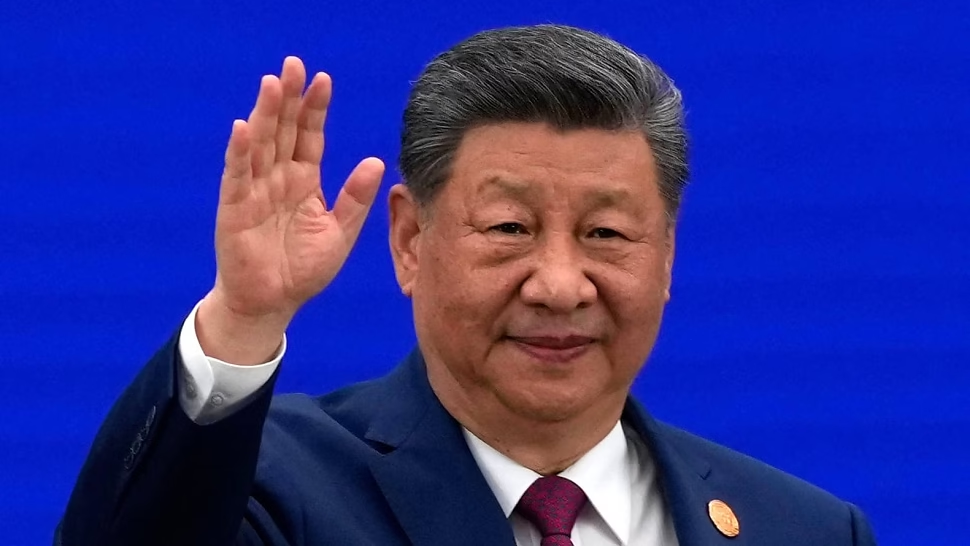
Xi Jinping calls for global AI governance without unilateral dominance

China proposes international cooperation in artificial intelligence and offers training to developing countries.

China bets on global governance of AI

Chinese President Xi Jinping urged the promotion of global governance of artificial intelligence (AI) and stated that its development should not belong to a single country. During the opening of the World Conference on Artificial Intelligence in Shanghai, he questioned what he called an “overreach” of the concept of national security in this area, in clear reference to the technological restrictions imposed by the United States.

“Artificial intelligence must become a symphony of global cooperation, not an isolated competition between nations,” Xi said.

As part of its strategy, China will strengthen AI collaboration with organizations such as ASEAN, the Arab League, the African Union, CELAC and the BRICS countries. In addition, it will offer five thousand training opportunities for developing countries in the next five years.

Multilateral agreement in Shanghai

Before the event, 29 countries—including Russia, Pakistan and Kazakhstan—signed an agreement with Beijing to create a World Artificial Intelligence Cooperation Organization, based in Shanghai. Analysts interpret this initiative as China’s response to the US Pax Silica framework, which seeks to strengthen AI supply chains with its allies.

Continue reading

The US reduces visas for foreign journalists to 240 days

Trump administration shortens visa validity for foreign correspondents to 240 days.

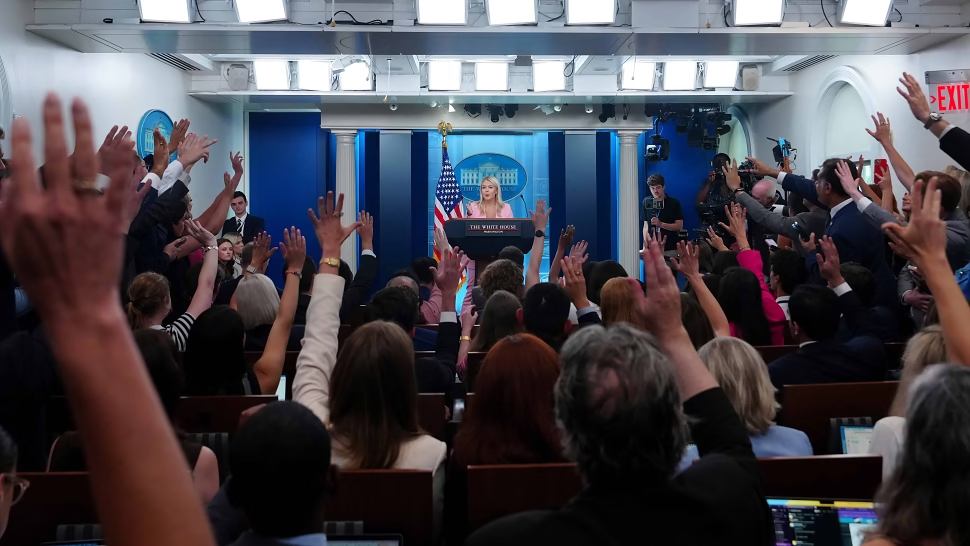
Donald Trump’s administration implemented a drastic change to the visa system for international correspondents. From now on, visas for foreign journalists will have a maximum validity of 240 days, compared to the several years allowed by the previous scheme. In the case of Chinese journalists, the stay permit is reduced to only 90 days.

Reactions and justifications

The Department of Homeland Security explained that the “duration of status” system, which allowed correspondents to remain in US territory as long as they met their visa requirements, is eliminated. Instead, renewable fixed periods are established, with the aim of facilitating the supervision and review of each case.

Organizations such as Reporters Without Borders and the Committee to Protect Journalists pointed out that the measure restricts press freedom and hinders information coverage by international media in the United States. From Beijing, the Chinese government described the decision as discriminatory and warned that it will take response measures.

The new regulations also impact students and other visitors under similar schemes. At a time when Washington and Beijing seek to stabilize their bilateral relations, this immigration hardening could fuel tensions between both powers.

Continue reading

Germany and France strengthen cooperation in nuclear defense

Germany joins a French-led nuclear exercise before the end of the year.

German-French military agreement

Germany and France agreed to strengthen their defense cooperation. The German military will participate in a nuclear exercise led by French forces before the end of the year.

The announcement was made by Chancellor Friedrich Merz and President Emmanuel Macron. Both stressed that the measure seeks to reinforce European security in a context of growing global uncertainty.

Conventional participation, without breaking with NATO

Merz explained that German participation will, for now, only be through conventional means. He clarified that this collaboration complements the NATO deterrence scheme, of which Germany continues to be a part through the deployment of US nuclear weapons on its territory.

The chancellor pointed out that the current geopolitical scenario requires new responses in terms of security. The joint exercise is part of a broader European strategy to diversify defensive capabilities.

France, as a nuclear power, has been leading this type of maneuvers for decades. The incorporation of Germany represents an unprecedented step in the military integration of the continent.

Continue reading