Plenitude Crematorium Case reaches 96 identified bodies

Advances in the forensic investigation and support for families affected by the macabre discovery, while the search for justice grows.

Advances in the Forensic Identification of the Plenitude Crematorium Case

Three months after the macabre discovery of 386 uncremated bodies in the facilities of the Plenitud crematorium, located in Ciudad Juárez, forensic authorities have made significant progress. The Attorney General’s Office of the State of Chihuahua officially reported that the number of identifications of human remains amounts to 96. At the same time, the legal dimension of the case is expanding, with 62 families that have already filed a formal complaint for the crime of fraud.

The process of notifying the bereaved is in an advanced phase. Of the 96 people identified, the relatives of 86 have already been contacted and notified. The authorities have indicated that it is planned to notify the 10 remaining families in the next few hours, thus completing this crucial stage of the administrative mourning for all the cases resolved to date.

RelatedOnly 86 identified of 386 bodies in Plenitude Crematorium

Delivery of Remains and Complaint Mechanisms

In a detailed statement, the Prosecutor’s Office specified that, of the total number of identifications, 79 bodies have already been delivered to their respective families. This restitution process is accompanied by the institutions involved, seeking to provide a minimum of comfort and certainty in the midst of the tragedy.

A technological aspect that has proven effective in this complex investigation is the use of a specialized web portal. Through the address https://fgewebapps.chihuahua.gob.mx/Crematorio, families and citizens in general have been able to provide vital information and images. Thanks to this digital tool, the identification of three people has been achieved, which underlines the importance of community collaboration in solving large-scale forensic cases.

The 62 fraud complaints filed so far were filed with the Specialized Unit for the Investigation of Dangerous Crimes against Peace, Personal Safety and Public Faith. This collective legal action seeks to establish criminal and civil responsibilities for the alleged scam committed against the families, who paid for a cremation service that was never carried out.

Comprehensive Attention to Victims and Political Development of the Case

In follow-up to the institutional commitment, the State Attorney General’s Office, together with the Directorate of Expert Services and Forensic Sciences and the Executive Commission for Attention to Victims of the State of Chihuahua (CEAVE), continues its work in a coordinated manner. The approach is not limited to criminal investigation, but extends to psychological care, the provision of transparent information and legal advice for all affected relatives who require it. This comprehensive care model recognizes the deep trauma and vulnerability of the families impacted by this event.

While local institutions advance in the process, the case has transcended the state level. This same day, members of groups made up of relatives of the possible victims moved to Mexico City. Their objective was to demonstrate publicly and formally request that the Attorney General’s Office (FGR) take up the case, arguing the need for an investigation at the federal level that could expedite and strengthen the search for truth and justice.

This movement generated an immediate response from the state president. The governor of Chihuahua, María Eugenia Campos Galván, assured that the mourners would be being mobilized by the senator for MORENA, Juan Carlos Loera de la Rosa, hinting at a possible political motivation behind the protest. Until the closing of this report, the senator in question had not commented on the governor‘s statements, leaving a space of uncertainty about the political scope of this human tragedy.

The case of the Plenitud crematorium has become an emblem of the failures in the regulation of the funeral sector and a litmus test for the justice system and forensic services in Mexico. The identification of 96 bodies represents methodical progress, although it also shows the long and painful journey that still lies ahead for the almost 300 families who continue to wait for answers. The combination of a rigorous criminal investigation, the use of technology for human identification and continuous psychosocial support are the pillars on which the path towards accountability and reparation of damage is slowly built.

Share this information to keep your community informed about this crucial case for justice and transparency. Explore more content related to judicial and forensic news on our site.
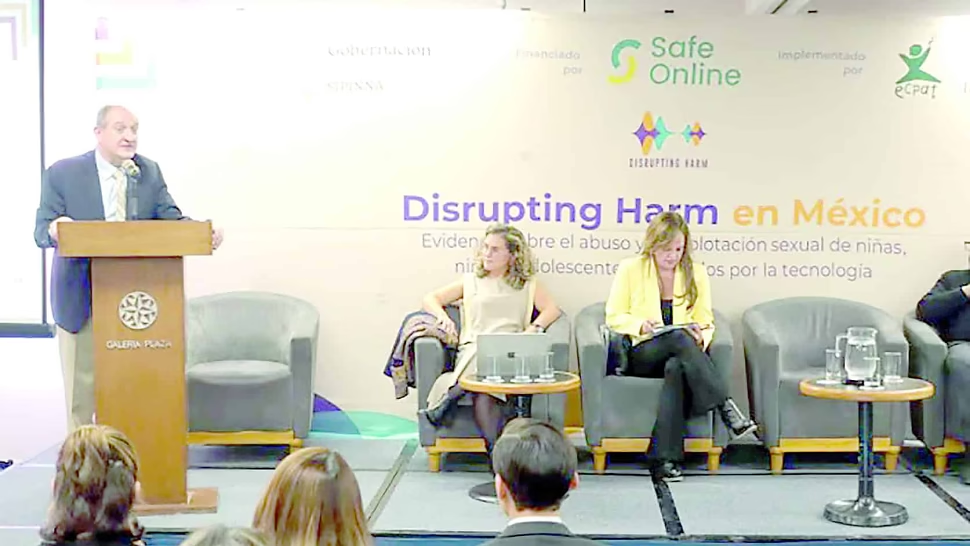
Digital sexual exploitation affects 1.6 million adolescents in Mexico

1.6 million adolescents in Mexico suffer online sexual exploitation every year.

The report reveals alarming figures

Unicef, ECPAT International and Interpol published the study “Disrupting Harm México”, which indicates that one in eight adolescent Internet users in the country – around 1.6 million – experienced sexual exploitation facilitated by digital technologies for a year.

67% of cases occurred online only, mainly on social networks and platforms. However, violence is not limited to the virtual sphere: in almost two out of every three situations, the victims knew their attackers, who were usually friends, partners or family members.

The report documents serious under-reporting. 32% of victims did not tell anyone what happened out of shame or fear, and less than 1% filed a formal complaint. This reflects normalization and silence around these attacks.

Consequences and call to action

In mental health, the consequences are profound. Those who suffered this type of violence are 15 times more likely to self-harm and 12 times more likely to have thoughts about their own death, compared to those who did not have that experience.

Fernando Carrera, Unicef ​​representative in Mexico, asked to reinforce prevention and responsibility of digital platforms. Lorena Villavicencio Ayala, from SIPINNA, stated that the State must guarantee the safety of girls, boys and adolescents in digital environments.

Continue reading

Pemex and Petrobras join forces in the Gulf of Mexico

Pemex and Petrobras sign two-year pact to explore the Gulf of Mexico.

Strategic alliance between the oil companies of Mexico and Brazil

This Tuesday, Pemex and Petrobras signed a cooperation agreement for exploration and production projects. The agreement was signed in Rio de Janeiro and will be valid for two years. It does not imply joint investments or the creation of a consortium.

The understanding focuses on deep waters of the Gulf of Mexico. Petrobras will contribute its experience in fields under salt layers, such as the Brazilian pre-salt. Magda Chambriard, president of Petrobras, noted that ignoring the area’s oil wealth would be implausible after years of greater development on the U.S. side. The board sees an opportunity to position the Brazilian company as a strategic partner of Pemex.

For his part, the general director of Pemex, Juan Carlos Carpio Fragoso, stated that the agreement opens new possibilities of collaboration for both companies and their countries. The cooperation also covers refining, petrochemicals, fertilizers, gas processing, energy efficiency and emissions reduction.

The pact occurs in a context of political rapprochement between the governments of Claudia Sheinbaum and Luiz Inácio Lula da Silva. Both seek to strengthen cooperation in strategic sectors, amid geopolitical tensions and the influence of the United States in the region.

Continue reading

Bicameral commission begins functions after 22 months of delay

After 22 months of delay, the Bicameral National Security Commission begins.

They install a commission with a delay of 22 months

The Chamber of Deputies and the Senate installed the Bicameral National Security Commission, 22 months behind schedule. The body will have the task of supervising and exercising parliamentary control over the State’s security policies.

Senator Eugenio Segura Vázquez was appointed president of the commission. In his speech, he noted that the objective is to strengthen the security strategy through closer legislative support. He acknowledged recent progress, but warned that relevant challenges persist.

Segura Vázquez reported that since September 2024 the daily average of homicides has been reduced by 46% and high-impact crimes have fallen by 27%. He also highlighted that the National Guard has about 120 thousand elements. He assured that these results reflect an ongoing strategy, but the work is not finished. The commission must recognize progress, point out pending issues and improve coordination.

The senator announced that the intelligence and investigation axis will be a priority, as it is key in the relationship with the National Intelligence Center. The objective: strengthen parliamentary control without losing sight of the country’s structural challenges.

Continue reading