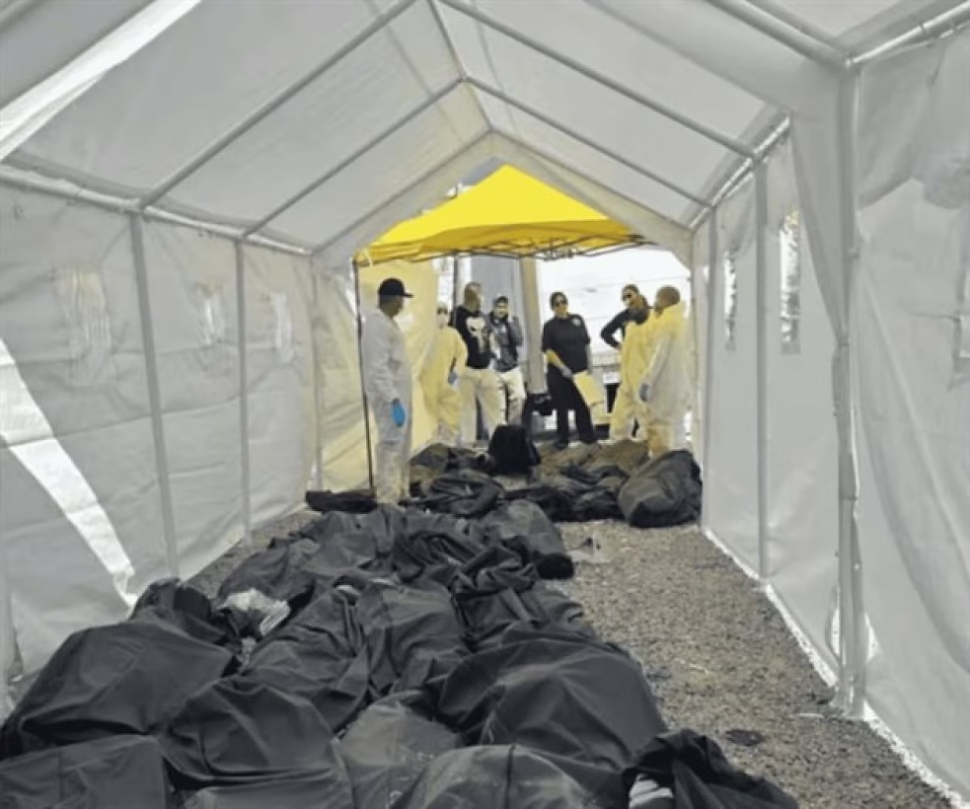
Methodical Advancement in the Identification of Victims of the Plenitude Crematorium
The Attorney General’s Office of the State of Chihuahua (FGE) has reported significant progress in the complex investigation of the “Plenitud” crematorium, located in Ciudad Juárez. To date, 105 people have been formally identified of the 386 who were found uncremated in the month of June. This process, which combines cutting-edge expertise and attention to victims, represents a crucial step towards justice and dignity for the bereaved.
The identification has been possible thanks to the coordinated and specialized work of multiple entities. The Directorate of Expert Services and Forensic Sciences, the State Victim Care Center (CEAVE) and the Public Ministry of the Specialized Unit have worked together to achieve this objective. As a result of these institutional efforts, 98 families have already been officially notified, and it is expected that the remaining seven will receive the communication in the next few hours, thus closing a period of distressing uncertainty for them.
Technology and Citizen Collaboration as Pillars
A notable aspect of this research is the integration of digital tools to speed up recognition tasks. Six of the identifications made were achieved thanks to the personal data and images provided by citizens through the official web portal enabled by the state prosecutor’s office. This site, which remains active to continue collecting testimonies and graphic material, has become a vital channel for solving the case, demonstrating the importance of community collaboration in large-scale forensic investigations.
As for the final disposal of the bodies, the authorities have detailed that, of the 105 identified, 89 have already been delivered to their families. To support the bereaved in this sensitive process, the support of various institutions and companies in the funeral sector has been provided, allowing families to dispose of the remains of their loved ones in the way they consider most appropriate, trying to mitigate, as far as possible, the deep emotional impact.
Legal Actions and the Path to Justice
In parallel to the identification and delivery tasks, the legal aspect of this case is advancing. So far, 73 families, who have already received the body of their loved one, have filed a formal complaint with the Northern Zone District Attorney’s Office. The main accusation is for the crime of fraud against the people who are responsible for the irregular operation of the crematorium. This legal figure seeks to punish deception and breach of contract with the agreed upon funeral services, which constitutes an additional violation of the rights of consumers and victims.
The FGE has reiterated its commitment to continue with these tasks in a comprehensive and joint manner. The work plan not only includes persistence in forensic identification tasks for the rest of the victims, but also the maintenance of psychosocial support. Specialized psychological care, constant information and legal advice continue to be provided to all affected relatives who require it, recognizing that the trauma of this event requires long-term professional support.
This case has put on the table the need for stricter regulation and effective supervision of the funeral sector, an area that, by its nature, handles a deep emotional burden for families. The magnitude of the events that occurred at the “Plenitud” crematorium not only represents a human tragedy of considerable proportions, but also a systemic failure that requires forceful responses from the authorities and the implementation of mechanisms that prevent the repetition of similar events. Transparency in the process and constant communication with family members are, in this context, non-negotiable elements for the reconstruction of citizen trust in institutions.
Share this information to keep your community informed about this crucial justice process and explore more current-related content on our site.