Only 86 identified of 386 bodies in Plenitude Crematorium

Slow progress in the forensic identification of exhumed remains, as families continue their tireless search for answers and justice.

Advances in the Forensic Identification of the Plenitude Crematorium Case

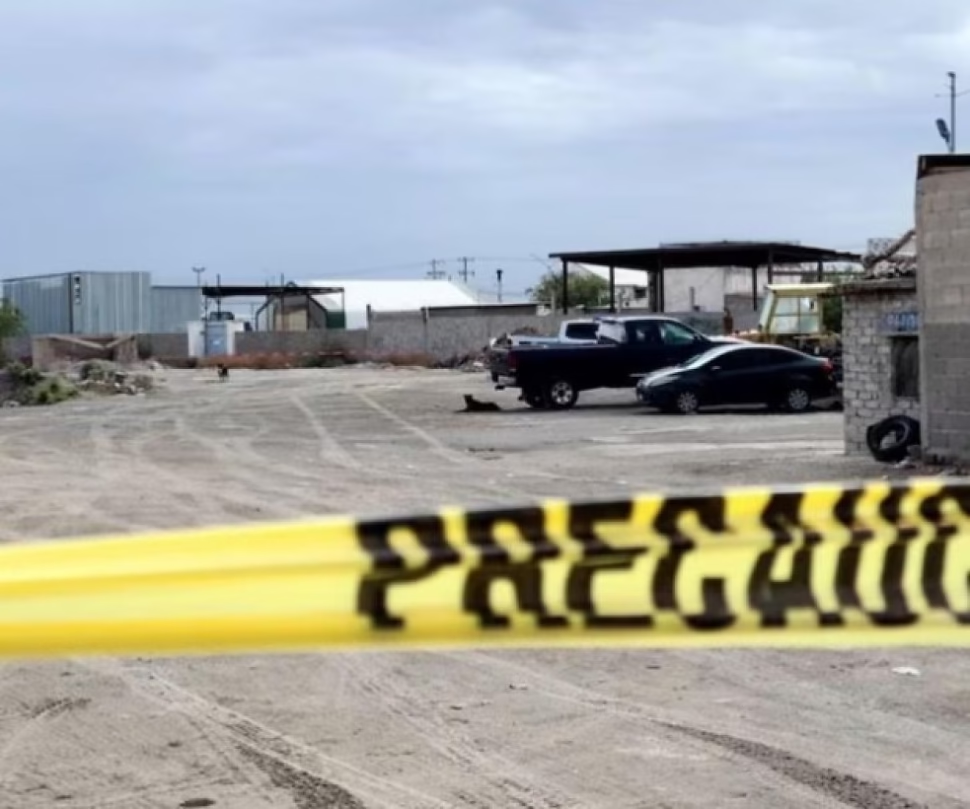
Almost three months after the discovery of 386 bodies in the facilities of the Plenitud crematorium in Ciudad Juárez, Chihuahua, forensic authorities have confirmed the positive identification of only 86 individuals. This discovery, of catastrophic proportions, continues to represent a monumental challenge for expert services and affected families.

Of the 86 relatives identified through technical-scientific analysis, 74 families have been formally notified. In a crucial step towards the culmination of mourning, the physical delivery of the remains of 67 people to their loved ones has been achieved. It is anticipated that in the next few hours the remaining 12 families whose individualization processes have been satisfactorily concluded will be notified.

RelatedPlenitude Crematorium Case reaches 96 identified bodies

Criminal Search and Investigation Mechanisms

A vital component in this effort has been the official website enabled by the Attorney General’s Office of the State of Chihuahua. This digital platform, designed to collect information and images of people reported missing, has borne tangible fruit, directly contributing to the confirmation of three identities. Additionally, eight solid identity hypotheses are being used that are pending definitive confirmation by family members.

In the field of criminal investigation, the Unit Specialized in the Investigation of Dangerous Crimes against Peace, Personal Safety and Public Faith, has already accumulated 53 formal complaints for the crime of fraud. These accusations are directed against the person or persons responsible for the operation of the crematorium and the alleged fraud of hundreds of families.

The State Attorney General’s Office (FGE) has emphasized its unwavering commitment to providing legal and human certainty to families. Identification efforts continue uninterrupted. At the same time, a broad support mechanism has been deployed that includes the Executive Commission for Attention to Victims of the State of Chihuahua (CEAVE), providing specialized psychological care, constant information and legal advice to all the bereaved who have requested it.

The Tireless Fight of the Collectives for Justice

In marked contrast to the methodical pace of the official investigation, the family groups formed after the tragedy maintain their pressure in the streets. Their central demand remains the same: demand justice and clear answers through demonstrations and peaceful protest actions.

Recently, members of the Justice for Our Bereavements collective demonstrated at the facilities of the Undersecretary of Human Development and Common Good (SDHyBC). During the protest, they were received by Undersecretary Austria Galindo, who heard firsthand the group’s demands. These requests focus on expediting the processes of forensic identification of the bodies located in the crematorium and guaranteeing a thorough criminal investigation. The official reiterated the agency’s willingness to maintain a constant dialogue and provide timely follow-up to each of the approaches presented by the families.

This case underscores the critical importance of forensic protocols in crisis situations, the need for transparency in high-impact investigations, and families’ fundamental right to the truth. The resolution of this tragic episode will depend on the persistence of scientific research and continued accountability by the corresponding authorities.

Share this information to keep the debate about justice and victims’ rights alive. Explore our site for more analysis of relevant forensic and judicial cases.

How to prevent illnesses and falls with low-cost changes

WEF study proposes simple changes in homes and physical activity to save billions.

Small actions, big savings

Reducing diabetes, preventing falls, and preventing dementia is possible with minimal home adjustments, physical activity programs, and accessible technology. This is stated by the World Economic Forum (WEF) in its study “The longevity dividend”.

The report estimates that shifting policies toward prevention would free up $6.4 trillion globally. These resources today are used to treat diseases that could be avoided.

Concrete strategies

To prevent falls, experts recommend grab bars and lighting on stairs. With an investment of less than 400 billion dollars, almost 400 million falls would be avoided by 2040. This would generate more than 5 trillion in health savings.

In diabetes, community physical activity programs could stop 8.5 million cases of type 2 diabetes by 2040. The cost per person ranges between one and 40 dollars, and the gains in productivity would exceed 125 billion.

Hearing loss has a direct link to dementia. Expanding access to hearing aids would prevent 2.4 million cases of dementia and save more than 325 billion in health.

Economic benefits

The study, applied in 21 countries by the WEF and Marsh, indicates that companies and governments address health, finances and work separately. If integrated, they would unlock 5.8 trillion in healthcare savings and 645 billion in productivity gains.

“Poor health strains health systems and personal finances, affecting financial resilience and generating broader economic costs,” the report warns.

Impact on women

A relevant fact: women who dedicate a year to care work see their retirement savings reduced by 24% due to absence from work and the wage gap. Institutions often treat these problems separately, despite their consequences.

The WEF concludes that there is a window of opportunity to align health, finance and employment policies. The key: allocate budgets to prevention and care for the elderly population with public-private collaboration.

Continue reading

AICM taxi drivers refuse to apply discounts agreed for the World Cup

Three AICM taxi drivers groups refuse to apply discounts of up to 18% during the World Cup.

Three groups of taxi drivers that operate at the Mexico City International Airport (AICM) refused to apply discounts of up to 18% on their rates during the World Cup. The measure contradicts previous agreements announced by airport authorities and part of the union.

The companies Nueva Imagen, Porto Taxi and Sitio 300 issued a statement to clarify their position. They argued that they have no contractual relationship with the Grupo Aeroportuario Marina (GAM), the entity that promoted the benefits for airport users.

According to permit holders, the announced discounts do not represent a direct reduction in rates. They are, they say, adjustments derived from compensation for improper charges and administrative processes for maintenance work at the AICM.

They demand transparency

The taxi drivers asked the AICM authorities to make public the documents that support these measures. They also called on the GAM to make transparent the minutes and contracts where the application of discounts had been agreed upon. They questioned the legal validity of the obligations attributed to them.

The refusal could affect users who expected more affordable rates during the sporting event. Until now, there is no certainty about the real cost of service at the AICM during the World Cup.

Continue reading

Morena opens the door to a coalition with the PVEM in San Luis Potosí

Morena conditions alliance on PVEM ruling out Ruth González for the governorship.

Morena-PVEM Coalition for 2027?

The state leadership of Morena in San Luis Potosí left open the possibility of an alliance with the Green Ecologist Party (PVEM) for the local elections of 2027. The condition: that the PVEM present a different profile from that of Senator Ruth González.

Rita Ozalia Rodríguez Velázquez, state president of Morena, explained that if the PVEM discards Ruth González—wife of Governor Ricardo Gallardo—the green party could lead the coalition, which would also integrate the Labor Party (PT).

The leader clarified that the relationship with the PVEM at the local level does not face a conflict, although she admitted that there is no direct communication between both state leaders. Decisions about alliances, he said, are made by national leaders.

The possible agreement arises in the midst of the debate about nepotism, after Ruth González’s intention to succeed her husband in the state government was questioned. Morena looks for profiles that avoid that controversy.

Rodríguez Velázquez stressed that there is coordination between the party leadership to define the electoral strategy. For now, the panorama in San Luis Potosí remains open.

Continue reading