Eight months after its implementation, the Michoacán Plan for Peace and Justice shows concrete results. The federal government reported a sustained reduction in intentional homicides and other high-impact crimes in the state.
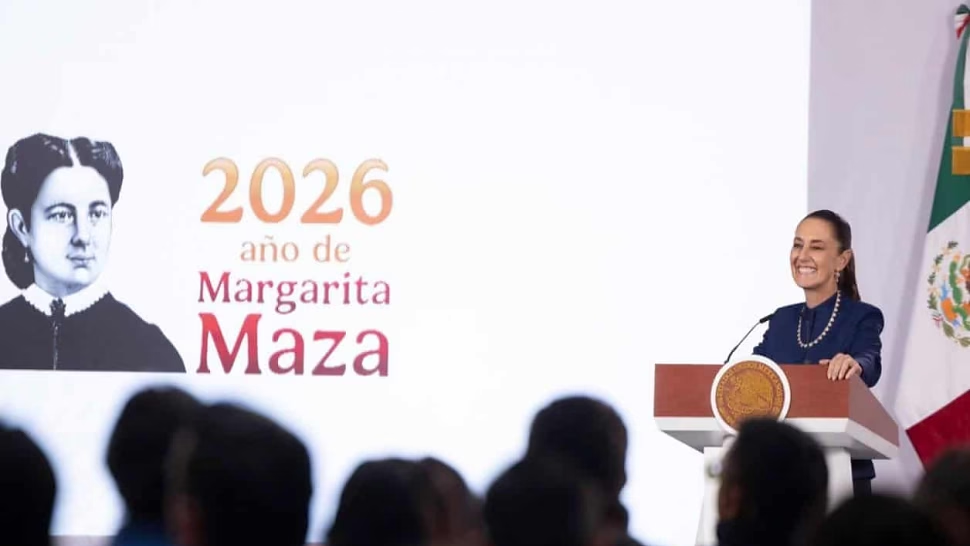
The strategy was launched after the death of the mayor of Uruapan, Carlos Manzo. During the morning conference, President Claudia Sheinbaum and the head of the Executive Secretariat of the National Public Security System, Marcela Figueroa, presented the figures.
Decrease of 46%
The daily average of intentional homicides went from 4.32 victims in January 2025 to 2.33 in June 2026. This represents a drop of 46%. Figueroa detailed that June 2026 was the month with the lowest incidence since 2015. Compared to June 2025, the reduction was 43%.
The annual trend is also positive. After reaching their highest level in 2021, homicides began to decline. The preliminary data for 2026 is the lowest in the historical series. Compared to 2025, the daily average went from 3.5 to 2.2, a reduction of 37%.
High impact crimes
The daily average of high-impact crimes fell 3% compared to 2025: from 18.1 to a preliminary figure for 2026. If the trend continues, this year would close with the lowest average in eleven years.
Beyond security
Governor Alfredo Ramírez Bedolla affirmed that the plan gives “very evident results” in security, education and infrastructure. He thanked the federal support and highlighted programs such as the Gertrudis Bocanegra scholarships and road works: the expansion to four lanes of the highway towards Lázaro Cárdenas and the export highway between Uruapan and Zamora.
“It is clear to us that we are not alone, we are well supported by our president,” said Ramírez Bedolla. Sheinbaum is on a two-day tour of Michoacán, which includes visits to communities like Cherán.