Pemex will invest 93 billion pesos in petrochemicals and fertilizers

The plan seeks to increase national production and reduce imports in strategic sectors.

Petrochemical reactivation plan

The general director of Pemex, Carlos Carpio Fragoso, announced a public and mixed investment of 93 billion pesos to reactivate the petrochemical and fertilizer industry. The period covers 2026-2030.

The objective is to recover national production, reduce imports and strengthen food and industrial sovereignty. The announcement was made during the morning conference in Coatzacoalcos, headed by President Claudia Sheinbaum.

RelatedPharmaceutical investment of 21 billion pesos promotes Plan México

“For decades in our country the petrochemical industry was abandoned, making us dependent on imports,” said Carpio Fragoso.

The goal is to increase petrochemical production to 849 thousand tons per year and exceed 4 million tons of fertilizers. To do this, existing infrastructure will be rehabilitated and new facilities will be built.

The strategic complexes include Cangrejera, Morelos and Cosoleacaque, as well as plants in Poza Rica, Lázaro Cárdenas and Camargo. Joint production in Morelos, Cangrejera and Cosoleacaque will reach 1.8 million tons annually. The ProAgro and Fertinal plants will produce 2.4 million tons of fertilizers.

The largest project is the rehabilitation of the Ethane-Ethylene system, with 30 billion pesos. Five plants will be modernized in Cangrejera and Morelos, with an estimated production of 520 thousand tons per year and more than 6 thousand direct and 18 thousand indirect jobs.

Other projects: Aromatics (11 billion pesos, 329 thousand tons annually, 2 thousand direct jobs); ammonia production in Cosoleacaque (13 billion pesos, 957 thousand tons annually, 1,800 jobs); recovery of Fertinal and ProAgro (13,700 million pesos, 2.4 million tons, 7,900 jobs); and new Escolín plant in Poza Rica (25 billion pesos, 708 thousand tons of granulated urea, 3,900 direct jobs and 11,700 indirect jobs).

Carpio Fragoso assured that this strategy is key to food security. “Strengthening our value chain in petrochemicals and fertilizers is not only an operational goal, but a fundamental pillar for Mexico’s food security and sovereignty,” he said.

CRT foresees 85% of registered lines before staggered cuts

The CRT estimates that between 120 and 130 million cell phones will be registered before the progressive cut.

Mobile line registration: 85% will be linked before cuts

The Telecommunications Regulatory Commission (CRT) expects that between 120 and 130 million cell phones will be registered, which represents about 85% of the total active lines in the country.

Currently there are 144.6 million lines. Ricardo Castañeda Álvarez, general director of Regulatory Policy of the CRT, estimated that between 14 and 24 million will not be registered and will be deregistered as the process progresses.

The suspension process will begin on August 15. Lines ending in 0 will be deactivated first and then in stages until the end of the year, with the aim of avoiding technical saturations.

Castañeda explained that the extension was due to the risk that millions of users would not meet the original deadline, which would have generated operational complications similar to massive saturations in emergencies. He ruled out a new extension of the deadline.

He assured that the registry does not violate privacy because the information is managed by the operators. The main objective is to combat crimes such as extortion, fraud and virtual kidnappings.

Continue reading

They accuse the PAN of an irregular scheme in social support

Morena accuses the PAN of an alleged scheme to collect commissions on social programs.

Accusations for alleged diversion in social programs

Morena deputies in Mexico City accused PAN legislators of operating an irregular scheme through the sale and purchase of household products, supposedly disguised as a social support program in Tlalpan and Xochimilco.

According to the complaint, those involved acquired items such as water tanks, cisterns, solar heaters, washing machines, mattresses, laptops and screens through a civil association. They would then have resold them at higher prices to the inhabitants of those districts.

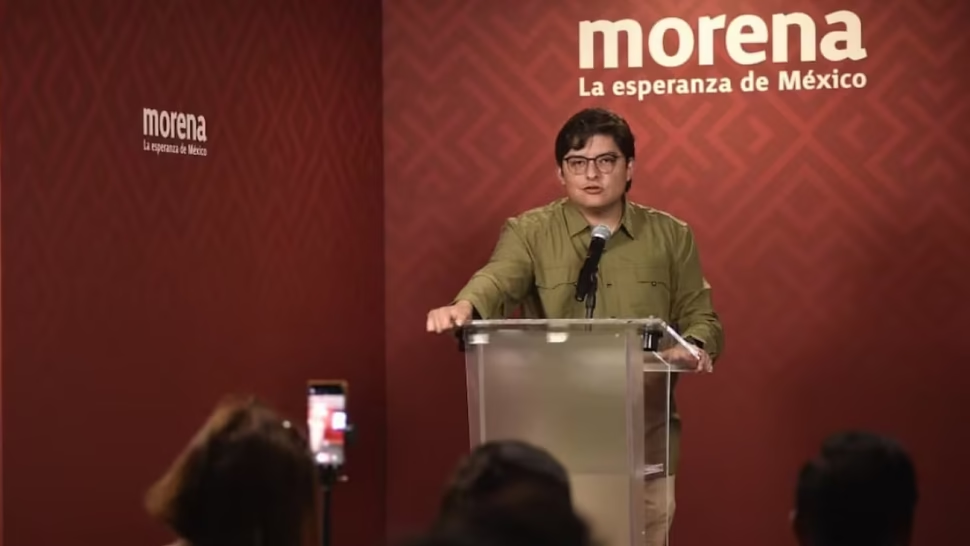
Morena spokesperson Paulo García stated that the mechanism included a triangulation of resources where the civil association paid commissions for each product delivered. In addition, legislators would have made profits between the purchase price and the resale price.

The Morenistas pointed out that the products carried names, photographs and partisan colors, which could constitute personalized promotion of public servants, prohibited by Article 134 of the Constitution outside of electoral campaigns.

The complainants announced that they will file complaints with the Electoral Institute of Mexico City so that the facts can be investigated.

For their part, PAN legislators denied the irregularities. They assured that these are operations between individuals through a foundation that sells products at low cost, without public resources.

The case has opened a debate about transparency and oversight of social programs in the capital’s mayors.

Continue reading

World Cup in Mexico: alert for increase in domestic violence

UN Women warns that attacks in homes increase up to 38% during the tournament.

Impact on homes

National and international organizations have raised alarms about an increase in different types of violence related to the Soccer World Cup in Mexico.

According to UN Women in Mexico, attacks within the home can increase between 26% and 38%, depending on whether the favorite team wins or loses. This tendency is aggravated when there is alcohol consumption, according to the same source.

The institutions warn that these episodes fall mainly on women, girls, boys and adolescents. The alert seeks to raise awareness and prevent damage during the development of the mega-event.

Continue reading