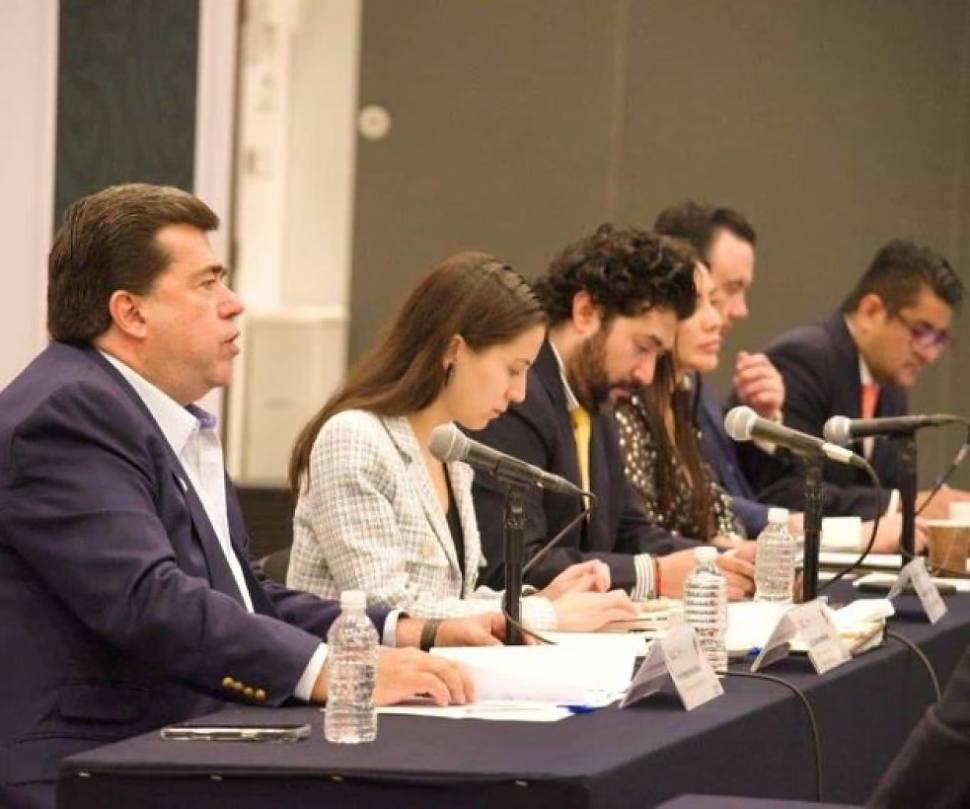
Pedro Haces demands that fewer hours do not mean less salary

The debate on reducing hours faces a dilemma: how to prevent fewer hours from meaning less money?

The union leader who wants to have his cake and eat it too

Ah, the eternal discussion: working less without earning less. Pedro Haces, the enlightened leader of the CATEM (Autonomous Confederation of Workers and Employees of Mexico, in case anyone doubted its acronym), has decided that it is time to balance the impossible. Reduce the working day without touching the salary? What a revolutionary idea! Why didn’t we think of it before? Oh, wait… yes it occurred to us, but businessmen usually make a grimace as if they were being offered to share their yachts.

In an act of unprecedented audacity, Haces dropped this gem during a forum on the reduction to 40 hours per week (organized, of course, by the Ministry of Labor): “There should be no cut in hours if that means a cut in income”. Brilliant, Peter. And do you also want it to rain chocolate while unicorns give out free hugs? Of course, because in the magical world of union desires, companies are eager to pay the same for less work. Or could it be that Haces knows some accounting trick that the rest of the planet ignores?

RelatedPedro Haces Barba rejects accusations of links with irregular billing

The “new floor” and other euphemisms to avoid saying “we want more”

The Morenoist deputy is not satisfied with asking for the apparently impossible. No, he goes further: he suggests that 40 hours are just the “new floor” (translated: “this is the minimum, then we continue pimping”?). And, of course, he proposes a pilot program because, according to him, what works in a call center (where stress is measured in coffees and screaming customers) does not necessarily apply in a factory or the field. Wow, how insightful. Did you discover that not all jobs are the same? Nobel Prize in Economics for this man!

Meanwhile, President Claudia Sheinbaum talks about implementing the change “gradually”, which in political language means “let’s see if in a decade we can convince someone”. Instead, ask for weekly and monthly schedules, because why wait if you can demand everything now? Of course, without specifying how the hell such a marvel would be financed. Printing bills with López Obrador’s face? Or do businessmen keep mountains of gold under their desks?

The only thing that is clear is that, after the extraordinary period in the Chamber of Deputies, Morena will prioritize this issue. In other words, they will put it in the pile of “promises that sound good in the campaign but are a headache in reality”, along with free gasoline and the end of corruption.

What’s next? Ask that the 4-hour day count as overtime? Or that Fridays are optional, but paid? Anyway, while Haces and company fantasize about work utopias, the rest of us will continue here, counting the minutes until the weekend… which, for now, is still 48 hours.

Would you like to see this reform become a reality? Share this note and join the debate. And if you want more analysis on how dreams collide with the economy, explore our content!
Direct vote for plurinominales: the Espadas proposal in the INE

Councilor Uuc-kib Espadas proposes that citizens directly elect proportional representation deputies.

Two tickets for deputies

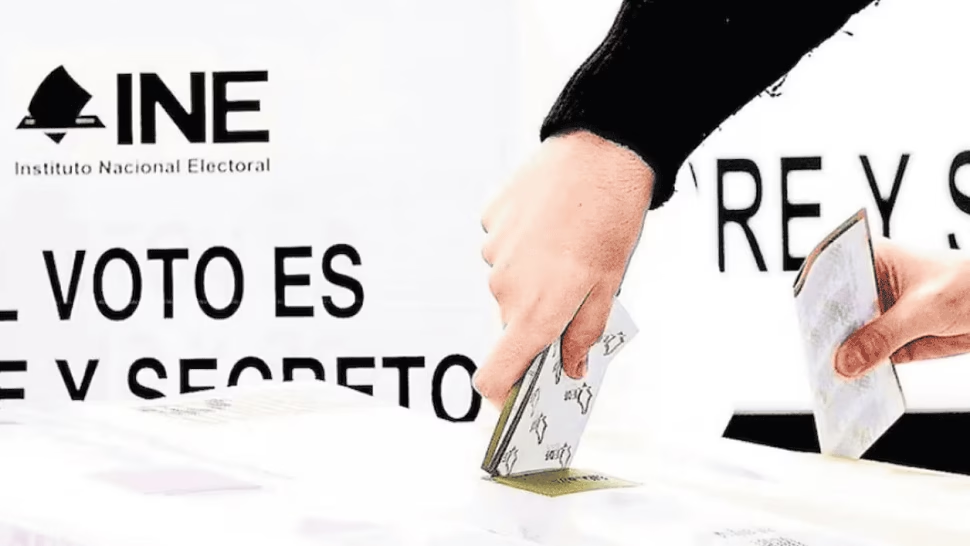
The electoral advisor Uuc-kib Espadas Ancona will present a key proposal to the General Council of the INE: allow citizens to vote directly for multi-member deputies in the 2026-2027 federal process.

The initiative proposes dividing the election into two ballots. One will contain the relative majority candidates; the other, the group names of those who the parties nominate as proportional representation.

Espadas announced that he will present his model to his fellow councilors at the end of September or beginning of October.

Cost and logistics

The counselor acknowledged that issuing an extra ballot would imply an additional expense of between 200 and 250 million pesos, within the usual INE printing package. However, he pointed out that, after the experience of the election of the Judiciary in 2025, it would be possible to put both ballots in the same ballot box and do the counting separately, as is already done.

No need for legal reform

Espadas clarified that the INE has the power to implement this change without a legal reform. According to him, the April electoral reform was the right time to legislate it, but the authority can act on its own.

“The electoral authority does have the possibility of implementing two ballots for the election of deputies even without this legal reform, I insist, since this would fully guarantee the freedom of voting through the two current election methods,” he explained.

The debate is just beginning, but the proposal opens the door to a transformation in the way federal legislators are elected.

Continue reading

Sheinbaum reserves opinion on CNDH recommendation for Ayotzinapa

The president awaits more progress from the Prosecutor's Office and the Truth Commission before setting a position.

President Claudia Sheinbaum avoided immediately taking a position on recommendation 208VG/2026 of the National Human Rights Commission (CNDH) in the Ayotzinapa case. The president said that she will wait for the Truth Commission and the Prosecutor’s Office to present greater progress.

Sheinbaum explained that he asked the Secretary of the Interior, Rosa Icela Rodríguez, to carry out an exhaustive analysis of the CNDH document, headed by Rosario Piedra Ibarra. The objective is to define a government position based on the new findings.

“I prefer that it be reported what the data is, what the investigation that has been done, what are the new lines of investigation that were initiated after our arrival to the government (…) and that within that framework an opinion could be presented,” said the head of the Executive.

No participation of the Government in the report

Sheinbaum clarified that the Federal Government did not participate in the preparation of the CNDH report. He reiterated his administration’s commitment to the fathers and mothers of the 43 missing normal students to achieve truth, justice and locate the students.

Continue reading

FGR assures that Ruffo Appel is not persecuted for his ideas

The FGR presented 96 pieces of evidence against former governor Ruffo Appel for alleged fuel smuggling.

FGR details the evidence against Ruffo Appel

The Attorney General’s Office (FGR) stated that the former governor of Baja California, Ernesto Ruffo Appel, is not being investigated for political or ideological reasons. The agency detailed that 96 pieces of evidence have been integrated against him, related to his alleged participation in a hydrocarbon smuggling network.

In a statement, the FGR stressed that all procedures are carried out in accordance with due process and respect for the presumption of innocence. The evidence includes expert opinions in chemistry, mechanical and electrical engineering, as well as criminalistics studies and technical photography.

“Photographic opinions, to technically document the findings and investigative acts carried out; criminalistics opinions, aimed at fixing, preserving, analyzing and correlating the located evidence; and identification opinions, to know the type of hydrocarbon, whether gasoline or diesel,” stressed the FGR.

The link with the Ingemar company

The investigation also focuses on the company Ingemar S.A. de C.V., where Ruffo Appel is a shareholder. The company was established in August 2018 in Mexico City. Two months later, Ruffo joined the company’s variable capital. By 2021, he was already listed as a shareholder and secretary of the Board of Directors, participating in strategic decision-making together with José Merino Valdés Cuervo.

Continue reading